


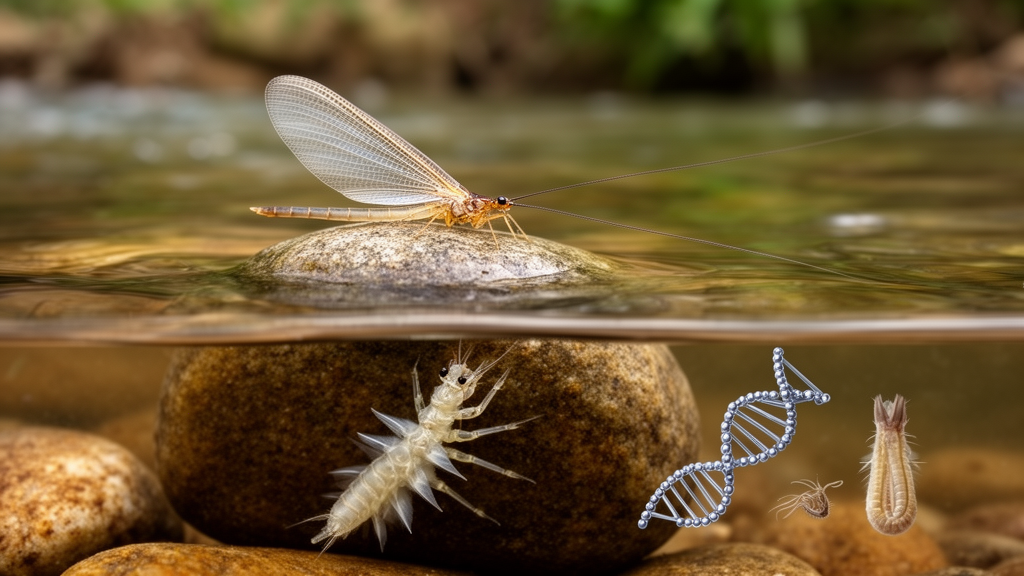
A new species of small minnow mayfly has been identified from Thailand after researchers combined detailed observations of larval anatomy with DNA analysis. The mayfly, named Alainites siamensis, was described from larvae collected in headwater streams across four Thai provinces. Its identification was supported by a distinctive combination of mouthpart, leg, gill and abdominal characters, together with mitochondrial cytochrome c oxidase subunit I sequences that separated the Thai specimens from other sequenced members of the genus.
The discovery was reported by researchers studying the diversity of Baetidae, a widely distributed family of small minnow mayflies that includes about 1,070 species in 110 genera. Thailand’s known mayfly diversity has expanded in recent years through large-scale aquatic-invertebrate surveys, with 10 genera and 14 species of Baetidae previously recorded in the country. The researchers said that under-sampled areas and poorly studied genera suggest Thai mayfly diversity could continue to increase, although the new work focused on a single Alainites species and its larval characters.
Alainites is part of the Indobaetis complex, whose three genera, Alainites, Nigrobaetis and Takobia, have had debated taxonomic status. Earlier revisions did not examine type material comprehensively, and recent authors have generally recommended retaining the three genera until a global phylogeny can resolve their relationships using molecular and morphological evidence. Alainites was established in 1994 for species formerly placed in Baetis. Its larvae were originally characterized by an elongated paraproct prolongation, a bifid and feathered prostheca on the right mandible, the absence of a villopore and a laterally compressed body.
The new species was first encountered during aquatic macroinvertebrate surveys in Phetchabun and Kanchanaburi provinces, with additional material collected in Tak and Kamphaengphet provinces. Larvae were taken by hand, with sorting from stream debris and sediments using D-framed dip nets, and were preserved in 95% ethanol. The type series included one larva and 20 paratypes from Yakruae stream in Nam Nao National Park, Phetchabun Province, where the holotype was collected at an altitude of 832 metres. Other examined material came from streams in Mae Ra Mad and Mae Sod districts in Tak Province, a stream near Mining Dr. Phol Kleepbuathe in Kanchanaburi Province, and Pong Nam Ron in Kamphaengphet Province.
Alainites siamensis reaches a maximum larval length of 4.2 millimetres and has a median caudal filament about two-thirds the length of its cerci. Its body is generally medium brown, with a slightly darker area between the ocelli and at the antenna bases, pale brown thoracic sternites, and light brown cerci and median filament without distinct bands. The larvae possess seven pairs of abdominal gills. Gill IV and gill V are larger than the others, and the gill margins are serrated and carry fine simple setae. The first gill is the smallest, measuring about half the length of abdominal tergite II.
Several mouthpart and leg characters help distinguish the new species. Its left mandibular incisors are almost fused and form seven blunt denticles, while the right incisors form eight. The right prostheca is bifid, with two feathered filaments of unequal length, matching a key feature of Alainites. The terminal segment of the labial palp is subrectangular with an almost straight lateral margin. The foreleg has fewer than five strong setae on the dorsal margin of the fore tibia, usually three or four, and each tarsal claw carries seven to nine denticles that increase in size toward the tip. The foreleg also lacks a femoral villopore, another diagnostic character used to place the species in the genus.
The paraproct provides additional diagnostic detail. Its prolongation is well developed, with numerous small spines along the lateral margins and five particularly large spines on the distal margin inside the prolongation. The outer distal margin carries roughly 20 to 30 medium spines, while the cercotractor has about 14 to 16. Together, these characters separate A. siamensis from the closely related A. lingulatus, A. laetificus and A. yixiani. The number of gill pairs also distinguishes it from A. acutulus, A. laetificus, A. pascalae and A. yehi, all of which have six pairs rather than seven.
Molecular evidence came from six specimens representing three populations. DNA was extracted with a non-destructive method so that the same individuals could later be examined morphologically. A 658-base-pair fragment of the mitochondrial COI gene was amplified, sequenced by the Sanger method, edited and aligned before genetic variation was calculated with Kimura-two-parameter distances. A maximum-likelihood reconstruction used the Tamura-Nei model with gamma correction and invariant sites, selected through Akaike and Bayesian information criteria, and was assessed with 100 runs and 1,000 bootstrap replicates. The analysis was conducted in MEGA-X, and new sequences were added to GenBank.
The three Thai populations had very low intraspecific variation, from 0% to less than 2%, while distances between A. siamensis and the other sequenced Alainites species ranged from 17% to 28%. In the COI reconstruction, all six Thai larvae grouped into one clade that was clearly separated from the other sequenced Alainites species. The authors used the molecular result to support species delimitation, noting that the interspecific distances were greater than the 3% maximum value they described as generally considered for intraspecific divergence. The analysis included eight Alainites species, but sequences were unavailable for several morphologically close Southeast Asian species, including A. lingulatus and A. laetificus; A. yixiani was the only previously sequenced species from Southeast Asia included in the distance calculations.
Ecological observations indicated that the larvae live among aquatic plants and the roots of riparian vegetation in slow- to moderately flowing streams. Although the species was found at sites in northern and northwestern Thailand, the authors characterized it as rare and not abundant. The known localities span elevations from 154 metres in Kamphaengphet Province to 832 metres at the type locality. Its name refers to Siam, the former name of Thailand, and to the known distribution of the species. The material is deposited in the Collection of Aquatic Insects at Khon Kaen University and the Museum of Zoology in Lausanne, and the new species has been registered with ZooBank.
The authors say that a complete molecular analysis of Southeast Asian Alainites will be needed to clarify the relationships and geographic patterns of the group. Most of the eight Alainites species reported from Southeast Asia are known from only one country, and five are recorded only from islands. A. siamensis is the first Alainites reported from an inland Southeast Asian country. Based on the genus’s ecological requirements and presumed dispersal capacity, the researchers anticipate that additional reports could come from Cambodia, Laos, Myanmar and Vietnam, and they suggest that the species might also occur on some islands. Those expectations are hypotheses for future sampling, not findings demonstrated by the present study, whose material came from four Thai provinces.
Subject of Research: Description of a new Alainites mayfly species from Thailand using larval morphology and mitochondrial DNA
Article Title: A new species of Alainites ( Ephemeroptera , Baetidae ) from Thailand
Article References: Phlai-ngam, S., Tungpairojwong, N., & Gattolliat, J.-L. (2022). A new species of Alainites (Ephemeroptera, Baetidae) from Thailand. Alpine Entomology, 6, 133-146. https://doi.org/10.3897/alpento.6.96284
Image Credits: AI Generated
Keywords: new mayfly species, Alainites siamensis, Thailand, Baetidae, Ephemeroptera, larval morphology, mitochondrial DNA, COI sequencing, mayfly taxonomy, aquatic biodiversity, species, Alainites
Cite Scienmag News
Drew Townsend. (October 20, 2026). New Thai mayfly species identified by larval anatomy and DNA. Scienmag. https://scienmag.com/new-thai-mayfly-species-identified-by-larval-anatomy-and-dna/
Drew Townsend. "New Thai mayfly species identified by larval anatomy and DNA." Scienmag, 20 October 2026, https://scienmag.com/new-thai-mayfly-species-identified-by-larval-anatomy-and-dna/. Accessed 20 October 2026.
Drew Townsend. "New Thai mayfly species identified by larval anatomy and DNA." Scienmag. October 20, 2026. https://scienmag.com/new-thai-mayfly-species-identified-by-larval-anatomy-and-dna/


