


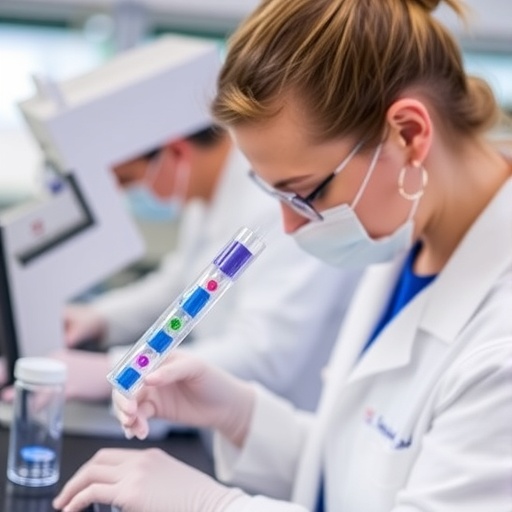
In the intricate realm of molecular biology, peptides—fragmented chains of amino acids—play an essential role in a multitude of biological functions. These concise bio-molecules serve as vital messengers that regulate everything from sensory perception to complex physiological processes. However, despite their significance, the accurate decoding of these short peptide sequences remains a formidable challenge, primarily due to their small size which offers limited analytical clues. Conventional peptide sequencing methods usually depend heavily on existing protein databases for sequence identification, creating a substantial barrier when confronting novel or uncharted peptides. Addressing this limitation, a pioneering team at Kyushu University in Fukuoka, Japan, has unveiled a groundbreaking peptide sequencing method that eschews reliance on any pre-existing sequence data.
At the forefront of this innovation is Associate Professor Mitsuru Tanaka and his research group from Kyushu University’s Faculty of Agriculture. They devised a novel approach that leverages the power of mass spectrometry combined with an ingenious chemical tagging mechanism. Mass spectrometry, an analytical mainstay, identifies molecules by measuring the mass-to-charge ratio of ionized particles derived from a target sample. However, what sets their method apart is the employment of “de novo” sequencing—a technique that reads sequences directly from raw mass spectrometry data without any need to compare against known databases. This allows for the identification of unprecedented peptide sequences, thereby opening new avenues in proteomic research.
The key to this technology’s success lies in the chemical modification of peptides at their N-terminus (the beginning of the amino acid chain). Using a coumarin-derived compound called N-succinimidyl 7-methoxycoumarin-3-carboxylate (Me-Cou), the researchers tag the peptides, thereby enabling a more controlled fragmentation during mass spectrometric analysis. This tagging facilitates a predictable stepwise breakdown of the peptide molecules, generating a distinctive “ladder” of fragments. Each rung on this ladder corresponds to a successive amino acid in the chain, which dramatically simplifies the sequence reading process and leads to more precise identification.
This coumarin-assisted sequencing scheme offers remarkable improvements in accuracy over traditional database-dependent techniques. To quantify its efficacy, Tanaka’s team rigorously tested 132 peptides of known sequences, encompassing both dipeptides and oligopeptides. The results were striking: conventional methods identified only half of the dipeptides and just over half of the oligopeptides correctly, alongside a significant number of misidentifications. In stark contrast, their coumarin-tagged approach accurately identified all peptides without a single error. This validation underscores the method’s robustness and marks a significant leap in resolving the long-standing hurdles in peptide sequencing.
Beyond standard peptides, the team extended their approach to analyze complex biological mixtures, using casein peptone—an amalgamation of peptides derived from milk proteins—as a test sample. When compared to existing methodologies, the Me-Cou tagging technique uncovered a vastly greater variety and quantity of short peptides, especially those ranging from two to ten amino acids in length. This finding is encouraging because such short peptides are traditionally difficult to sequence but are ubiquitous in biological and food samples, often maximizing bioactivity and physiological relevance.
Looking further ahead, the applicability of this technique holds great promise in diverse scientific domains. Food science, for example, stands to benefit significantly from a deeper understanding of the peptide composition in fermented products such as sake and soy sauce. Likewise, biomedical research investigating bodily fluids like blood and urine could exploit this method to uncover novel peptide biomarkers, potentially revolutionizing diagnostics and therapeutic monitoring. The ability to reliably sequence previously inaccessible peptides offers invaluable insights into biological systems and metabolic pathways that were once considered too complex to dissect at this granular level.
The innovation presented by Tanaka and his collaborators is not merely an incremental advance but a paradigm shift. By integrating coumarin-based N-terminal derivatization with cutting-edge liquid chromatography and trapped ion mobility spectrometry coupled with quadrupole time-of-flight mass spectrometry (LC-TIMS-qTOF/MS), they have constructed a powerful analytical platform. This platform maximizes the resolution and sensitivity of peptide detection and sequencing, ultimately propelling peptidomics—the comprehensive study of peptides—to new heights.
Moreover, the methodological design emphasizes reliability and user-friendliness, eliminating the dependence on extensive database searches and computationally intensive algorithms typical of conventional peptide identification approaches. This simplification could accelerate high-throughput analyses and facilitate broader adoption across research laboratories with varying levels of technical expertise. Such democratization of sophisticated analytical techniques is crucial for fostering cross-disciplinary advances in health, nutrition, and biochemical studies.
The significance of this new strategy is further amplified when considering the dynamic nature of peptide research. Emerging evidence continues to highlight the diverse roles peptides play, from modulating immune responses to acting as signaling molecules in the nervous system. Nevertheless, a full comprehension of their biological impacts demands comprehensive characterization. By overcoming the challenges of sequencing short peptides directly from raw data, Tanaka’s method equips scientists with the tools needed to delve deeper into peptide-driven phenomena and unknown sequences that could unlock unforeseen biological functions.
In summary, the development of a coumarin-based tag-aided de novo peptide sequencing strategy signifies a robust, reliable, and revolutionary advance in proteomics. Its capability to accurately sequence short peptides without prior sequence knowledge has been empirically demonstrated, offering profound implications for the analysis of both synthetic and natural peptide mixtures. This leap forward is poised to energize research fields ranging from food science and nutrition to medicine and biochemistry, heralding a new era in peptide science.
With Kyushu University’s rich heritage as a leading research institution known for tackling complex scientific challenges, this breakthrough epitomizes the institution’s commitment to innovation and societal benefit. As research progresses, the ramifications of this technology will likely extend beyond laboratory walls into practical applications that enhance human health, nutrition, and our understanding of life at the molecular level.
The paper reporting this work, entitled “N-terminal Coumarin Derivatization-Aided De Novo Peptide Sequencing and Its Application to Peptidomics Using LC-Trapped Ion Mobility Spectrometry-qTOF/MS,” appears in the journal Analytical Chemistry. As the technique gains traction, it is expected to become a cornerstone method within the peptidomics field, catalyzing advances and inspiring further methodological improvements worldwide.
Keywords
Peptide sequencing, de novo sequencing, coumarin derivatization, mass spectrometry, LC-TIMS-qTOF/MS, proteomics, peptidomics, short peptides, analytical chemistry, N-terminal tagging, peptide fragmentation, innovative methodology
Cite Scienmag News
Bethany Barker. (June 16, 2026). New Technique Unlocks Precise Sequencing of Short Peptides Concealed in Food and the Human Body. Scienmag. https://scienmag.com/new-technique-unlocks-precise-sequencing-of-short-peptides-concealed-in-food-and-the-human-body/
Bethany Barker. "New Technique Unlocks Precise Sequencing of Short Peptides Concealed in Food and the Human Body." Scienmag, 16 June 2026, https://scienmag.com/new-technique-unlocks-precise-sequencing-of-short-peptides-concealed-in-food-and-the-human-body/. Accessed 3 September 2026.
Bethany Barker. "New Technique Unlocks Precise Sequencing of Short Peptides Concealed in Food and the Human Body." Scienmag. June 16, 2026. https://scienmag.com/new-technique-unlocks-precise-sequencing-of-short-peptides-concealed-in-food-and-the-human-body/


