


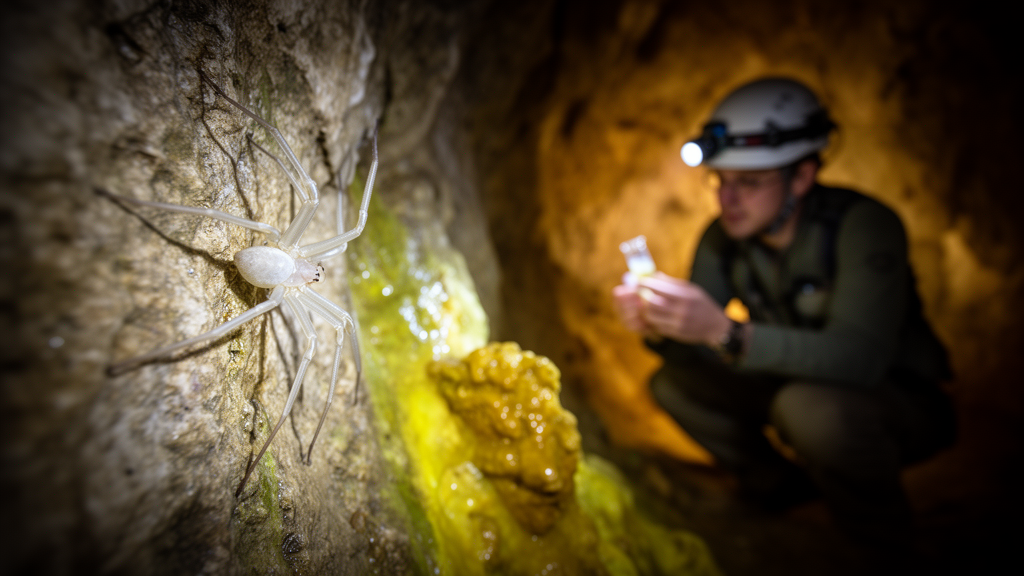
Deep in the aphotic reaches of sulfidic caves straddling the Greek-Albanian border, an international team of arachnologists has uncovered a tiny predator perfectly adapted to one of Earth’s most unusual subterranean ecosystems. The new species, formally described as Cataleptoneta sulfur in the journal ZooKeys, is a midget cave spider measuring barely more than a millimeter in length, yet its discovery carries outsized significance for understanding how life diversifies in isolated underground habitats. The species was found in Skordili’s Sulfur Cave, Turtle Cave, Pixaria Cave, and Langarica Cave, all within the Vromoner Canyon region of the Sarandaporo River Valley, and it represents the first recorded member of its genus in Albania.
The family Leptonetidae, to which the new species belongs, comprises some 400 described species distributed across 22 genera worldwide. These spiders are quintessential denizens of cryptic habitats, occupying caves, leaf litter, soil crevices, and the spaces beneath stones. Many cave-dwelling leptonetids display classic troglomorphic features: elongated appendages, reduced pigmentation, and diminished or entirely absent eyes, all reflecting long evolutionary isolation from the sunlit surface world. What sets the family apart morphologically is a distinctive six-eyed arrangement, with four eyes clustered in a compact anterior group and two others positioned behind them, although in some troglophilic species even these vestigial structures have been lost altogether.
Identifying leptonetids is notoriously difficult. Their minute bodies, simplified female genital structures, and limited external morphological differentiation mean that taxonomists often depend on the finer details of male palpal anatomy, sometimes requiring high-resolution microscopy to resolve. The researchers behind the new description, led by István Urák, Serban Sarbu, and Tamás Szűts, relied on an integrative approach combining scanning electron microscopy, digital imaging, detailed drawings, and DNA barcoding to establish that their specimens represented something genuinely new. The holotype male was collected in November 2023 from Skordili’s Sulfur Cave, a system whose entrance lies in Greece but whose deeper galleries extend beneath the Albanian border.
The diagnostic feature that sets Cataleptoneta sulfur apart from all of its seven known congeners is remarkably specific: three setae on the male palpal tarsus whose bases are modified into a shape resembling a three-petaled tulip. Under the scanning electron microscope, these delicate structures are clearly visible on a retrolateral outgrowth of the tarsal depression, accompanied by a thin bent seta, a thick apical bent seta, and a basal straight seta. Such fine-scale morphological characters are precisely the kind of evidence needed to distinguish species in a family where gross anatomy offers few reliable markers. The male holotype measures just 1.26 millimeters in total length, with a pale, highly depigmented body, pale yellow carapace, and long slender legs arranged in the characteristic leptonetid formula.
Females of the new species are similar in coloration but slightly larger in body size with shorter legs. Their internal genitalia are simple, featuring a pair of spermathecae connected to weakly sclerotized, very elongate S-shaped sperm ducts with a characteristic inwardly directed medial twist. Both sexes possess six eyes, though the posterior lateral eyes are absent in some specimens, a further hint of the species’ deep adaptation to lightless environments. The spiders build simple, flat webs on cave walls and speleothems in moist areas, often close to sulfidic streams and lakes, and they feed on collembolans that graze on the rich chemoautotrophic sulfur-oxidizing biofilms coating the cave walls.
The biology of these caves is what makes the discovery truly extraordinary. Skordili’s Sulfur Cave is renowned for its exceptionally rich chemosynthesis-based subterranean community, an ecosystem powered not by photosynthesis but by microbes that derive energy from hydrogen sulfide. This invertebrate-driven food web supports an unusually dense array of life, including what researchers have described as an extraordinarily large spider web harboring dense colonies of spiders. The new leptonetid sits within this community alongside other small predators such as mites, pseudoscorpions, carabid beetles, and centipedes, all ultimately dependent on the same autochthonous sulfur-based food source. Because conditions in the caves remain constant year-round, males, females, and juveniles of the new species have been observed in every season, unaffected by the daily and seasonal fluctuations that govern life on the surface.
On the molecular front, the team obtained two COI mitochondrial barcode sequences, one from a Skordili’s Sulfur Cave specimen and one from Turtle Cave, each 642 base pairs long. The two sequences represent distinct haplotypes, one unique to each cave, with a p-distance of 0.008 indicating low but real genetic differentiation between the cave populations. Two independent species delimitation methods, ASAP and bPTP, both clearly recognized Cataleptoneta sulfur as a distinct species. The finding of two separate lineages within a single species, each confined to its own cave, illustrates how quickly populations can diverge when subterranean habitats act as evolutionary islands, cutting off gene flow between even geographically close systems.
The phylogenetic analysis also delivered surprises with implications beyond the new species itself. Using a maximum-likelihood approach on COI sequences, the researchers found that the genus Cataleptoneta, as currently circumscribed, is not monophyletic. In both the full and reduced datasets, only the genus Sulcia emerged as a natural group, while both Cataleptoneta and the related genus Barusia were rendered paraphyletic. This echoes the findings of a 2021 phylogenomic study by Ledford and colleagues, which used ultraconserved elements and reached a similar conclusion. The new species was placed in a basal position within the Paraleptoneta group in the larger analysis, and in a clade with Cataleptoneta lingulata and several Barusia specimens in the pruned dataset. Resolving these tangled relationships, the authors note, will require a well-sampled integrative study, since the paraphyly may stem from plesiomorphic characters being used as diagnostic traits.
With the addition of Cataleptoneta sulfur, the genus now includes nine species worldwide and eight in Europe, all concentrated in the eastern Mediterranean region. The distribution pattern suggests that further species likely await discovery in Mediterranean caves, making targeted surveys a priority for future research. The specimens were deposited in the zoological collection of the Department of Life Sciences at Sapientia Hungarian University of Transylvania in Romania, ensuring that the physical evidence underpinning the description remains available for future study.
Beyond its taxonomic novelty, the discovery underscores the value of leptonetids as models for studying speciation driven by long-term isolation and microhabitat stability. Their limited dispersal ability and high levels of local endemism mean that each cave system can harbor unique evolutionary lineages, yet these spiders are rarely encountered outside targeted surveys and remain an overlooked component of subterranean arthropod communities. As scientists continue to probe the chemosynthetic ecosystems of the Balkan karst, each new species described from these dark, sulfur-laced corridors adds a piece to the puzzle of how life persists, diversifies, and thrives in places where sunlight never reaches.
Subject of Research: Taxonomic description and molecular phylogenetics of a new cave-dwelling leptonetid spider species from sulfidic caves in Greece and Albania
Article Title: A new Cataleptoneta species ( Araneae , Leptonetidae ) from sulfidic caves in Greece and Albania
Article References: Urák, I., Ştefan, A., Motoc, R. M., Brad, T., Zsigmond, A.-R., Sarbu, S. M., & Szűts, T. (2026). A new Cataleptoneta species (Araneae, Leptonetidae) from sulfidic caves in Greece and Albania. ZooKeys, 1294, 89-107. https://doi.org/10.3897/zookeys.1294.202010
Image Credits: AI Generated
DOI: 10.3897/zookeys.1294.202010
Keywords: Cataleptoneta sulfur, Leptonetidae, cave spiders, sulfidic caves, Greece, Albania, COI barcoding, taxonomy, troglomorphism, chemosynthesis, new species, Vromoner Canyon
Cite Scienmag News
Drew Townsend. (October 16, 2026). New sulfur-cave spider species discovered on the Greek-Albanian border. Scienmag. https://scienmag.com/new-sulfur-cave-spider-species-discovered-on-the-greek-albanian-border/
Drew Townsend. "New sulfur-cave spider species discovered on the Greek-Albanian border." Scienmag, 16 October 2026, https://scienmag.com/new-sulfur-cave-spider-species-discovered-on-the-greek-albanian-border/. Accessed 16 October 2026.
Drew Townsend. "New sulfur-cave spider species discovered on the Greek-Albanian border." Scienmag. October 16, 2026. https://scienmag.com/new-sulfur-cave-spider-species-discovered-on-the-greek-albanian-border/


