


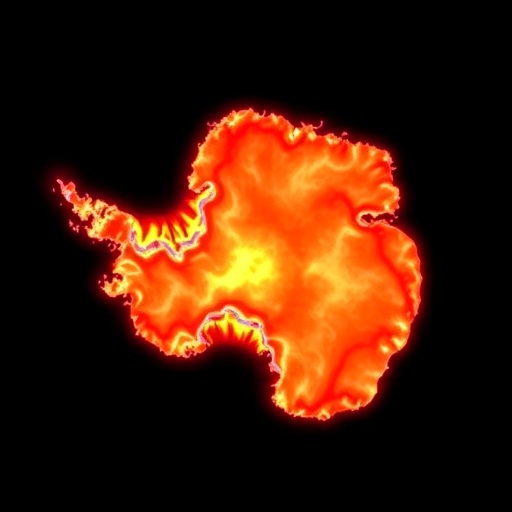
In a groundbreaking and comprehensive study unveiled by researchers at the University of Cambridge in collaboration with the University of California, scientists have provided compelling evidence for a significant poleward migration of deep-ocean heat towards the Antarctic continent. This revelation is the first of its kind, demonstrating how the circumpolar deep water — a mass of warmer water circulating around Antarctica — has changed its position, encroaching closer to the vulnerable ice shelves that surround the continent. These ice shelves serve as critical buttresses for the immense Antarctic ice sheets, which contain vast reserves of freshwater capable of raising global sea levels by nearly 58 meters if destabilized.
For decades, understanding the subtle but consequential shifts in the Southern Ocean’s thermal structure has been constrained by the sporadic nature of oceanographic measurements, primarily derived from research vessels making infrequent transects roughly every ten years. This limitation in continuous data has left scientists dependent on snapshots that, while detailed in temperature, salinity, and nutrient profiles, lacked the temporal resolution necessary to track long-term changes in heat distribution conclusively. To overcome this barrier, the study’s authors synthesized historical ship data with the more recent and expansive coverage provided by a network of autonomous Argo floats. These floats drift through the upper ocean, regularly gathering temperature and salinity data, yet their relatively short operational timeframe compared to ship records previously restricted their utility in long-term trend analyses.
The researchers harnessed advanced machine learning algorithms to amalgamate these disparate datasets, generating a novel and continuous four-decade record of detailed monthly oceanographic profiles around Antarctica. This innovative approach revealed an unequivocal poleward migration and expansion of warm circumpolar deep water, a phenomenon that had been anticipated by climate models but never before documented with such clarity in observational data. The movement of this warmer water mass toward the continental shelf alters the delicate oceanic conditions that historically shielded the Antarctic ice shelves by maintaining a protective layer of cold water beneath.
Joshua Lanham, lead author and Earth Sciences expert at Cambridge, emphasized the gravity of the findings: “This warm circumpolar deep water possesses the capacity to infiltrate beneath Antarctic ice shelves, initiating melting from below and compromising the structural integrity of these crucial formations.” The process threatens to accelerate ice shelf collapse, which would, in turn, unleash rivers of inland ice to flow unchecked into the ocean, significantly contributing to global sea level rise. Equally important is the broader implication of these changes on ocean circulation and climate systems worldwide.
The Southern Ocean functions as a vital component of Earth’s climate regulation, absorbing over 90 percent of excess heat generated by anthropogenic global warming. The circumpolar deep water is deeply involved in the global conveyor of oceanic currents, mediating the transfer of heat, carbon, and nutrients through a system that interconnects ecosystems across vast geographic expanses. Alterations to this intricate balance therefore resonate far beyond polar seas. Co-author Professor Sarah Purkey from the Scripps Institution of Oceanography analogized the changing ocean conditions to a bathtub that was once filled with cold water but now increasingly warmed, intensifying ice melt risks. The ocean’s altered circulation patterns fundamentally shift the delivery mechanisms of heat and material fluxes around Antarctica.
Delving deeper into oceanographic processes, dense and frigid polar waters traditionally form near the surface and sink, driving the global overturning circulation crucial for Earth’s climate stability. This involves phenomena such as the Atlantic Meridional Overturning Circulation (AMOC), a major driver of heat exchange in the Atlantic basin. However, climate warming and influxes of freshwater from melting ice have been identified as factors weakening this sinking process in the North Atlantic, with ominous forecasts for a similar decline in Antarctic dense water formation. The new evidence indicates the anticipated reduction of cold, dense water at the poles is already manifesting, allowing warmer circumpolar deep water to occupy the diminishing spaces.
Professor Ali Mashayek of Cambridge Earth Sciences illuminated the far-reaching significance of this discovery: “The Southern Ocean is a cornerstone in regulating planetary heat and carbon budgets. Our observations confirm that the warm circumpolar deep water is encroaching steadily, which could restructure cycles essential to ocean health and climate feedback loops on a global scale.” The findings thus signal not only immediate risks to Antarctic ice stability but also portend broader climate destabilization scenarios.
This study underscores the increasing utility of technological advances like autonomous Argo floats and machine learning in bridging gaps in oceanographic research. By fusing long-term ship data with these continuous monitoring systems, researchers can now detect subtle but consequential changes in the ocean’s thermal and chemical dynamics with unprecedented temporal and spatial resolution. The result is a refined lens through which to view humanity’s impact on the planet.
Moreover, the work highlights the Southern Ocean’s role as a sensitive barometer of climate change. While climate models such as those reviewed by the Intergovernmental Panel on Climate Change (IPCC) have forecast these oceanic shifts for years, empirical validation has lagged. The current study changes this narrative, transforming theoretical projections into observed realities. Understanding the pace and extent of such changes equips the scientific community and policymakers with better tools for anticipating future sea level rise and contributing to mitigation strategies.
The implications for Antarctic ice shelves cannot be overstated. As warmer circumpolar deep water infiltrates beneath these floating ice platforms, basal melting accelerates, thinning the shelves from below and undermining their structural coherence. This process destabilizes the containment of inland ice sheets, increasing the likelihood of rapid ice flow and large-scale disintegration. The resulting contributions to global sea level rise could inundate coastal communities worldwide and alter ocean circulation and weather patterns in unpredictable ways.
In summary, the poleward migration of warm circumpolar deep water towards Antarctica is a critical development in understanding the interplay between oceanic heat, climate change, and polar ice dynamics. This multidisciplinary research melds oceanography, climate science, and data analytics to reveal an evolving Southern Ocean system that is responding rapidly to anthropogenic influences. Continued monitoring and enhanced modeling will be essential to charting future changes and guiding global responses to safeguard both polar environments and interconnected global systems.
News Publication Date: 28-Apr-2026
Web References:
DOI link
Keywords
Climate change, Antarctic climate, Polar climates, Anthropogenic climate change, Ocean circulation, Ocean temperature
Cite Scienmag News
Violet Maxwell. (April 28, 2026). New Study Shows Deep-Ocean Heat Advancing Toward Antarctica Over Time. Scienmag. https://scienmag.com/new-study-shows-deep-ocean-heat-advancing-toward-antarctica-over-time/
Violet Maxwell. "New Study Shows Deep-Ocean Heat Advancing Toward Antarctica Over Time." Scienmag, 28 April 2026, https://scienmag.com/new-study-shows-deep-ocean-heat-advancing-toward-antarctica-over-time/. Accessed 5 September 2026.
Violet Maxwell. "New Study Shows Deep-Ocean Heat Advancing Toward Antarctica Over Time." Scienmag. April 28, 2026. https://scienmag.com/new-study-shows-deep-ocean-heat-advancing-toward-antarctica-over-time/


