


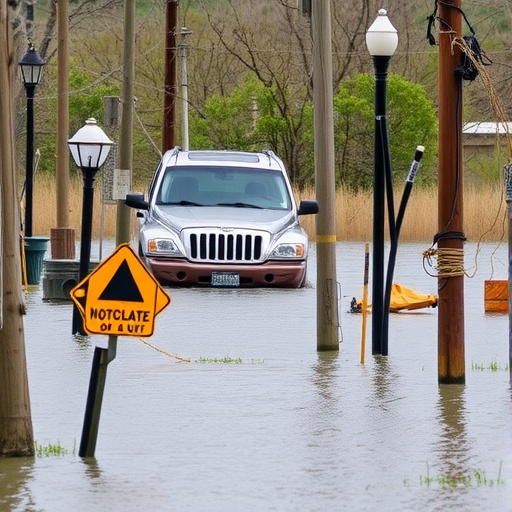
In an era marked by escalating climate risks and intensifying hydrological extremes, a groundbreaking study recently published in Nature Water uncovers a startling economic consequence of wetland degradation across the United States. Environmental Defense Fund (EDF) researchers, including Jesse Gourevitch, Adam Gold, and Helena Garcia, present compelling evidence that the loss of wetlands upstream profoundly magnifies downstream riverine flood damages, leading to a staggering increase exceeding $10 billion in residential flood insurance claims since 1985. This study elucidates the crucial, yet often undervalued, role that wetlands play as natural infrastructures modulating flood risk.
Utilizing a spatially explicit, sub-watershed-level analysis, this research integrates hydrological modeling with socio-economic data, particularly insurance claim records from the National Flood Insurance Program (NFIP). By correlating changes in upstream wetland extent with the magnitude of downstream flood insurance payouts, the study isolates the impact of wetland loss on flood severity while controlling for confounding variables such as antecedent local precipitation and intrinsic flood exposure of affected properties. This methodological rigor allows for robust attribution of increased flood damages to wetland area reductions, advancing beyond prior assessments that predominantly offered qualitative or aggregate insights.
The quantification reveals that every hectare of wetland lost upstream corresponds to a 0.01% to 0.03% increase in residential flood claim payments downstream. While seemingly marginal per unit area, these increments aggregate to an unparalleled nationwide surge of $10.1 billion in NFIP claims, reflecting a 9% rise in flood-related payouts attributable to wetland decline over nearly four decades. Spatial variability is pronounced, with metropolitan Houston, southeastern Louisiana, and coastal Florida emerging as epicenters where wetland depletion translates into disproportionately amplified insurance costs, underscoring regional vulnerabilities rooted in both ecological and socio-economic factors.
A salient revelation of the study is the identification of wetland ecosystem services in measurable economic terms. In the top decile of sub-watersheds, each hectare of wetland conserves approximately $24,783 in residential flood damage annually. Astonishingly, the top one percentile of watersheds showcases values exceeding $301,268 per hectare, underscoring the immense protective benefits wetlands confer in critical hydrological contexts. This granular valuation equips policymakers and urban planners with concrete metrics to incorporate ecosystem services into infrastructural cost-benefit analyses and land-use decisions.
Beyond economic metrics, the research emphasizes equity dimensions of wetland loss impacts. Lower-income and predominantly non-white communities have disproportionately borne the brunt of amplified flood damages stemming from upstream wetland depletion. This intersectional insight highlights the urgency of integrating environmental justice considerations in conservation strategies and flood risk mitigation policies, ensuring vulnerable populations do not shoulder inequitable burdens of ecological degradation.
The scope of the study acknowledges limitations inherent in relying solely on NFIP data, which insures approximately 30% of total flood damages nationwide. By extrapolating to encompass uninsured losses and private insurance claims, the researchers estimate that the aggregate cost of flood damage attributable to historical wetland loss could exceed $33 billion since 1985. These figures starkly illustrate the expansive financial stakes tied to wetland conservation and restoration efforts, amplifying the imperative for proactive natural infrastructure management.
From a hydrological perspective, wetlands function analogously to sponges, absorbing substantial volumes of precipitation and surface runoff during storm events. This attenuation delays and diminishes flood peaks downstream, thereby mitigating property damage. Yet, persistent wetland conversion for development and agriculture continues apace, eroding these ecosystem services. The study’s findings make explicit the hidden costs of such land-use changes, reframing wetlands as critical assets whose depletion generates tangible, quantifiable economic consequences.
The authors also explore the policy implications of recent regulatory proposals, particularly the Trump Administration’s proposed revision to the federal “Waters of the United States” (WOTUS) definition. This redefinition threatens to exclude up to 91% of non-tidal wetlands from federal protection if they lack long-term surface water presence, potentially stripping vast tracts of wetlands from regulatory safeguards. The study estimates that these non-WOTUS wetlands, absent additional protection, provide flood mitigation services valued at approximately $177 billion for residential properties alone, signaling a profound risk of future unchecked losses in flood resilience.
Notably, the research underscores that the measured benefits of wetlands extend well beyond riverine flood mitigation for residences. Additional ecosystem services—such as biodiversity habitat, water quality enhancement, carbon sequestration, and recreational value—compound the societal benefits of wetland ecosystems. Including these factors would only magnify the economic imperative to preserve and restore wetlands as multifunctional landscapes vital to climate adaptation and environmental sustainability.
Consequently, this study delivers a clarion call to integrate wetland valuation comprehensively into federal and state decision-making frameworks. Whether informing benefit-cost analyses for infrastructure investments, refining flood insurance models to reflect natural flood defenses, or guiding targeted conservation financing through easements and acquisitions, the evidence-based quantification of wetlands’ flood risk reduction services is poised to reshape environmental governance paradigms.
As climate-induced flooding intensifies, and development strains hydrological systems, this pivotal research accentuates that restoring and protecting wetlands is neither a mere environmental ideal nor a marginal policy convenience. Instead, it constitutes a foundational strategy to curb economic losses, foster community resilience, and achieve equitable climate adaptation outcomes. The $10 billion increase in flood claims linked to wetland loss is an unequivocal economic signal—preserving nature’s infrastructure is essential for sustainable water resource management and disaster risk mitigation in the twenty-first century.
Cite Scienmag News
Violet Maxwell. (June 2, 2026). New Study Reveals Wetland Loss Drives $10 Billion Surge in Residential Flood Insurance Claims. Scienmag. https://scienmag.com/new-study-reveals-wetland-loss-drives-10-billion-surge-in-residential-flood-insurance-claims/
Violet Maxwell. "New Study Reveals Wetland Loss Drives $10 Billion Surge in Residential Flood Insurance Claims." Scienmag, 2 June 2026, https://scienmag.com/new-study-reveals-wetland-loss-drives-10-billion-surge-in-residential-flood-insurance-claims/. Accessed 4 September 2026.
Violet Maxwell. "New Study Reveals Wetland Loss Drives $10 Billion Surge in Residential Flood Insurance Claims." Scienmag. June 2, 2026. https://scienmag.com/new-study-reveals-wetland-loss-drives-10-billion-surge-in-residential-flood-insurance-claims/


