

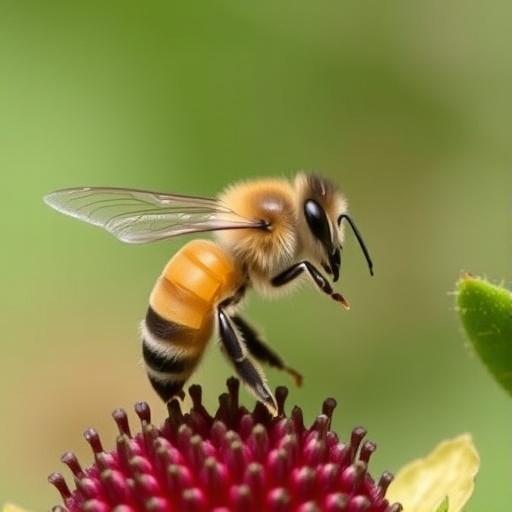
In a groundbreaking study that illuminates the intricate interplay between environmental stress, social behavior, and hormonal regulation, a team of researchers at Michigan State University has uncovered fascinating insights into the physiological resilience of honey bees. Their research reveals that honey bees exhibit a rapid rise in juvenile hormone (JH) levels when exposed to elevated temperatures, but crucially, this spike only occurs in bees acting in isolation. Social context, mediated by chemical communication within the colony, serves as a protective mechanism, dampening hormonal surges that would otherwise arise from thermal stress.
The investigative team, led by entomologist Zachary Huang, conducted a series of controlled experiments to explore how group-living dynamics influence hormonal responses to heat shock. Subjecting bees to an acute heat treatment of 40°C for one hour, a temperature eminently achievable during summer conditions even in temperate regions such as Michigan, they quantified the resultant fluctuations in juvenile hormone titers. Remarkably, solitary bees exhibited a pronounced and rapid elevation in JH, whereas bees clustered in groups of 25 maintained stable hormone levels, suggesting a buffering effect imparted by social cohesion.
Juvenile hormone plays a multifaceted role in insect physiology. While traditionally associated with maintaining larval stages by inhibiting metamorphosis, in adult honey bees JH is pivotal in regulating behavioral maturation. Lower levels correlate with nursing behaviors, whereas increasing JH signifies progression toward foraging roles. This hormonal gradient underpins task allocation within colonies, highlighting the sophisticated biological orchestration supporting colony function. The newly observed link between heat-induced stress and JH elevation in solitary bees adds an unexpected dimension to our understanding of how environmental factors intersect with developmental endocrinology.
Pivotally, the study also shines a spotlight on ethyl oleate (EO), a primer pheromone naturally secreted by forager bees. Ethyl oleate is instrumental in modulating the pace at which young bees transition from nursing duties to active foraging, effectively synchronizing colony labor division through chemical signaling. Until now, the potential involvement of EO in mitigating physiological stress responses remained unexplored territory. Huang and his collaborator Thomas Rachman, then a high school student, probed this by exposing solitary bees to EO within treated vials during heat shock.
Their findings revealed that ethyl oleate significantly suppresses the stress-induced surge of juvenile hormone that typically manifests in isolated bees exposed to high temperatures. Solitary individuals enclosed in EO-conditioned environments maintained hormone profiles comparable to those of bees housed in social groups. This suggests that EO not only regulates developmental timing but also functions as a chemical buffer, mediating resilience to environmental stressors through endocrine pathways.
The implications of this research are profound, especially in the context of escalating global temperatures and mounting environmental pressures faced by pollinator populations. By demonstrating that social pheromones can modulate physiological responses to thermal stress, this work provides a compelling case for re-evaluating how honey bee colonies—and potentially other social insects—adapt and endure adverse climatic conditions. The buffering capacity imparted by social living and chemical communication may confer colonies with a previously underappreciated level of resilience against heat-related challenges.
Importantly, the researchers developed a straightforward thermal stress assay — a controlled one-hour exposure at 40°C — that can serve as a powerful tool for future studies investigating the nexus of environmental stress, hormonal dynamics, and social behavior. This method offers a replicable and sensitive approach for elucidating the mechanisms driving colony resilience, enabling scientists to dissect the biological pathways by which social insects cope with climatic perturbations.
Huang’s reflection, “Being social can make you cool!”, encapsulates the nuanced discovery that sociality, through biochemical signaling, mitigates physiological stress in honey bees. This insight not only enriches the field of entomology but also deepens our appreciation of the evolutionary advantages conferred by complex social systems in insects. The subtle orchestration of hormone levels via pheromonal cues exemplifies a sophisticated evolutionary strategy to maintain colony homeostasis in fluctuating environments.
Moreover, this work addresses a critical gap in our understanding of how individual and collective responses to environmental stressors are integrated at the molecular level. The suppression of JH rise by EO in the context of heat exposure underscores the multi-functionality of pheromones beyond mere developmental regulators, extending their influence into stress physiology. This dual role of EO may be a critical factor enabling colonies to maintain workforce stability and functionality under heat stress conditions.
Given the global decline of honey bee populations due to habitat loss, pesticides, disease, and climate change, insights into intrinsic resilience mechanisms offer a beacon of hope for conservation efforts. By elucidating how social and chemical interactions enhance stress tolerance, this research may guide innovative strategies to bolster colony health and sustainability in the face of environmental challenges.
The publication of these findings in the journal Insect Science marks a significant advancement in entomological research, marrying endocrinology, ethology, and environmental biology. The collaborative effort, integrating expertise across academic levels, spotlights the value of interdisciplinary and inclusive scientific inquiry.
Future research building on this thermal stress assay can further unravel the complexities of social buffering in insect societies, potentially expanding to other species with similar pheromonal communication systems. Understanding the molecular underpinnings of such phenomena will be vital for devising novel approaches to pollinator protection and management.
In sum, this compelling study breaks new ground by revealing that the social environment and pheromone signaling critically influence hormonal responses to heat stress in honey bees. It advances the notion that the communal life of bees is not just behaviorally adaptive but physiologically protective, granting the colony enhanced resilience in a warming world. The elegant interplay between juvenile hormone dynamics and ethyl oleate signals opens promising avenues for future investigation into the biological safeguards inherent in social insects.
Subject of Research: Animals
Article Title: Rapid hormonal rise in honey bees due to heat-shock is mitigated by a primer pheromone
News Publication Date: 31-Mar-2026
Web References: http://dx.doi.org/10.1111/1744-7917.70272
References: Huang, Z., Rachman, T., et al. (2026). Rapid hormonal rise in honey bees due to heat-shock is mitigated by a primer pheromone. Insect Science. DOI: 10.1111/1744-7917.70272
Keywords: honey bees, juvenile hormone, ethyl oleate, heat stress, social insects, pheromones, hormonal regulation, thermal resilience, pollinator health, colony resilience


