

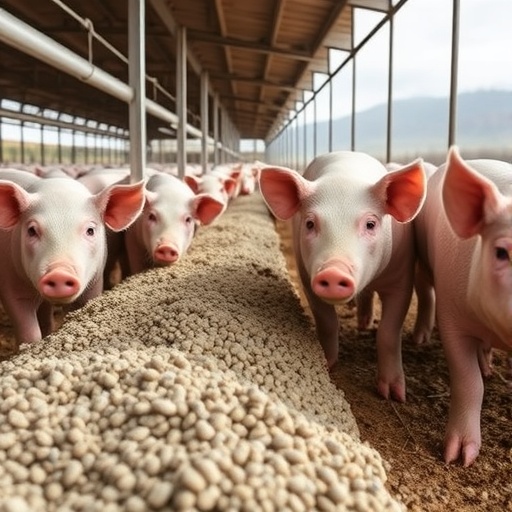
A groundbreaking study has unveiled a potent and previously underestimated link between ammonia emissions originating from intensive livestock farming and the surge in soil nitrous oxide (N2O) emissions, a gas infamous for its role in climate change as a powerful greenhouse agent and a dominant contributor to ozone layer depletion. This research sheds new light on how atmospheric ammonia deposition near livestock facilities can escalate soil microbial activities that generate nitrous oxide, expanding our understanding of agricultural pollution’s broader impact on global warming.
Published in the journal Nitrogen Cycling, the research delineates a comprehensive field investigation conducted near a large-scale pig farm located in central China. Scientists meticulously measured soil N2O emissions across various sites positioned 50 to 500 meters downwind of the farm, where a natural gradient of ammonia deposition was present. The findings reveal a compelling trend: soils subjected to higher atmospheric ammonia loads exhibited a marked increase in nitrous oxide emissions, providing direct evidence of ammonia’s indirect yet significant influence on climate-relevant greenhouse gases.
Livestock farming stands as the preeminent global source of ammonia emissions, which primarily escape into the atmosphere from animal enclosures and manure storage systems. Once airborne, ammonia molecules travel and deposit onto adjacent soils and ecosystems, initiating a cascade of biochemical transformations. While ammonia itself is not a greenhouse gas, its transformation upon deposition activates complex nitrogen cycling pathways mediated by soil microorganisms, which in turn amplify N2O production — a potent greenhouse gas with a global warming potential nearly 300 times that of carbon dioxide over a hundred-year horizon.
To elucidate the mechanisms underpinning this interaction, the team focused on key soil microbial communities responsible for nitrogen transformations. They identified an increased abundance of ammonia-oxidizing archaea (AOA), microorganisms that catalyze the conversion of ammonium (NH4+) to nitrate (NO3−) through nitrification. This microbial process, stimulated by elevated ammonia deposition, was linked to heightened nitrous oxide production as a byproduct. These insights were further verified by controlled laboratory experiments demonstrating significantly greater N2O emissions from soils treated with ammonium-based nitrogen sources compared to nitrate additions.
This microbial pathway is critical because nitrification processes inherently involve intermediate transformations where nitrous oxide is produced. As ammonia accumulates due to deposition from livestock emissions, it serves as an abundant substrate fueling AOA activity and thus driving an increase in N2O emission rates from soil. This discovery underscores the intricate yet impactful ways in which agricultural ammonia can exacerbate climate forcing gases beyond its immediate air quality implications.
Quantitative estimates from the study suggest that within the 500-meter radius surrounding the pig farm, nitrous oxide emissions from soil could reach approximately 69.7 kilograms of nitrogen per year. This corresponds to about 1.3 percent of the total ammonia nitrogen deposited — a figure exceeding the emission factor commonly adopted in international climate models. Such discrepancies highlight the necessity for revising current greenhouse gas inventories to incorporate ammonia-driven nitrous oxide emissions more accurately, particularly in regions with intensive livestock production.
The ramifications of this research extend beyond simply identifying a new source of greenhouse gases. They point to a critical feedback loop where livestock ammonia emissions enhance soil nitrification and denitrification processes, escalating N2O emissions that counteract the climate benefits of methane mitigation efforts typically targeted in the agricultural sector. This nuanced understanding compels a holistic approach to managing nitrogen emissions from farming practices to achieve meaningful climate impact reductions.
Moreover, nitrous oxide’s dual environmental threat is significant — besides its greenhouse warming capacity, it is recognized today as the principal anthropogenic ozone-depleting substance. Its prolonged atmospheric lifetime and potent effects on the stratospheric ozone layer exacerbate threats to human health and ecosystems, underscoring the urgency of mitigating all major N2O sources, including those previously underappreciated like ammonia deposition zones near livestock operations.
What makes this study particularly timely is the global trend of expanding livestock production driven by increasing demand for animal protein. As farming intensifies, ammonia emissions are likely to rise correspondingly, amplifying the risk of enhanced N2O emissions through the mechanism this study has elucidated. This emerging knowledge base calls for integrating ammonia reduction strategies alongside methane and nitrous oxide control measures within sustainable agricultural policy frameworks.
The authors advocate for targeted mitigation techniques, emphasizing that reducing ammonia volatilization from animal housing, manure management, and field application could serve dual purposes by improving air quality and substantially decreasing nitrous oxide emissions. Adopting such integrative approaches would help align agricultural practices with global climate objectives, closing a critical gap in greenhouse gas mitigation efforts that has escaped attention until now.
Jianlin Shen, the study’s corresponding author, highlighted the novelty and importance of these findings: “Our work reveals a significant, yet often overlooked, climatic consequence of ammonia pollution from livestock farms. By enhancing soil nitrification and associated nitrous oxide emissions, ammonia creates a secondary greenhouse gas source that must be addressed if we hope to curb agricultural impacts on climate change effectively.”
This innovative research not only deepens the understanding of nitrogen cycling in relation to anthropogenic activities but also sets the stage for revising emission models and environmental regulations worldwide. Ongoing and future studies are expected to broaden this work’s geographical scope and refine emission factors across diverse agroecosystems, ultimately contributing to more precise climate risk assessments and mitigation planning.
In sum, the intricate interplay between atmospheric ammonia from livestock and soil microbial activity driving nitrous oxide emissions reveals a hidden dimension of agricultural environmental impact. Recognizing and mitigating this link represents a crucial step forward in addressing both climate change and ozone depletion, further stressing the interconnectedness of ecosystem processes in shaping global environmental futures.
Subject of Research:
Not applicable
Article Title:
Increased soil N2O emissions under natural gradient of atmospheric NH3 deposition
News Publication Date:
28-Jan-2026
Web References:
https://doi.org/10.48130/nc-0025-0023
References:
Yi W, Liu G, Kang M, Wang J, Yuan H, et al. 2026. Increased soil N2O emissions under natural gradient of atmospheric NH3 deposition. Nitrogen Cycling 2: e011. DOI: 10.48130/nc-0025-0023
Image Credits:
Wuying Yi, Guoping Liu, Man Kang, Juan Wang, Hongzhao Yuan, Deli Chen, Jinshui Wu & Jianlin Shen
Keywords:
Emission detectors, Greenhouse gases, Animals


