

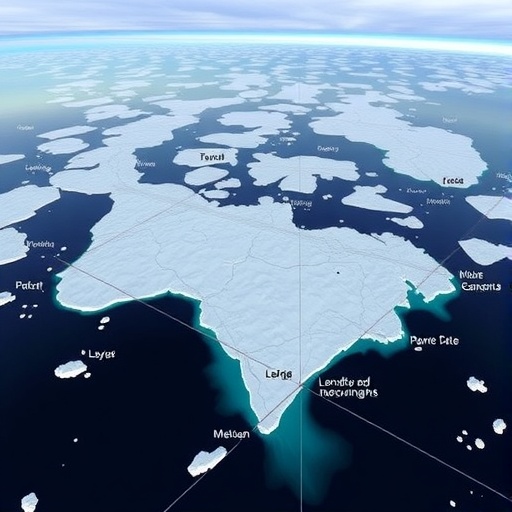
For nearly three decades, researchers at the University of Alaska Fairbanks have meticulously tracked the patterns of landfast sea ice along Alaska’s northern coast, uncovering a troubling decline in both its extent and seasonal duration. This unique form of sea ice, distinct from drifting pack ice, adheres firmly to the coastline and remains largely stationary, serving as a critical environmental and socio-economic pillar for indigenous populations and industrial activities alike. The latest analysis, extending previous studies with data spanning 27 years, reveals that landfast sea ice is not only vanishing earlier each spring but also forming later each autumn, significantly compressing the ice season and altering the delicate balance of the polar marine environment.
Landfast ice plays a vital role within Arctic coastal regions, acting as a natural stabilizer against the relentless forces of wind and waves. Its presence protects shorelines from erosive damage and facilitates the dispersal of freshwater from rivers into adjacent ocean waters, a process integral to nutrient cycling and biological productivity. Unlike transient sea ice floes that drift with winds and currents, landfast ice anchors itself either by freezing directly to the shore, by gripping onto shallow seafloor shelves, or by bonding together with grounded ice ridges—massive accumulations of ice rubble piled so high they settle on the seabed, forming a formidable barrier against oceanic turbulence. The stability of this ice is indispensable to indigenous Arctic communities, who depend on it as a reliable platform for hunting and traveling during the long winter months.
Yet, the new data paints a stark picture of a rapidly shifting Arctic seascape. From 1996 through 2023, the duration of the landfast ice season has shrunk dramatically by 57 days in the Chukchi Sea and by 39 days in the Beaufort Sea. This contraction is driven primarily by delayed ice formation in the fall, which is attributable to the ocean’s prolonged retention of heat well into the cooling months. In the Chukchi Sea, the season shortens further because the ice breaks away from the coast earlier in the spring. This phenological shift leaves the coastline exposed to more intense environmental stressors over longer periods and introduces uncertainty into the rhythms of subsistence hunting, jeopardizing livelihoods predicated on stable ice conditions.
More troubling is the recent decline of landfast ice extent in the Beaufort Sea, where conditions had remained relatively stable during the late 20th century into the early 2000s. The new findings indicate a significant reduction in how far the ice extends from shoreward boundaries, no longer routinely reaching into waters 20 meters deep as it once did. This retreat corresponds with an observed thinning of the overall Arctic sea ice, which compromises the formation of grounded ice ridges that serve as foundational anchors for vast tracts of stable ice. Without these ridges, the physical structure that maintains landfast ice integrity weakens, allowing ice to disintegrate and drift away more readily.
The implications of this trend extend beyond mere ice cover measurements. Landfast ice functions as a critical substrate for maritime infrastructure development including seasonal ice roads that connect offshore oil and gas operations to the mainland. As the stability and availability of summer and winter ice diminish, logistical challenges multiply for energy companies, increasing operational risks and costs. Moreover, the dwindling ice cover means that coastal shorelines experience amplified wave action and erosion. This exacerbates coastal vulnerability in an era of rising sea levels and intensifying storms, threatening habitats, human settlements, and vital ecosystems.
Scientifically, the process by which grounded ridges form represents a complex interplay of mechanical and thermodynamic forces. When sea ice is thick and robust enough, dynamic pressure from wind and current-driven ice floes causes blocks to collide and pile up along the coastline, creating ridges that freeze solidly to the seafloor. These ridges not only help lock the ice complex in place but also influence local sea ice morphology and dynamics. The observed decline in ridge formation signals a systemic shift in sea ice mechanics—one likely tied to a warming Arctic environment driving thinner, less durable ice layers that fail to sustain these crucial formations.
Further inquiry is essential to discern the underlying causes and cascading effects of this downward trajectory. Researchers, led by Professor Andrew Mahoney and his team, are probing whether the initial mechanical action that initiates ridge formation is diminishing, or if subsequent ice piling events are simply not occurring. This knowledge gap lies at the heart of predicting future changes in landfast ice and formulating strategies to mitigate related socio-environmental impacts. Without comprehensive understanding, vulnerable coastal communities and industries may find themselves unprepared for accelerating transformations.
The innovative research utilizes extensive datasets compiled by the National Ice Center and the National Weather Service Alaska Sea Ice Program, combining satellite observations with ground-based measurements to paint a high-resolution climatology of landfast ice trends. This rich archive enables scientists to track subtle yet consequential changes in sea ice’s spatial and temporal characteristics, offering invaluable insights into how an iconic natural feature of the Arctic is evolving amidst global climate change.
The environmental narrative unfolding in northern Alaska resonates as a microcosm of broader Arctic transformations. Landfast sea ice, once a reliable and resilient fixture of coastal landscapes, is succumbing to warming temperatures and shifting oceanographic conditions. Observed decreases in coverage and season length symbolize more than a retreating cryosphere—they signal a profound disruption of intricate ecological networks, indigenous cultural practices, and industrial operations historically adapted to frozen conditions.
Researchers emphasize that the consequences extend beyond physical ice loss. The retreat of landfast ice opens coastal zones to unimpeded wave action, accelerating erosion that threatens infrastructure and contaminates subsistence hunting grounds. The unpredictable nature of ice attachment and detachment further complicates travel and resource harvesting, increasing the risk of accidents and economic instability in communities with few alternatives.
This research joins a growing body of evidence documenting climate-driven changes throughout the Arctic. The detailed 27-year record enriches the scientific discourse by clarifying the accelerating pace at which landfast ice is diminishing and contextualizing its multidimensional impacts. As the Arctic continues to warm at twice the rate of lower latitudes, the challenge will be to translate these findings into actionable adaptation and conservation strategies that safeguard both natural and human systems.
To confront the complex dynamics at play, interdisciplinary collaboration will be crucial. Integrating climate modeling, geomorphological studies, and indigenous knowledge stands to deepen understanding and enhance resilience. Effective policy-making and community engagement grounded in rigorous science and lived experience are necessary to navigate the uncertainties of a rapidly transforming Arctic seascape.
The message from northern Alaska’s retreating landfast sea ice is unequivocal: a once steadfast element of the Arctic coastal environment is undergoing unprecedented change. Recognizing the cascading effects of this decline, from physical ice dynamics to cultural viability, is imperative for scientists, policymakers, and residents alike. Sustained research efforts and adaptive management will be pivotal in addressing the challenges posed by a warming world that threatens to reshape the frozen frontiers of the planet.
Subject of Research: Arctic landfast sea ice dynamics and climatology in northern Alaska and adjacent waters
Article Title: The Evolving Decline of Landfast Sea Ice in Northern Alaska and Adjacent Waters: Results from an Updated Climatology
News Publication Date: January 1, 2026
Web References:
- Journal of Geophysical Research: Oceans — https://agupubs.onlinelibrary.wiley.com/doi/10.1029/2025JC022464
- DOI: 10.1029/2025JC022464
Keywords: Landfast sea ice, Arctic sea ice decline, Chukchi Sea, Beaufort Sea, grounded ice ridges, coastal erosion, climate change, Alaska, sea ice seasonality, oceanography


