


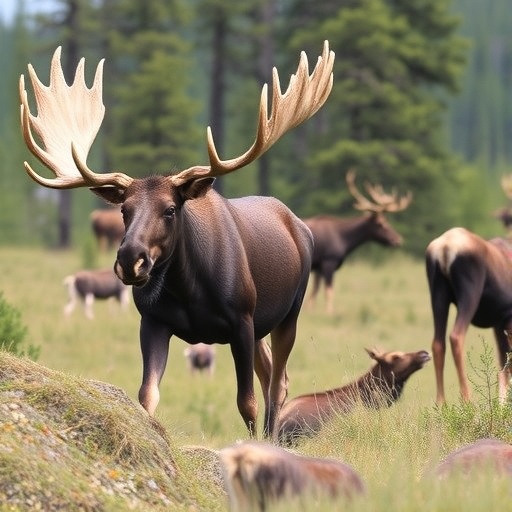
For decades, the moose of Colorado have been widely regarded as recent arrivals—transplanted by wildlife officials in the late 1970s. This understanding framed moose as “non-native” species in the southern Rocky Mountains, prompting debates about their ecological impact and appropriate management strategies in parks like the iconic Rocky Mountain National Park. However, groundbreaking interdisciplinary research is now challenging this notion, offering compelling evidence that moose have been longstanding inhabitants of the region, integrated into the landscape and Indigenous cultures for centuries, if not millennia.
At the heart of this paradigm shift lies an intricate synthesis of multiple sources: historical newspapers, archaeological findings, museum collections, scientific publications, and most notably, Indigenous oral histories. William Taylor, associate professor of anthropology at the University of Colorado Boulder and curator of archaeology at the CU Museum, spearheaded the study. He describes how long-overlooked archaeological collections, such as the pivotal Jurgens assemblage analyzed decades ago by Dr. Joe Ben Wheat, reveal moose remains dating back to the early Holocene era, thousands of years ago. These finds concretely anchor moose as ancient residents of northwest Colorado, contradicting narratives that paint them as recent invaders.
The research team’s methodical excavation of archival resources involved digitized newspapers spanning approximately 160 years, chronicling moose sightings and human interactions in continuous detail. This trove of longitudinal data enabled researchers to map moose presence concurrently with the nascent stages of European-American settlement. Their findings underscore the persistent existence of moose populations well before any formal wildlife reintroduction efforts. Alongside historical data, museum vertebrate collections and municipal photo archives provided further corroboration, culminating in a comprehensive temporal and spatial record of moose in the southern Rockies.
A particularly transformative aspect of the investigation was the deliberate inclusion of Indigenous knowledge systems. Crystal C’Bearing, a Northern Arapaho Tribal historic preservation officer and study co-author, elucidates the deep cultural significance of moose within her people’s traditions. Moose were, and remain, highly valued—central to clothing, societal regalia, and cultural practices. This Indigenous perspective not only affirms the biological presence of moose but enriches understanding of their ecological and symbolic roles that mainstream narratives often overlook.
The assembled evidence paints a nuanced historical ecology: moose were intrinsic components of southern Rocky Mountain ecosystems, shaped by natural predation, habitat dynamics, and Indigenous stewardship. This counters the simplistic notion of moose as disruptive outsiders. Jonathan Dombrosky of Crow Canyon Archaeological Center emphasizes that only by bridging archaeological science and Indigenous oral traditions can we reconstruct authentic baselines for regional biodiversity and more accurately inform conservation decisions.
The implications of these findings extend profoundly into contemporary wildlife management. As Rocky Mountain National Park grapples with ecological changes attributed to moose browsing pressures, wildlife managers commonly invoke the “non-native” label to justify interventions. However, co-author John Wendt urges a recalibration: “When modern park management occurs without historical processes such as predators and Indigenous hunting, observed impacts might reflect altered systems rather than alien species introductions.” This insight challenges existing frameworks and calls for integrative, historically informed strategies that recognize moose as native and co-evolutionary partners rather than intruders.
Methodologically, the study showcases the power of multidisciplinary collaboration and extensive archival excavation in historical ecology. Taylor recounts the painstaking process of unearthing fragmented archaeological records dispersed across idiosyncratic publications, museum catalogs, and hard-to-access manuscripts. The endeavor highlights how the veil of time drastically limits contemporary wildlife studies confined to recent decades. Joshua Miller of the University of Cincinnati elaborates that incorporating deep-time perspectives through diverse data threads effectively fills knowledge gaps and equips conservationists with richer ecological baselines.
This revisitation of moose history also gestures toward reconciliation and partnership with Indigenous communities in wildlife governance. C’Bearing advocates for Tribal engagement, recognizing their traditional roles as co-managers and sustainable hunters within these landscapes. Such collaborations could foster more culturally sensitive and ecologically sound management paradigms that honor both biodiversity and Indigenous sovereignty, potentially revitalizing cultural practices and restoring balance disrupted by past exclusionary conservation policies.
Overall, this compelling research redefines the temporal and cultural narratives surrounding moose in the southern Rockies. It disrupts entrenched assumptions about introduced species, reframes ecological histories, and underscores the indispensability of Indigenous knowledge to enrich scientific understanding. As climate change and human pressures fundamentally reshape mountain ecosystems, such interdisciplinary inquiries offer vital pathways to harmonize wildlife conservation with deep-rooted human-environment relationships.
The study, published in the Journal of Biogeography, exemplifies how deep archival research, coupled with respectful collaboration across scientific and Indigenous communities, can transform environmental narratives. Its conclusions challenge managers, scientists, and the public to reconsider what it means to be native, urging a holistic view of ecosystems as dynamic landscapes shaped by time, culture, and species interdependence. This reconceptualization paves the way for innovative, inclusive strategies in conserving the majestic moose and the rich ecological tapestry of the Rockies.
Web References: http://dx.doi.org/10.1111/jbi.70279
Cite Scienmag News
Courtney Benton. (June 23, 2026). New Study Reveals Moose as Indigenous Species in Colorado. Scienmag. https://scienmag.com/new-study-reveals-moose-as-indigenous-species-in-colorado/
Courtney Benton. "New Study Reveals Moose as Indigenous Species in Colorado." Scienmag, 23 June 2026, https://scienmag.com/new-study-reveals-moose-as-indigenous-species-in-colorado/. Accessed 4 September 2026.
Courtney Benton. "New Study Reveals Moose as Indigenous Species in Colorado." Scienmag. June 23, 2026. https://scienmag.com/new-study-reveals-moose-as-indigenous-species-in-colorado/


