


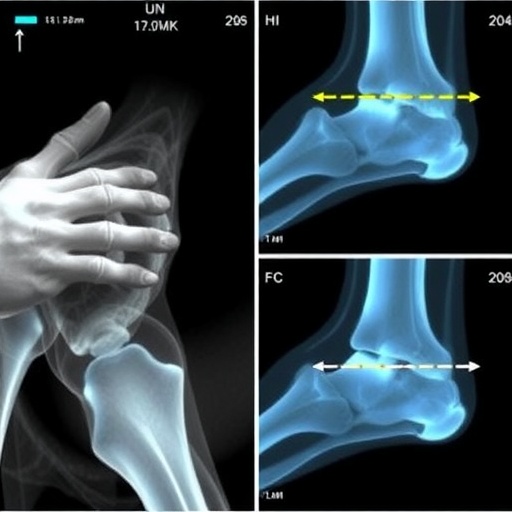
In a pioneering study that offers new hope for the future of human space exploration, researchers at National Jewish Health have provided encouraging evidence that short-duration spaceflight might not cause significant deterioration to the joint structures in astronauts’ lower extremities. This breakthrough was achieved through the innovative application of advanced musculoskeletal ultrasound imaging technology, which allowed for detailed examination of cartilage, synovial fluid, tendons, and ligaments in the hips, knees, and ankles of astronauts grappling with the unique challenges posed by microgravity. Such findings not only illuminate the potential resilience of the human musculoskeletal system in space but also herald a non-invasive method for real-time health monitoring during space missions.
The study, spearheaded by Dr. Richard Meehan and Dr. Smarika Sapkota, revolved around an intensive assessment of three astronauts who participated in the Axiom Mission 4 (Ax-4), an 18-day journey aboard the International Space Station (ISS). Unlike previous investigations, this research leveraged the precision of quantitative ultrasound imaging immediately before and within hours of return from spaceflight to detect subtle changes in joint morphology and possible inflammation—a capability that could prove instrumental in protecting astronaut health during longer expeditions. The results, published in the International Journal of Clinical Rheumatology, revealed no statistically significant changes in joint cartilage thickness or tendon and ligament integrity, nor evidence of inflammatory processes as measured by power Doppler imaging.
What sets this study apart is its demonstration of ultrasound as a potent, real-time, and non-invasive monitoring tool tailored for the unique environment of space. During the mission, astronauts engaged in structured cycling exercise protocols and utilized anti-inflammatory medications as medical countermeasures, strategies which likely contributed to the preservation of musculoskeletal health. The ultrasound scans found that cartilage thickness across hips, knees, and ankles remained stable, synovial fluid levels did not show meaningful variation, and tendon and ligament thickness did not undergo any decline or swelling. These data suggest that a combination of preventive exercise and medication could mitigate risks traditionally associated with microgravity-induced joint degradation.
However, the authors caution that their study’s limited duration—only 18 days—and the small cohort size restrict the broader applicability of these findings to longer-term missions, such as those envisaged for lunar or Martian expeditions. Extended exposure to microgravity environments could provoke different physiological responses, potentially leading to cartilage atrophy, joint instability, or inflammatory joint diseases. Hence, there is an urgent imperative for longitudinal studies encompassing a wider astronaut population and more protracted spaceflights to unravel the nuanced biomechanical and biochemical adaptations that the musculoskeletal system undergoes beyond short missions.
Dr. Sapkota, a co-author of the study, emphasized the critical importance of this ongoing research, underscoring that while no observable joint degradation was detected following the short mission, the microgravity conditions of long-term spaceflight remain a largely uncharted territory with potential risks. She advocates for the application of ultrasound technology in orbit to provide continuous monitoring, enabling personalized interventions tailored to each astronaut’s physiological needs. This individualized approach could revolutionize countermeasure strategies against musculoskeletal deconditioning in space—a key barrier to the success of extended space travel.
This research marks one of the first instances where quantitative ultrasound has been deployed immediately post-flight to analyze human joint structures systematically. By capturing data within hours of landing, the method reveals early markers of musculoskeletal health or distress that traditional post-mission evaluations might miss. The capacity for rapid, precise imaging onsite—without reliance on bulky and immobile terrestrial imaging systems—could fundamentally alter how space agencies manage astronaut health, optimizing mission planning and return-to-Earth rehabilitation.
From a technological perspective, the use of power Doppler ultrasound in this context is a novel innovation. Power Doppler imaging enhances the sensitivity for detecting blood flow and inflammation within soft tissues, an invaluable feature to discern early signs of joint inflammation or injury, which could otherwise compromise astronaut mobility and mission functionality. The absence of increased Doppler signals post-mission in this study indicates that anti-inflammatory strategies alongside exercise regimens are likely adequate in suppressing musculoskeletal inflammation under short-duration mission parameters.
Beyond space exploration, this investigative approach carries profound implications for terrestrial medicine. The insights gained into how human joints respond to immobility and altered load-bearing conditions in microgravity can inform treatments for patients experiencing prolonged bed rest, immobilization due to injury, or degenerative joint diseases such as osteoarthritis. The portability, affordability, and safety profile of ultrasound technology make it a promising candidate for routine monitoring in clinical settings, physical therapy, and rehabilitation centers worldwide.
Dr. Meehan remarked on the transformative potential of integrating ultrasound imaging into both aerospace medicine and conventional healthcare. By facilitating continuous, non-invasive, and real-time assessment of joint health, this technology could refine therapeutic protocols, personalize care pathways, and ultimately improve quality of life for diverse patient populations. The research undertaken in the extraterrestrial environment thus feeds directly back into advancing human health on Earth, epitomizing the reciprocal benefits of space medicine.
The observational pilot study’s synergy was underscored by collaborations among National Jewish Health, Axiom Space, and other key partners, illustrating the power of interdisciplinary and cross-sector alliances in pushing the boundaries of biomedical innovation. Emmanuel Hilaire, PhD, director of Technology Transfer at National Jewish Health, highlighted how space serves as a unique research laboratory, accelerating the development and deployment of next-generation medical technologies. These initiatives hold promising commercial and clinical value beyond their initial deployment in astronaut health monitoring.
In light of emerging plans for deep-space exploration and the intensifying push toward sustainable human presence on the Moon and Mars, understanding musculoskeletal resilience remains an urgent priority. This study paves the way for adopting ultrasound as a standard monitoring tool onboard spacecraft, enabling astronauts to maintain peak physical condition and preventing mission-critical injuries. The prospect of real-time diagnostics and tailored interventions in the void of space transforms the paradigm of healthcare delivery far from Earth’s support infrastructure.
As the spaceflight community eagerly anticipates longer missions, the research performed on the Ax-4 mission sets a foundational precedent. It also opens avenues for future technological enhancements, including automated ultrasound systems integrated with spacecraft health monitoring suites, AI-assisted image analysis for rapid diagnostics, and biosensors linked to pharmacological countermeasures. These advancements will collectively safeguard astronaut musculoskeletal integrity, ensuring the viability of humanity’s steps into deeper cosmic frontiers.
In conclusion, the compelling evidence from this study reinforces the resilience of lower extremity joint structures over short-duration spaceflight, while demonstrating that ultrasound imaging technology stands as a promising sentinel against musculoskeletal degeneration in space. As the aerospace medical community continues to decode the biological impacts of microgravity, the fusion of cutting-edge imaging and personalized countermeasures heralds a new era for astronaut health—a testament to human ingenuity and the relentless pursuit of exploration.
News Publication Date: 27-Feb-2026
Web References:
References:
- Meehan, R. T., Sapkota, S., et al. (2026). Ultrasound assessments of lower extremity joint structures from astronauts after 18 days onboard the International Space Station. International Journal of Clinical Rheumatology. DOI: 10.37532/1758
Keywords
Musculoskeletal health, spaceflight, ultrasound imaging, astronauts, joint cartilage, synovial fluid, microgravity effects, International Space Station, musculoskeletal ultrasound, tendon integrity, ligament health, inflammation monitoring, aerospace medicine, personalized countermeasures, space health technology
Cite Scienmag News
Grant Pearson. (May 8, 2026). New Study Reveals Minimal Joint Damage in Astronauts Following Short Space Missions, Showcasing Potential of Ultrasound Monitoring. Scienmag. https://scienmag.com/new-study-reveals-minimal-joint-damage-in-astronauts-following-short-space-missions-showcasing-potential-of-ultrasound-monitoring/
Grant Pearson. "New Study Reveals Minimal Joint Damage in Astronauts Following Short Space Missions, Showcasing Potential of Ultrasound Monitoring." Scienmag, 8 May 2026, https://scienmag.com/new-study-reveals-minimal-joint-damage-in-astronauts-following-short-space-missions-showcasing-potential-of-ultrasound-monitoring/. Accessed 4 September 2026.
Grant Pearson. "New Study Reveals Minimal Joint Damage in Astronauts Following Short Space Missions, Showcasing Potential of Ultrasound Monitoring." Scienmag. May 8, 2026. https://scienmag.com/new-study-reveals-minimal-joint-damage-in-astronauts-following-short-space-missions-showcasing-potential-of-ultrasound-monitoring/


