

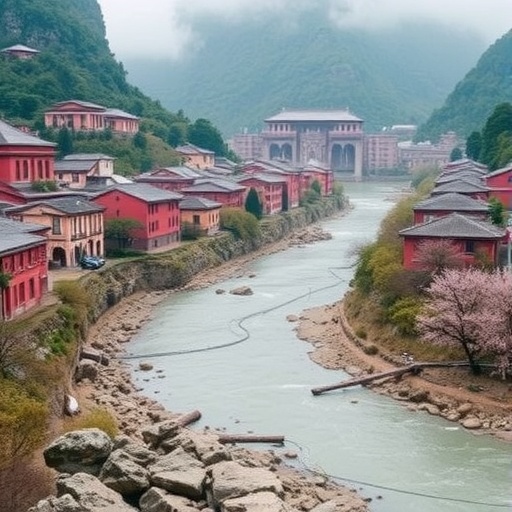
In the arid stretches of Northwest China, a region long synonymous with water scarcity and harsh environmental conditions, an unexpected climatic phenomenon is unfolding: the region is becoming wetter. This trend challenges longstanding assumptions and points to a profound transformation in the local hydrological cycle, revealing an intricate interplay between land surface processes and atmospheric dynamics. Recent research spearheaded by scientists deeply rooted in this landscape has uncovered that the growing precipitation is largely self-generated—from local land sources—rather than transported from external moisture systems as traditionally believed.
This groundbreaking study, published in Advances in Atmospheric Sciences, is the product of an interdisciplinary collaboration among the Northwest Institute of Eco-Environment and Resources at the Chinese Academy of Sciences, Lanzhou University, and the Lanzhou Institute of Arid Meteorology. The researchers, many of whom have dedicated their academic and professional lives to understanding the unique climatic intricacies of Northwest China, employed advanced modeling techniques coupled with extensive observational data to dissect the underpinnings of this humidification trend.
Historically, the climatic narrative of Northwest China has emphasized the region’s dependence on moisture influx from far-reaching sources, such as monsoonal systems and mid-latitude westerlies. However, with the advent of climate warming and ecological recovery initiatives starting in the late 20th century, this paradigm warrants reexamination. The data elucidates that local evapotranspiration—the combined process of water evaporation from the soil and transpiration via vegetation—is increasingly fueling precipitation, effectively recycling moisture within the region’s ecosystem-atmosphere interface.
A pivotal turning point was identified in the late 1990s, marking a shift from a decades-long decline in summer precipitation to a sustained upward trajectory. This inflection was not uniform across the entire area; western sectors adjacent to the Tianshan and Altun mountain ranges experienced notable precipitation surges, while certain eastern locales continued grappling with diminishing rainfall. These spatial disparities underscore the complex climatic heterogeneity induced by topographic and ecological variables.
Employing the Dynamic Recycling Model, the research team quantitatively parsed the moisture budget over two intervals: pre- and post-1998. The analysis revealed a measurable increase of about 10.62 millimeters in annual precipitation, corresponding to an approximate 9.18% uplift. Of this increase, an impressive 78% was traced back to locally recycled moisture arising from amplified evapotranspiration, while a smaller fraction—around 22%—stemmed from augmented external moisture transport.
This revelation reframes our understanding of regional water cycles, emphasizing the ascendancy of land-atmosphere coupling in fostering humidification. As temperatures rise, glacier and snowpack meltwater contributions enhance soil moisture and vegetation vitality, which in turn bolster evapotranspiration. This feedback loop, where biologically mediated water fluxes stimulate local precipitation, exemplifies a shift towards a more self-sustained hydrological regime, intertwining climatic and ecological processes.
Professor Haipeng Yu, the study’s lead author who has witnessed this environmental transformation firsthand since joining Lanzhou University in 2005, reflects on this shift as a testament to the adaptability and dynamism of regional climate systems. His and his colleagues’ enduring commitment to this domain has borne fruit in elucidating the mechanisms driving this wetting trend—information that carries profound implications for water resource planning and drought mitigation strategies.
Nevertheless, the sustainability of this humidification raises intricate questions. While ecological recovery and warming-enhanced meltwater currently fuel elevated evapotranspiration, ongoing glacial retreat and diminishing cryospheric reserves may curtail this moisture supply in the future. This impending constraint could disrupt the advantageous feedback, potentially arresting or reversing the precipitation growth, thereby reintroducing vulnerability into the region’s hydrological regime.
Further complexity arises from the influence of large-scale oceanic oscillations such as the Atlantic Multidecadal Oscillation, which modulates atmospheric circulation patterns and moisture transport pathways over interdecadal timescales. Understanding how these remote climatic oscillations interface with localized evapotranspiration dynamics is crucial for robust future climate projections and adaptive resource management.
The study’s sophisticated integration of long-term observational data and modeling articulates an urgent need to reassess regional climate models to incorporate enhanced land-atmosphere feedbacks. Traditional models that prioritize external moisture sources may undervalue the role of terrestrial processes in modulating precipitation patterns, leading to potential inaccuracies in forecasting and climate risk assessments.
Provocatively, the research illuminates the potential for ecological restoration efforts to wield climatic influence by altering surface moisture fluxes. As vegetation cover recovers and soil health improves, localized evapotranspiration intensifies, underpinning a virtuous cycle that not only supports biodiversity but also enhances regional water availability.
This emergent picture offers hope for the millions reliant on Northwest China’s precarious water resources, illustrating how synergistic climatic and ecological dynamics could alleviate some pressures posed by aridity. Yet, it also beckons caution, underscoring the delicate balance governing these systems and the unpredictability inherent in climate change trajectories.
In sum, the humidification of Northwest China epitomizes a transformative chapter in dryland climatology. It is an eloquent reminder that climate systems are not mere passive recipients of external forcings, but active arenas where terrestrial and atmospheric processes coalesce, adapt, and evolve. This study charts a path forward for integrated research and policy frameworks that embrace this complexity, ultimately fostering resilience in one of the world’s most challenging environments.
Subject of Research: Local evapotranspiration and climate variability driving humidification in Northwest China
Article Title: Local Evapotranspiration and Atlantic Decadal Variability Dominate the Humidification of Northwest China
News Publication Date: 7-Feb-2026
Web References: https://doi.org/10.1007/s00376-025-5414-5
Image Credits: Haipeng Yu
Keywords: Precipitation, Droughts, Evapotranspiration, Land–Atmosphere Coupling, Climate Change, Northwest China, Humidification, Water Cycle, Glacier Melt, Ecological Recovery


