


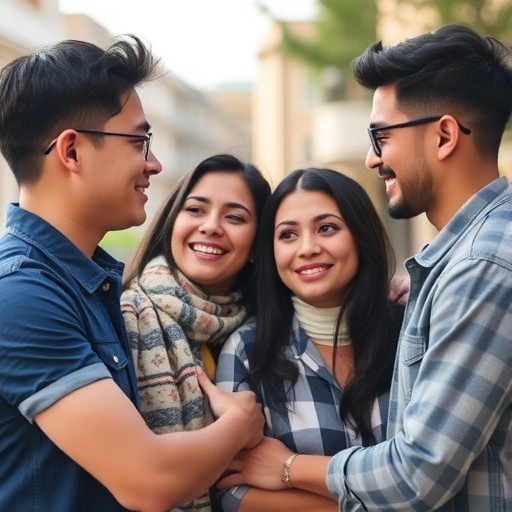
In today’s hyper-connected world, intercultural romantic relationships are more common than ever, yet they remain uniquely complex. A pioneering study published in Social Psychological and Personality Science sheds light on how social approval—or the lack thereof—significantly impacts the quality and longevity of these relationships. This research, conducted by Hanieh Naeimi and colleagues at the University of Toronto, delves into the nuanced roles of social networks, unearthing how approval from friends, family, and broader society interacts with cultural background and relationship dynamics to shape couples’ experiences.
The study’s central premise revolves around social approval as a multifaceted construct that encompasses emotional endorsement, acceptance, and validation from different social circles. By surveying an extensive and diverse sample of 757 individuals involved in intercultural romantic relationships, the researchers were able to quantitatively assess the weight of approval coming from three distinct sources: friends, family, and society at large. This approach allowed them to disentangle the complex social factors influencing partnership quality in a manner that previous smaller-scale or qualitative studies could not achieve.
One of the most striking findings is the outsized role that friends play in buffering intercultural couples against societal disapproval. Approval from friends emerged as the most robust predictor of relationship quality, overshadowing family and societal validation. This phenomenon was especially pronounced in couples where both partners hail from minority cultural backgrounds, who often face intersecting layers of discrimination and marginalization. The social support offered by friends—who may provide understanding, advocacy, and a safe emotional space—appears essential to sustaining and strengthening these partnerships amid adversity.
However, the research does not downplay the significance of family approval. Rather, it reveals that family acceptance holds particular importance for individuals from collectivistic cultures such as Latine and Middle Eastern backgrounds. In these cultural contexts, familial bonds and approval are crucial pillars for identity and social belonging. Furthermore, family approval was most impactful during the formative early stages of relationships, signaling that initial family support can set the foundation for future relational security and commitment.
The researchers also illuminate how societal approval, the broadest and most diffuse form of social validation, tends to exert a less direct influence on relationship quality. While societal attitudes and cultural norms represent omnipresent undercurrents that shape lived experiences, their effects often filter through proximate social circles like friends and family, who mediate and personalize these broader influences. This layered dynamic underscores the importance of micro-social environments in navigating the challenges of intercultural partnerships in a polarized social landscape.
In addition to cultural background, relationship length emerged as a key moderator in how social approval affects couples. As relationships progress beyond initial stages, the weight placed on family approval tends to diminish, whereas the role of friends remains consistently significant. This evolution points to the adaptive strategies couples employ to cultivate and rely on supportive social networks that reinforce their bond over time.
Moreover, the study highlights the intersection of cultural identity and interpersonal dynamics, emphasizing that intercultural relationships do not exist in a vacuum but are embedded within broader social and political contexts. Given the current climate of rising global mobility combined with heightened racial tensions and social divisions, understanding these dynamics is more urgent than ever. The research draws attention to how external social forces and internal relational processes intertwine to shape the lived realities of intercultural couples.
Naeimi and her team caution against oversimplifying the roles of social approval; they argue for a nuanced appreciation of how cultural scripts, differing expectations, and couple composition influence the relative importance of social validation sources. This complexity calls for tailored approaches in both research and practical support efforts, acknowledging that a “one size fits all” model cannot capture the richness and diversity of intercultural romantic experiences.
The study also paves the way for future inquiries into the mechanisms by which friends offer support. Whether through explicit validation of the relationship, active advocacy against prejudice, or fostering inclusion within social circles, the modes through which peer networks bolster relationship quality remain fertile ground for exploration. Understanding these processes over time could inform interventions aimed at enhancing the resilience and well-being of intercultural couples.
Importantly, the research distinguishes the unique context of romantic partnerships from other relationship types, urging caution in extending these findings beyond the scope of romantic intercultural unions. Different relational forms—platonic, familial, or professional—may engage different social approval dynamics and therefore require distinct analytical frameworks.
Ultimately, this study challenges us to reconsider the social ecology surrounding love and intimacy in an increasingly multicultural world. It underscores that interpersonal relationships are deeply embedded within, and responsive to, the broader societal milieu. Supportive friends, accepting families, and inclusive communities collectively form the social scaffolding that helps intercultural couples thrive despite external challenges.
This research brings a vital message to the forefront: love is not solely a private affair but a social phenomenon shaped by collective attitudes, cultural narratives, and personal networks. Fostering environments where intercultural relationships are seen, supported, and celebrated could be a powerful step toward greater social cohesion and understanding in our diverse societies.
In a time marked by both unprecedented global connectivity and social fragmentation, the findings offer a hopeful perspective. By reinforcing the value of friendship and the strategic cultivation of supportive networks, intercultural couples can better navigate disapproval and build durable, fulfilling connections. Social approval, then, is not merely a background variable but a key ingredient in the recipe for relational success in intercultural contexts.
In summary, Naeimi’s research advances the scientific understanding of how multi-layered social approval influences intercultural romantic relationship quality. It highlights the distinctive roles of friends and family, the modulation of these roles by culture and relationship stage, and the buffering capacity of social support against societal disapproval. These insights are crucial for researchers, practitioners, and communities aiming to nurture love across cultural boundaries in our increasingly interconnected world.
News Publication Date: 17-Nov-2025
Web References: 10.1177/19485506251389441
References: Available via the corresponding journal article DOI link
Cite Scienmag News
Courtney Benton. (November 17, 2025). New Study Reveals How Friends’ Support Safeguards Intercultural Couples. Scienmag. https://scienmag.com/new-study-reveals-how-friends-support-safeguards-intercultural-couples/
Courtney Benton. "New Study Reveals How Friends’ Support Safeguards Intercultural Couples." Scienmag, 17 November 2025, https://scienmag.com/new-study-reveals-how-friends-support-safeguards-intercultural-couples/. Accessed 3 September 2026.
Courtney Benton. "New Study Reveals How Friends’ Support Safeguards Intercultural Couples." Scienmag. November 17, 2025. https://scienmag.com/new-study-reveals-how-friends-support-safeguards-intercultural-couples/


