


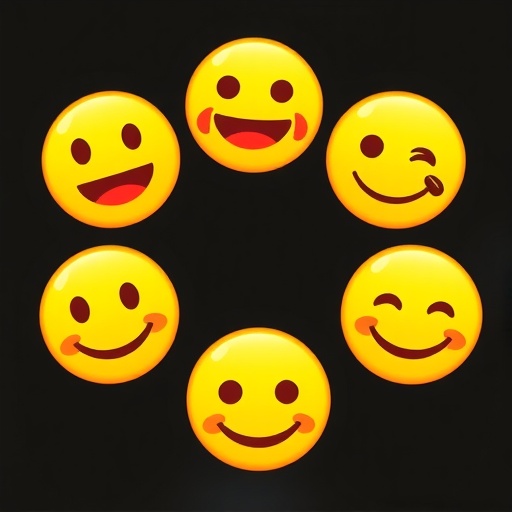
In an era where digital communication dominates our interactions, the significance of emojis extends far beyond mere embellishments or lighthearted fun. A groundbreaking study conducted by researchers at Bournemouth University reveals that the human brain processes emojis in a manner strikingly similar to how it interprets genuine human facial expressions. This insight challenges our conventional understanding of digital symbols and suggests that emojis function as potent emotional cues, integral to online social interaction.
Facial expressions have long been recognized as cornerstones of human communication, conveying a wealth of emotional and social information without the need for words. The nuanced muscle movements involved in expressions of happiness, anger, sadness, or surprise trigger specific patterns of neural activity that enable rapid interpretation by observers. Given this central role in face-to-face interactions, it was previously unclear how, or if, symbolic representations such as emojis could replicate this complexity within the digital realm.
To explore this question with precision, the Bournemouth research team employed electroencephalography (EEG), a non-invasive technique that records the brain’s electrical activity with millisecond accuracy. Participants were divided into two groups: one exposed to images of real human faces exhibiting distinct emotional expressions, and another presented with emoji counterparts representing the same affective states. EEG measurements focused on capturing neural response dynamics within milliseconds after stimulus presentation.
The study’s results were striking. Neural responses elicited by emojis mirrored those triggered by real human faces, particularly within brain regions associated with facial recognition and emotional processing. Madeline Molly Ely, the PhD student who spearheaded this investigation, emphasized that the evidence reflects a shared neural coding mechanism between digital and biological facial cues. This finding implies that emojis are not simply decorative or superficial elements—they are processed by the brain as meaningful emotional signals that can influence the social exchanges occurring in digital communication.
Temporal aspects of these neural responses further underscore the parallels between emoji interpretation and human face perception. The reactions occurred remarkably quickly, typically between 145 and 160 milliseconds after the image appeared. Such rapidity aligns with the brain’s known speed in decoding facial emotions in real-life interactions, highlighting the efficiency of emoji processing within the sensory and cognitive circuits involved.
These findings carry profound implications for understanding modern communication. While emojis may appear as small, colorful icons on our screens, their impact on social cognition and emotional exchange is significant. They provide users a way to convey complex affective states in environments stripped of physical presence or vocal tone. Recognizing emojis as legitimate carriers of emotional information validates their importance in cultivating empathy, minimizing misunderstandings, and enriching conversations online.
Moreover, this research bridges psychological science and digital sociology, shedding light on how technological innovations reshape fundamental human behaviors. The brain’s ability to assimilate symbolic emoji expressions alongside natural facial cues suggests a remarkable adaptability in social cognition. This adaptability ensures continuity in emotional resonance even as communication mediums evolve, preserving the vital social glue that facial expressions provide.
The use of randomized controlled clinical trial methods reinforces the robustness and scientific integrity of the research findings. By systematically comparing neural activity across controlled stimulus conditions, the study mitigates confounding factors and strengthens causal inferences about emoji processing. Such methodological rigor elevates confidence in the conclusion that emojis evoke authentic neural correlates of emotion recognition.
As society increasingly relies on digital platforms for personal and professional communication, understanding the neurological basis of emoji usage offers valuable guidance. It invites reconsideration of how virtual interactions are designed, encouraging integration of emotionally expressive elements that support nuanced human connection. Furthermore, these insights may inform developments in artificial intelligence and human-computer interaction, where interpreting human emotions accurately remains a paramount challenge.
From a cognitive neuroscience perspective, the identification of shared neural codes between emojis and human faces invites deeper inquiry into the mechanisms of symbol processing in the brain. How the visual cortex and limbic structures coordinate to decode simplified digital icons yet produce comparable emotional impact involves complex neural computations deserving further exploration. Such research holds promise for augmenting communicative technologies that resonate more profoundly with human emotional experience.
In addition to illuminating the neural underpinnings of emoji perception, this study spotlights broader themes in behavioral psychology and social psychology, including the roles of nonverbal cues and emotional expression in social networks and interactions. Emojis emerge as a critical bridge in the digital age, helping to maintain human social behavior’s richness even when physical presence is impossible, thus fostering social development and cohesion in increasingly virtual societies.
Indeed, the ramifications of these scientific findings extend beyond academic discourse, permeating everyday communication practices. The next time an individual casually inserts a 😊 or 😠 into a message, they, consciously or not, activate genuine emotional processing pathways in their recipient’s brain. Thus, emojis serve not just as icons but as meaningful threads in the fabric of human relationships, subtly influencing moods, perceptions, and social bonds.
Overall, the Bournemouth University study published in the journal Psychophysiology marks a paradigm shift in our comprehension of digital culture’s psychological dimensions. It challenges superficial dismissals of emojis and repositions them as vital components of emotional dialogue with neuropsychological validity. As digital communication continues to evolve rapidly, embracing the emotional power of symbols like emojis will be essential for nurturing authentic and effective human connections.
Cite Scienmag News
Cassandra Pierce. (April 20, 2026). New Study Reveals: Emojis Experience Emotions Too. Scienmag. https://scienmag.com/new-study-reveals-emojis-experience-emotions-too/
Cassandra Pierce. "New Study Reveals: Emojis Experience Emotions Too." Scienmag, 20 April 2026, https://scienmag.com/new-study-reveals-emojis-experience-emotions-too/. Accessed 7 September 2026.
Cassandra Pierce. "New Study Reveals: Emojis Experience Emotions Too." Scienmag. April 20, 2026. https://scienmag.com/new-study-reveals-emojis-experience-emotions-too/


