


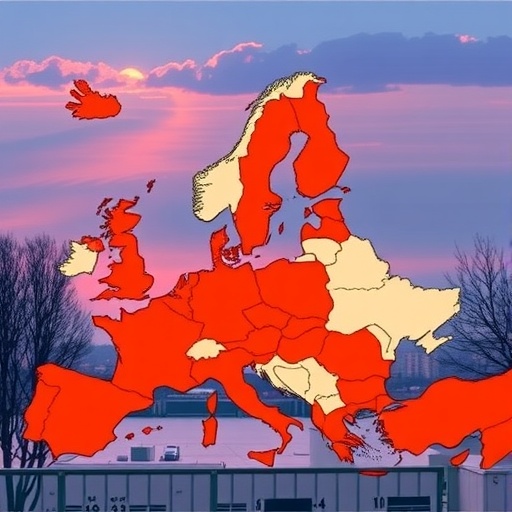
A groundbreaking study led by researchers at the Barcelona Institute for Global Health (ISGlobal), supported by the ”la Caixa” Foundation, has delivered new insights into how socioeconomic disparities modulate temperature-related mortality across Europe. Published in the prestigious journal Nature Health, the research provides the first comprehensive quantification of the impact of socioeconomic inequalities on mortality due to extreme temperatures, analyzing data from both urban and rural populations across 32 European countries. This large-scale investigation offers a nuanced understanding of how climate change and social inequality intersect to influence public health outcomes throughout the continent.
The study, which evaluated over 161 million deaths occurring between 2000 and 2019, reveals a multifaceted relationship between temperature extremes and mortality shaped significantly by socioeconomic context. The research emerged under the umbrella of the European Research Council-funded project EARLY-ADAPT, aiming to capture how different social determinants modify the risk landscape posed by heatwaves and cold spells. The meticulous computational modeling utilized in the study leverages daily mortality records and correlates them with socioeconomic indicators, enabling a robust assessment of vulnerability patterns across diverse European regions.
One of the central revelations is the markedly increased vulnerability of socially deprived regions to both heat- and cold-related mortality. Several variables underpin this heightened susceptibility, including energy poverty, substandard housing insulation, restricted healthcare access, and lower levels of health literacy. These factors coalesce to amplify health risks during temperature extremes, demonstrating that climatic hazards disproportionately afflict populations already burdened by social and economic disadvantages. Consequently, public health strategies must integrate social deprivation as a critical factor in climate adaptation planning.
The researchers employed indicators such as the Gini index—a measure quantifying inequality in wealth distribution—as well as metrics of energy poverty and material deprivation, finding consistent correlations between these factors and elevated temperature-related mortality. Their approach contrasts two hypothetical scenarios: one envisaging all regions as socioeconomically advantaged, and the other depicting maximal deprivation across the board. Astonishingly, the differences in attributed deaths surged above 300,000 when factoring in the inability to maintain adequate home warmth, underscoring energy poverty as a significant driver of cold-related fatalities. Economic inequality and material deprivation similarly contributed to an enhanced mortality burden, with tens of thousands of excess deaths linked to these factors.
In a striking contrast, regions characterized by higher gross domestic product (GDP) per capita and increased life expectancy demonstrated a protective effect against cold-related deaths. The mechanisms behind this phenomenon likely include superior building insulation, robust healthcare infrastructures, and lower prevalence of energy poverty. These conditions mitigate exposure to cold and improve resilience against hypothermia and related illnesses. However, these economically prosperous areas simultaneously exhibit heightened mortality during heatwaves, a paradox attributed to urban heat island effects and intense urbanization.
The urban heat island effect exacerbates thermal stress by trapping heat in densely built environments composed of asphalt, concrete, and limited green spaces. Such urban configurations absorb and radiate heat more effectively than rural counterparts, exposing city dwellers to sustained higher temperatures during heatwaves. This environmental dynamic, coupled with socioeconomic disparities within urban centers, exacerbates heat-induced morbidity and mortality. Therefore, wealthier but heavily urbanized regions face distinct challenges that differ from those experienced in more deprived rural areas, necessitating tailored public health interventions.
Beyond the environmental determinants, the study highlights how public health risks from climate variability are intricately interwoven with socioeconomic fabric. While climate change indiscriminately elevates exposure to extreme weather, its health consequences disproportionately impact vulnerable social groups, magnifying existing inequities. The research poignantly illustrates that thermal exposure from both cold spells and heatwaves does not constitute a homogeneous risk, but rather one that is filtered through the lenses of wealth, housing quality, health systems, and social supports.
The urgency of these findings grows as climate change continues to reshape temperature patterns, increasing the frequency and intensity of heatwaves while gradually altering colder extremes. Between 2022 and 2024 alone, Europe witnessed over 180,000 heat-related deaths, validating temperature as a rapidly emerging determinant of public health. While cold-related mortality currently exceeds that of heat in absolute terms, global warming trends are expected to narrow or even invert this difference in the coming decades. This shifting epidemiological landscape demands an integration of climatic, social, and health data when formulating adaptation policies.
Experts involved in the research emphasize that adaptation strategies must incorporate social dimensions to effectively reduce vulnerability. Recognizing that wealth distribution, housing conditions, and urbanization patterns shape mortality risks enables policymakers to develop targeted interventions. This may include strengthening housing insulation programs, improving healthcare outreach in deprived areas, and urban planning reforms to mitigate heat island effects. The study’s comprehensive, region-specific insights provide a valuable framework for prioritizing resources and enhancing resilience against climate-related health challenges.
Moreover, the geographic scope and scale of the analysis—covering 654 administrative regions and encompassing urban and rural settings alike—advance our understanding beyond prior studies that often focus on selective cities or countries. This pan-European perspective facilitates cross-border comparisons and enables identification of regionally-specific vulnerabilities. Nonetheless, the authors call for similar research initiatives in less studied regions, such as the Global South, where data gaps persist despite potentially heightened exposure to climate risks.
In conclusion, the ISGlobal-led study furnishes compelling evidence that socioeconomic inequality is a key modifier of climate-related mortality and must be front and center in public health discourse. As Europe’s population grapples with increasing thermal hazards, this research underscores that socioeconomic policies and climate adaptation strategies are inseparable. Only through integrated, equity-focused approaches can societies mitigate the disproportionate burden borne by marginalized communities and safeguard public health in an era of global environmental transformation.
News Publication Date: May, 2026
Web References:
- Nature Health Article DOI
- EARLY-ADAPT Project: ISGlobal EARLY-ADAPT
- Related heat mortality study: Nature Medicine (2025)
- Projected temperature-related mortality shifts: Nature Medicine (2024)
References:
Paniello-Castillo B, Chen ZY, Shartova N, Méndez Turrubiates RF, Beltrán N, Peyrusse F, et al. Socioeconomic inequality drivers of vulnerability and burden to heat- and cold-related mortality: a European-wide analysis in 654 contiguous regions. Nat Health. May, 2026.
DOI: 10.1038/s44360-026-00106-0
Cite Scienmag News
Phoebe Ingram. (May 8, 2026). New Study Quantifies for the First Time How Socioeconomic Inequality Influences Temperature-Related Mortality in Europe. Scienmag. https://scienmag.com/new-study-quantifies-for-the-first-time-how-socioeconomic-inequality-influences-temperature-related-mortality-in-europe/
Phoebe Ingram. "New Study Quantifies for the First Time How Socioeconomic Inequality Influences Temperature-Related Mortality in Europe." Scienmag, 8 May 2026, https://scienmag.com/new-study-quantifies-for-the-first-time-how-socioeconomic-inequality-influences-temperature-related-mortality-in-europe/. Accessed 3 September 2026.
Phoebe Ingram. "New Study Quantifies for the First Time How Socioeconomic Inequality Influences Temperature-Related Mortality in Europe." Scienmag. May 8, 2026. https://scienmag.com/new-study-quantifies-for-the-first-time-how-socioeconomic-inequality-influences-temperature-related-mortality-in-europe/


