


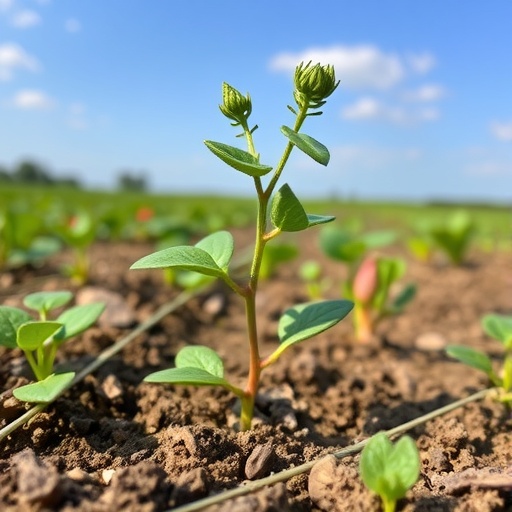
In a groundbreaking study recently published in Nature Microbiology, researchers at the University of Kansas have unveiled new insights into the intricate relationship between soil microbes, plants, and the long-term environmental conditions that shape them. This pioneering investigation analyzes soils from diverse climates across Kansas to explore the “legacy effects” — a phenomenon where soil microbial communities retain and express adaptations developed over countless generations in response to their particular climatic histories. These microbial legacies, the research suggests, play a crucial role in shaping plant performance, especially under varying water availability conditions.
The concept of “legacy effects” refers to the capacity of soil microorganisms such as bacteria and fungi to “remember” past environmental stresses, influencing not only their own physiology but also the plants they inhabit. These ecological memories impact critical ecosystem functions, including carbon sequestration and nutrient cycling, but their precise mechanisms have remained elusive. Dr. Maggie Wagner, associate professor of ecology and evolutionary biology at the University of Kansas and co-author of the study, emphasized the transformative potential of understanding these effects. She noted that legacy effects might profoundly affect not only natural ecosystems but also agricultural productivity by modulating plant responses to drought and other stresses.
Wagner and her colleagues embarked on a comprehensive soil sampling campaign encompassing six distinct sites across Kansas. These locations spanned from the moist, lower-altitude eastern regions to the arid and elevated western High Plains, shaped by the rain shadow of the Rocky Mountains. This geographic gradient provided a natural laboratory to examine how differing climate histories could imprint on soil microbial communities and how these imprints influenced plant growth. The results underscored striking differences in microbial legacy effects shaped by the variable precipitation patterns and altitudes of these regions.
Central to this investigation was the novel experimental approach combining classical culturing methods with cutting-edge genetic and physiological analyses. The team grew plants in soils harboring distinct microbial communities with documented “memories” of either well-watered or drought conditions over five months. Remarkably, despite thousands of microbial generations occurring in this period, the drought memory persisted, influencing plant growth and stress tolerance. This finding highlights the robustness and ecological significance of microbial legacy effects in real-world soil environments.
The study focused primarily on two plant species: corn (Zea mays), a globally important crop, and big bluestem grass (Andropogon gerardii), a native prairie species. The researchers observed that native grasses exhibited much stronger positive responses to microbial communities from their home soils compared to corn grown in those same environments. This pattern likely reflects the co-evolutionary history between native plants and their resident microbial assemblages, a relationship that agricultural crops have not shared due to their domestication and spread from geographically distinct regions.
Digging deeper into the molecular dialogue between plants and their soil microbes, the team employed genetic analyses to identify key genes influenced by legacy effects. Of particular interest was the activation of the gene encoding nicotianamine synthase in plants grown with drought-conditioned microbial communities. Nicotianamine synthase catalyzes the production of nicotianamine, a molecule critical for iron acquisition and has been implicated in enhancing drought tolerance. This gene’s elevated expression under drought, but only in the presence of drought-conditioned microbes, reveals a fascinating tripartite interaction linking climate history, microbial memory, and plant stress physiology.
The implications of these findings extend far beyond ecology and basic science. For farmers and agricultural biotechnologists, this research offers a roadmap for harnessing beneficial soil microbes to bolster crop resilience under increasingly unpredictable climatic conditions. By identifying microbes with specific drought memories and understanding how they interact with plant genetics, it may be possible to develop microbial inoculants that enhance crop performance sustainably. This is particularly timely as microbial commercialization in agriculture is a multibillion-dollar industry with rapid growth and innovation.
Collaboration across disciplines and continents was integral to this study. Researchers from the University of Nottingham in the UK contributed expertise in microbial ecology, while geneticists and plant physiologists from multiple institutions, including the Universidad Nacional Autónoma de México and the Ministério da Agricultura e Ambiente in Cabo Verde, enriched the study’s scope. This interdisciplinary approach enabled the team to bridge gaps between microbiology, evolutionary biology, and plant sciences, driving a holistic understanding of legacy effects in complex soil ecosystems.
The study’s findings also provide a framework for future research avenues, such as discerning how widespread legacy effects are across other crops and ecosystems, and exploring the molecular underpinnings of microbial-plant interactions under various environmental conditions. More detailed investigations into how legacy effects influence microbial gene expression and community dynamics could yield new strategies for managing soil health and promoting sustainable agriculture globally.
Dr. Wagner stresses the importance of viewing soil microbes not merely as passive passengers in agriculture but as active agents shaped by evolutionary histories that influence plant ecology fundamental to food security. This nuanced perspective could inform policy and farming practices aiming to optimize microbial communities in soil through crop rotation, soil amendments, or targeted microbial treatments tailored to local climate legacies.
In essence, this research represents a paradigm shift in how we perceive soil ecosystems — as dynamic, historically informed entities rather than static environments. It highlights the potential to unlock nature’s hidden adaptations to address urgent challenges such as drought resilience and sustainable food production. By integrating molecular genetics, ecology, and practical agronomy, the University of Kansas-led team sets the stage for a new chapter in ecological and agricultural science optimized for the realities of climate change.
News Publication Date: 30-Oct-2025
Web References:
- Original Article DOI: 10.1038/s41564-025-02148-8
- National Science Foundation Division of Integrative Organismal Systems: https://www.nsf.gov/bio/ios
Cite Scienmag News
Alan Morgan. (October 30, 2025). New Study Investigates How Soil Microbes’ Legacy Influences Plant Growth Across Kansas. Scienmag. https://scienmag.com/new-study-investigates-how-soil-microbes-legacy-influences-plant-growth-across-kansas/
Alan Morgan. "New Study Investigates How Soil Microbes’ Legacy Influences Plant Growth Across Kansas." Scienmag, 30 October 2025, https://scienmag.com/new-study-investigates-how-soil-microbes-legacy-influences-plant-growth-across-kansas/. Accessed 4 September 2026.
Alan Morgan. "New Study Investigates How Soil Microbes’ Legacy Influences Plant Growth Across Kansas." Scienmag. October 30, 2025. https://scienmag.com/new-study-investigates-how-soil-microbes-legacy-influences-plant-growth-across-kansas/


