

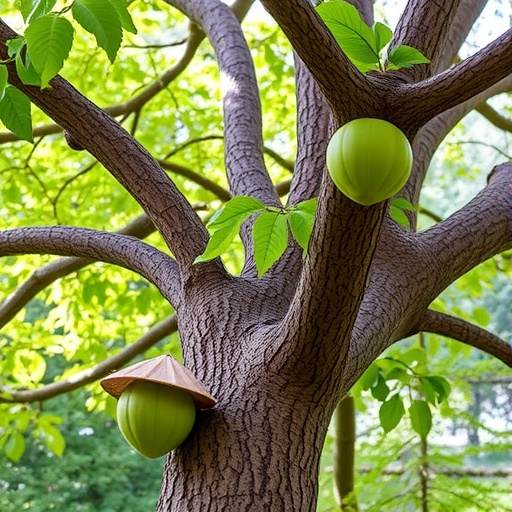
The butternut tree (Juglans cinerea), a species cherished for its pale, fine-grained wood and critical ecological role in North America’s forests, teeters on the edge of extinction. Once common across the eastern United States, this native tree has suffered devastating population declines primarily due to an invasive pathogenic fungus causing butternut canker disease. Now, a groundbreaking multi-institutional research endeavor spearheaded by Virginia Tech offers an unprecedented beacon of hope for the species’ restoration, employing cutting-edge data science techniques to identify and preserve natural genetic resistance within remaining populations.
Decimating butternut populations across a century, butternut canker, caused by the fungus Ophiognomonia clavigignenti-juglandacearum, relentlessly destroys bark tissue, girdling branches and stems and ultimately killing trees. This disease has pushed butternut to the International Union for Conservation of Nature’s (IUCN) Red List of endangered species, underscoring the urgent need for intervention strategies that go beyond traditional nursery propagation and transplanting. Researchers now recognize that some individuals possess innate genetic resistance to this fungal pathogen, opening a new front in conservation efforts focused on leveraging these resilient genotypes.
The Virginia Tech study, published in the journal Forest Ecology and Management, exploits a sophisticated habitat suitability modeling approach that integrates multifaceted data streams, including climatic variables, soil chemistry, and landscape genomics. By mapping where both pure Juglans cinerea and naturally occurring hybrids with Japanese walnut (Juglans ailantifolia)—a species more tolerant of butternut canker—are most likely to thrive, the research establishes a spatial framework to prioritize and optimize restoration efforts. This approach reflects a paradigm shift from indiscriminate planting toward targeted conservation based on ecological and genetic insights.
Assistant Professor Carrie Fearer, leading the study, emphasizes the importance of understanding the environmental niche that supports disease-resistant individuals. “Our integrative modeling enables forest managers to pinpoint microhabitats where temperature regimes, precipitation patterns, and soil carbon levels synergize to foster natural resistance,” she explains. This fine-scale habitat delineation is crucial for directing limited restoration resources to locations with the highest probability of success, thereby improving long-term survival and reducing costs associated with transplantation failures.
The research harnessed collaborative synergy, melding field sampling by Purdue University scientists, genetic resistance screening by U.S. Forest Service pathologists, and computational modeling expertise from Virginia Tech. This interdisciplinary nexus generated a unique dataset that couples genotype information with detailed environmental variables to produce predictive maps. These maps reveal promising restoration zones spanning southern Indiana, western Kentucky, western Michigan, and extensive regions across New England, where resistant trees and hybrids are either thriving or hold strong restoration potential.
Of particular note is the role of hybridization between native butternut and Japanese walnut, which may be enhancing the species’ resilience. Naturally occurring hybridization events introduce genetic variability, some of which confers improved disease tolerance. The models highlight these hybrid zones, underscoring the ecological value of genetic introgression as a natural adaptive mechanism. Recognizing and incorporating these hybrid individuals into restoration strategies could accelerate the recovery of butternut populations under evolving climate pressures.
Beyond its timber and genetic value, butternut serves as an essential mast-producing tree for wildlife, contributing large nuts consumed by turkeys, deer, bears, and other forest fauna. Its decline disrupts forest food webs and ecosystem dynamics, highlighting the broader environmental stakes of this conservation challenge. As Fearer notes, “Protecting butternut is about safeguarding the biodiversity and ecological heritage of eastern North American forests.”
The project also exemplifies the power of open data sharing and interagency cooperation in conservation biology. Purdue’s Aziz Ebrahimi remarks on how integrating genomic datasets with climate models and disease-resistance screenings transforms disparate local field trials into actionable tools. This allows forest managers to make informed decisions about seed sourcing, nursery regeneration, and planting locations aligned with predicted habitat suitability and genetic composition, embodying a modern, science-driven restoration framework.
U.S. Forest Service plant pathologist Anna Conrad underscores the complexity of managing butternut canker disease. Coordinated efforts among plant pathologists, forest ecologists, geneticists, and climatologists enable innovative and holistic solutions. “Pooling expertise and resources is vital,” she says. “Our integrated approach not only advances disease management but also enhances restoration success through targeted interventions based on multifactorial risk and resilience assessments.”
Rapid climate change compounds the urgency of this work, as shifting temperature and precipitation regimes alter the suitability of habitats for native species such as butternut. The modeling framework developed here can be adapted to other tree species facing similar threats from invasive pathogens and changing climatic envelopes, providing a scalable means of enhancing forest resilience and biodiversity preservation at regional scales.
Fearer emphasizes a critical conservation principle: “Translocating trees must be strategic, not random. Our models direct us to where butternut—not only survives but prospers under future climate scenarios.” This precision reforestation approach harnesses the power of data-driven predictive ecology to reinforce forest health, mitigate biodiversity losses, and sustain ecosystem services upon which wildlife and human communities rely.
In sum, this pioneering research marks a major advance in combating butternut’s near-extinction by synthesizing genomic science, disease ecology, and climatology into a unified conservation tool. It offers a replicable blueprint for restoring threatened tree species under complex environmental pressures and invasive threats, elucidating a path toward resilient, biodiverse forests in an era of unprecedented ecological change.
Subject of Research: Restoration ecology and disease resistance mapping for endangered butternut trees (Juglans cinerea)
Article Title: Habitat suitability ensembles of genotype and disease resistance for Juglans cinerea to assist restoration efforts
Web References:
– https://www.sciencedirect.com/science/article/pii/S0378112726002069?via%3Dihub
– http://dx.doi.org/10.1016/j.foreco.2026.123708
Image Credits: Photo by Max Esterhuizen for Virginia Tech
Keywords: butternut tree, Juglans cinerea, butternut canker, disease resistance, forest restoration, habitat suitability modeling, genetic resistance, hybridization, climate adaptation, invasive fungal disease, conservation ecology, forest biodiversity


