


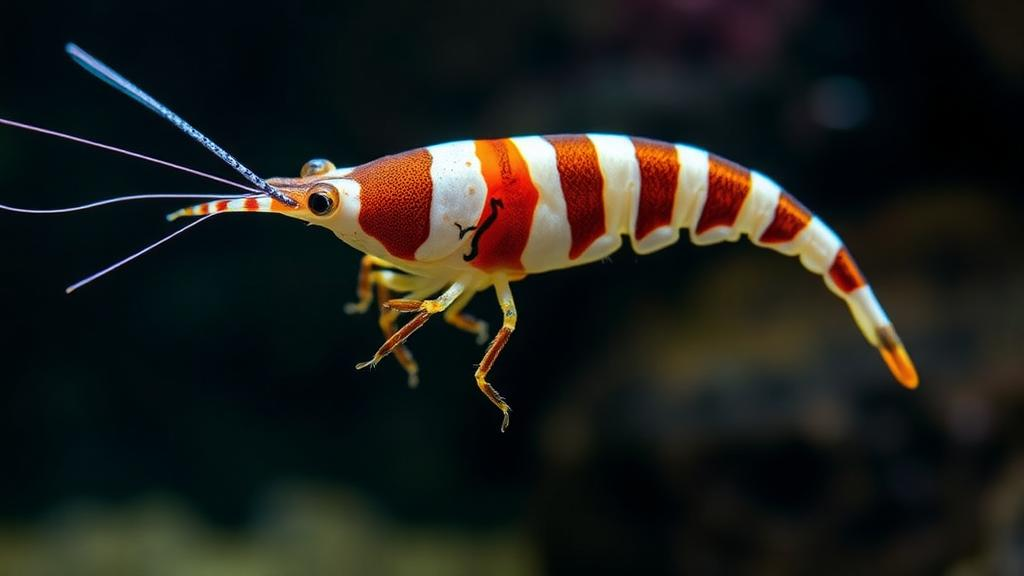
Deep in the forested streams of Qichong National Nature Reserve in Guangxi, southern China, researchers have documented two atyid shrimps — and one of them turns out to be entirely new to science. The discovery, published in the journal Zoosystematics and Evolution, describes Caridina grammosticta, a strikingly patterned freshwater shrimp whose seven reddish-brown transverse stripes and scattered deep red spots make it instantly recognizable in the field. Remarkably, this species had already been circulating in the ornamental aquarium trade for years before anyone formally named it, a situation that now raises urgent conservation concerns for its wild populations.
The atyid shrimps are an ancient lineage, originating in the Cretaceous period and diversifying rapidly during the Paleogene. Today the family comprises 47 genera, nine of which occur in China. These shrimps play a crucial ecological role in freshwater ecosystems, acting as an intermediate link in food webs that connects periphyton and detritus producers to higher trophic levels. Southern China’s streams, with their high habitat heterogeneity, varied substrates, and abundant aquatic vegetation, harbour exceptional shrimp diversity — Guangxi alone has recorded as many as 35 atyid species.
Qichong National Nature Reserve, established in 2002 and upgraded to national status in 2013, covers 143.36 square kilometres of mid-mountain terrain in Zhaoping County, with its highest peak reaching 1,251 metres. The reserve’s sandstone and arenaceous shale bedrock, red soils, and dense stream networks draining into the Guijiang River create ideal conditions for freshwater biodiversity. Despite this richness, atyid shrimps had never been recorded there before the dedicated surveys that led to this discovery, making the finding the first documentation of the family within the reserve’s boundaries.
Between 2025 and 2026, the research team sampled four sites within QNNR, along with two additional localities elsewhere in Guangxi: a stream near Zhongliang Township in Jinxiu County, sampled as far back as 2018, and another near Nanbianshan Town in Lingui District, Guilin City, sampled in March 2026. Using fine-meshed dip nets with a mesh size of just 0.6 millimetres, the collectors targeted microhabitats including stream banks, submersed leaf litter, aquatic vegetation, rocky substrates, and wooded debris. Specimens were anaesthetised with ice, photographed alive, and preserved in ethanol for morphological and molecular analysis. All material has been deposited at the South China Sea Institute of Oceanology, Chinese Academy of Sciences, in Guangzhou.
The second species documented in the reserve, Neocaridina palmata, was first described in 1948 from Chongqing and is far more widespread. It occurs across central and southern China, from Hubei and Anhui in the north to Yunnan and Sichuan in the west, extending into northern Vietnam. Molecular analysis of the QNNR specimens revealed 100% sequence similarity to reference material from Leye, Guangxi, confirming the identification. This hardy shrimp shows strong competitive dominance, forming dense populations in vegetated habitats, and serves local communities as human food, poultry feed, angling bait, and a popular aquarium subject — several ornamental colour morphs have been selectively bred from it by hobbyists.
Caridina grammosticta, by contrast, is a more restricted and more delicate animal. Males reach a carapace length of up to 6.1 millimetres and females up to 6.8 millimetres. The species is diagnosed by a combination of subtle morphological characters: the wider endopod of the male first pleopod, which is reniform with a rounded tip and distinctly concave inner margin; the slender carpus of the first pereiopod; and the slender chela of the second pereiopod. The rostrum carries 14 to 20 dorsal teeth and 6 to 10 postorbital teeth, while the scaphocerite is notably elongated, measuring 4.1 to 4.4 times as long as wide. Its eggs are large for the genus, at 0.87 to 0.90 by 1.22 to 1.43 millimetres.
To confirm the species’ status, the team sequenced two mitochondrial loci — cytochrome c oxidase subunit I and 16S ribosomal RNA — from the new species and a suite of related Caridina species across southern China and Vietnam. Phylogenetic analysis using maximum likelihood on concatenated sequences, with the GTR+G+I substitution model and 1,000 bootstrap replicates, placed C. grammosticta as the closest relative of C. stellata, described from Jinxiu in 2022. Genetic distances reinforced the distinction: COI p-distances between the new species and C. stellata ranged from 11.8% to 12.0%, while intraspecific divergence within C. grammosticta was at most 0.9%. Distances to C. serrata, C. cantonensis, C. mariae, and C. argilla were even greater, ranging up to nearly 20%.
The comparison with C. stellata is particularly instructive. The two species share a similar rostrum shape, a long stylocerite, and comparable pleopod morphology, yet differ in measurable ways: the endopod of the male first pleopod in C. grammosticta is 2.73 to 3.19 times as long as wide, versus 3.70 to 3.90 in C. stellata; the carpus of the first pereiopod is more slender; and the chela of the second pereiopod is proportionally narrower. Similar fine-grained distinctions separate the new species from C. cantonensis, C. sphyrapoda, C. nguyeni, C. serrata, and C. argilla, each diagnosed by ratios of appendage proportions, spiniform setae counts, and egg dimensions — the kind of painstaking comparative anatomy that underpins modern alpha taxonomy.
Living specimens display a light red, translucent body marked with seven narrow reddish-brown transverse stripes — one discontinuous curved stripe on the cephalothorax, short stripes on the first two abdominal somites, and full-width stripes on somites three through six, with the sixth being the broadest. Numerous deep red irregular spots scatter across the cephalothorax and second somite, and deep red rings adorn the antennules, maxillipeds, and pereiopods. The telson and uropods are bright red. The specific epithet grammosticta derives from the Greek grammē (line) and stiktos (spot), capturing this dual pattern of linear markings and punctate spots. All known populations inhabit clear, rocky streams at 500 to 725 metres elevation, with water depths of 15 to 30 centimetres, dissolved oxygen of 8 to 9 milligrams per litre, and a pH of 6.8 to 6.9.
The three known localities — in Hezhou, Guilin, and Laibin — are separated by roughly 53 to 81 kilometres and all drain into tributaries of the Pearl River system, suggesting the species may have dispersed along this hydrological network. But its future is far from secure. Traded in the ornamental market long before its formal description, the species is largely wild-harvested in Jinxiu County and sold across Guangdong, Guangxi, and Hong Kong under inconsistent commercial names. The lack of baseline population data, combined with unregulated overcollection within its narrow range, is driving rapid population decline and raising the risk of local extinction. The authors call for urgent harvesting restrictions and market supervision, alongside the development of artificial propagation and stable captive breeding supply chains to meet demand without further depleting wild stocks — a familiar dilemma in which the aquarium trade that celebrates a species may also be the greatest threat to its survival.
Subject of Research: Taxonomic description and molecular phylogenetics of a new atyid shrimp species from Guangxi, China
Article Title: Two atyid shrimps ( Decapoda , Caridea , Atyidae ) from Qichong National Nature Reserve, Guangxi, China, with the description of a new species
Article References: Hou, J., Zhang, X., Wei, D., Zhu, F., Chen, W., & Guo, Z. (2026). Two atyid shrimps (Decapoda, Caridea, Atyidae) from Qichong National Nature Reserve, Guangxi, China, with the description of a new species. Zoosystematics and Evolution, 102(4), 1033-1046. https://doi.org/10.3897/zse.102.199045
Image Credits: AI Generated
Keywords: Caridina grammosticta, Atyidae, new species, freshwater shrimp, Guangxi, taxonomy, aquarium trade, conservation, molecular phylogenetics, China biodiversity, Qichong National Nature Reserve, Neocaridina palmata
Cite Scienmag News
Margaret Porter. (October 16, 2026). New Striped Shrimp Species from China Was Sold in Aquariums Before Science Named It. Scienmag. https://scienmag.com/new-striped-shrimp-species-from-china-was-sold-in-aquariums-before-science-named-it/
Margaret Porter. "New Striped Shrimp Species from China Was Sold in Aquariums Before Science Named It." Scienmag, 16 October 2026, https://scienmag.com/new-striped-shrimp-species-from-china-was-sold-in-aquariums-before-science-named-it/. Accessed 16 October 2026.
Margaret Porter. "New Striped Shrimp Species from China Was Sold in Aquariums Before Science Named It." Scienmag. October 16, 2026. https://scienmag.com/new-striped-shrimp-species-from-china-was-sold-in-aquariums-before-science-named-it/


