


A new species of conifer sawfly, Pristiphora brevitheca, has been identified in Hebei Province, China, where its larvae feed on the needles of Picea meyeri, a spruce endemic to the country. The taxonomic study combines adult and larval morphology, a cytochrome c oxidase I phylogeny, a partial mitochondrial genome and observations of the insect’s seasonal development. Field observations showed that the larvae can completely defoliate individual branches, providing evidence that the newly described species is a herbivore of this spruce rather than merely an unstudied member of the genus.
The holotype and first specimens were collected on 13 July 2022 at the Beimandian Substation of the Saihanba Mechanical Forest Farm in Weichang County at an elevation of 1,850 metres. Additional material came from Sidaogou in Baliang and Dahuanqi in Sandaoyingzi. The examined series included 26 females and 15 males collected in June 2023, as well as smaller samples from 2022 and 2023. The female holotype is approximately 6.5 millimetres long, while males are about 5.0 millimetres long. Deposited specimens are distributed among the Asian Sawfly Museum in Nanchang, the Biohazard Prevention and Control Center of the National Forestry and Grassland Administration in Shenyang and the Saihanba Machinery Forest Farm.
Researchers established the species’ identity through a combination of body colour, antennal structure, female ovipositor anatomy, the form of the lancet and male genitalia. The female lancet bears nine serrulae and has a ventral margin that curves upward. Its third valvula, part of the ovipositor assembly, is approximately 0.7 times as long as the second valvifer and has a small invagination when viewed dorsally. In males, the valvispina is slightly bent and has thinned, serrated dorsal and ventral margins, while the paravalva narrows abruptly toward its apex. These characters place the new species in the Pristiphora abietina group and distinguish it from the closely related P. jacutica, described by Beneš in 2014.
Colour supplies further diagnostic information, although the study evaluates it alongside structural characters rather than relying on appearance alone. P. brevitheca is predominantly black, with yellowish-white to yellow areas on portions of the face, thorax, abdomen, legs and ovipositor sheath. The wing stigma and most wing veins are black-brown, while the apical part of vein C is pale. Female body length ranges from 6.5 to 7.0 millimetres and male length from 4.5 to 5.0 millimetres. The third antennal segment is slightly compressed in females and strongly compressed in males. The authors also note limited variation, including brown spots on the mesepisternum in some individuals and a forewing Rs vein that may be vestigial or absent.
The molecular analysis used 810-base-pair COI sequences aligned from multiple Pristiphora species, with Nematus pumila selected as the outgroup. Following model selection with jModelTest, the researchers inferred a maximum-likelihood phylogeny using IQ-TREE and 1,000 ultrafast bootstrap replicates. The best-fitting substitution model was TPM1uf+I+G. In the resulting tree, P. brevitheca was sister to P. gerula, and those two species occurred with P. saxesenii and P. compressa in a clade that was itself sister to P. abietina. The analysis supported the monophyly of the P. abietina group as redefined in earlier phylogenetic work. However, the authors caution that not every species in the group has an available COI sequence, so the tree reflects only the comparative data available for the analysis.
To supplement the single-locus phylogeny, the team assembled a partial mitochondrial genome from larval integument muscle collected at the Beimandian Substation. Illumina HiSeq 6000 sequencing generated 214,164,390 raw reads, which were assembled and annotated with a workflow using MitoZ, Geneious Prime, the MITOS web server and related-species sequences for comparison. The resulting assembly was 16,187 base pairs long and contained 13 protein-coding genes, 21 transfer RNAs and two ribosomal RNAs. It lacked trnQ and the control region and was therefore explicitly treated as partial rather than a complete mitochondrial genome. Its adenine-plus-thymine content was 80.9 percent: adenine accounted for 43.4 percent, thymine 37.5 percent, cytosine 11.2 percent and guanine 8.0 percent.
The researchers also reconstructed the secondary structures of the 21 transfer RNAs and mapped the arrangement of genes in the partial mitochondrial assembly. Most protein-coding genes began with ATN codons, and most ended with TAA stop codons; nad4 was the exception, using TA as its stop codon. Six transfer RNAs, both ribosomal RNAs and four protein-coding genes were placed on the N-strand, while the J-strand encoded the remainder. The authors note that Nematinae is genomically underrepresented relative to its more than 1,200 described species and that relatively few complete mitochondrial genomes have been reported for the subfamily. They say they plan to use long-read sequencing in subsequent work to obtain a more complete assembly and enable further comparative and phylogenetic analyses.
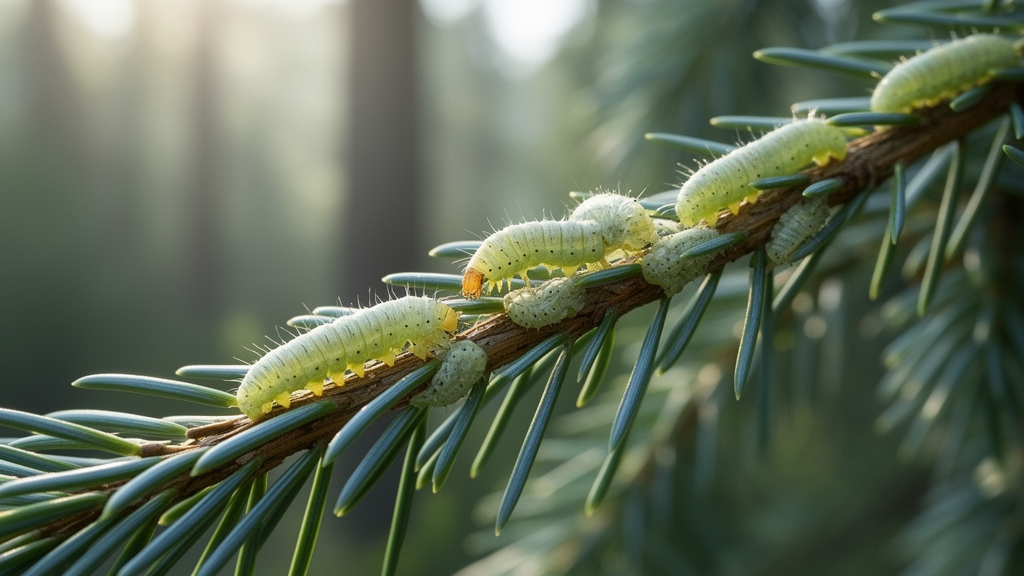
Observations made under natural conditions in 2024 documented the species’ seasonal life history in Hebei. Adults began emerging around 20 May, and elongated, milky-white eggs appeared around 25 May. The incubation period was five to six days. Larvae then passed through four instars, the first two lasting two to three days each, the third three to four days and the fourth four to five days. Early larvae had grass-green thoraces and abdomens with dirty brown heads, whereas later larvae developed clay-brown heads, green bodies and two dark longitudinal stripes along the sides of the back. Around 16 June, mature larvae began spinning cocoons, which changed from white through clay yellow to dark brown as they developed.
Picea meyeri was recorded as the host plant, and the feeding observations document complete defoliation of individual branches. The study therefore establishes both an association between the sawfly and a specific spruce and a measured consequence of larval feeding. It does not, however, quantify the geographic range of the species, establish the frequency of population increases or measure effects on tree survival. The currently documented distribution is confined to Hebei Province, and the host record involves one plant species. The seasonal observations cover one natural period rather than multiple years, so the timing and duration recorded in 2024 cannot by themselves establish a stable annual pattern throughout the species’ range.
Within the broader taxonomy, Pristiphora belongs to the sawfly family Tenthredinidae and the subfamily Nematinae. The cited framework recognized about 240 species in the genus, with 34 recorded from China before this discovery. The P. abietina group was first defined by Benson in 1958 and was later divided into several complexes; subsequent phylogenetic work removed the erichsonii and pallida groups and retained the compressa complex under the redefined abietina grouping. P. brevitheca is a Chinese addition to that lineage. The study presents a combined taxonomic and biological description of a new animal species through its adult and larval morphology, mitochondrial organization, COI-based placement, host association, development stages and observed feeding effects.
Subject of Research: Taxonomic identification and biology of a spruce-defoliating sawfly in Hebei, China
Article Title: A new species of Pristiphora Latreille ( Hymenoptera , Tenthredinidae ), a defoliator of Picea meyeri in China
Article References: Liu, M.-M., Li, M., Li, S., Li, Z.-J., & Wei, M.-C. (2025). A new species of Pristiphora Latreille (Hymenoptera, Tenthredinidae), a defoliator of Picea meyeri in China. Journal of Hymenoptera Research, 98, 525-543. https://doi.org/10.3897/jhr.98.152315
Image Credits: AI Generated
Keywords: new species, Pristiphora brevitheca, sawfly, Picea meyeri, taxonomy, mitochondrial genome, COI phylogeny, larval defoliation, Hebei Province, insect morphology, species, Pristiphora
Cite Scienmag News
Gavin Prescott. (October 20, 2026). New spruce-defoliating sawfly species identified in China. Scienmag. https://scienmag.com/new-spruce-defoliating-sawfly-species-identified-in-china/
Gavin Prescott. "New spruce-defoliating sawfly species identified in China." Scienmag, 20 October 2026, https://scienmag.com/new-spruce-defoliating-sawfly-species-identified-in-china/. Accessed 20 October 2026.
Gavin Prescott. "New spruce-defoliating sawfly species identified in China." Scienmag. October 20, 2026. https://scienmag.com/new-spruce-defoliating-sawfly-species-identified-in-china/


