


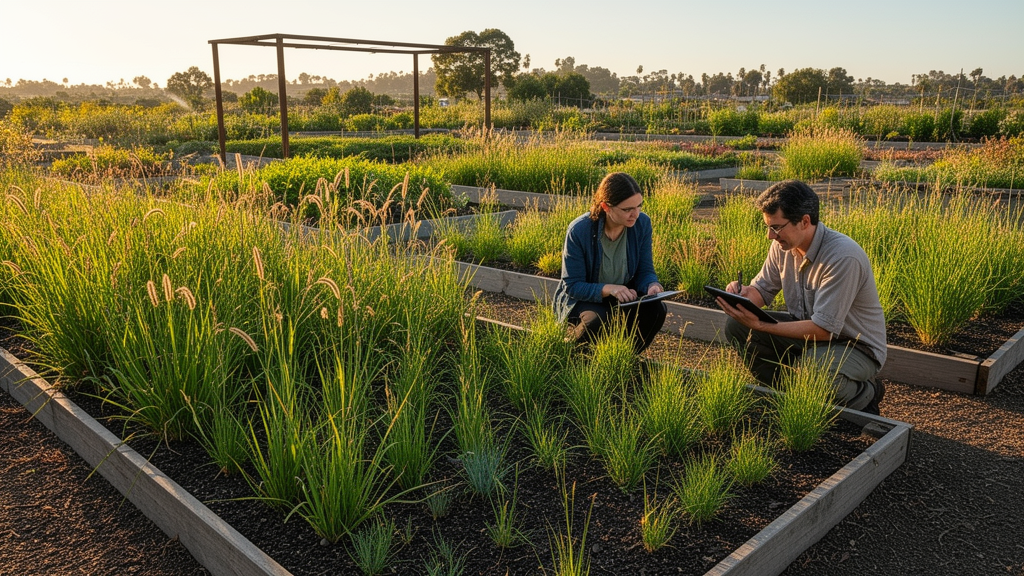
Plants from introduced populations in California did not consistently outperform plants from native Spanish populations when three invasive Mediterranean annual grasses were grown side by side. In a common-garden experiment, only slim wild oats, Avena barbata, showed the predicted combination of greater size, higher fecundity and a faster life cycle. Soft brome, Bromus hordeaceus, had lower reproductive biomass and allocation in California, while false brome, the Brachypodium distachyon species complex, produced fewer reproductive structures, germinated later and flowered later.
The study therefore found no single set of superior life-history traits shared by all three introduced grasses. The researchers collected seeds in March through June 2023 from 12 to 15 populations per species in each range, yielding 40 populations in Spain and 41 in California. Bulk samples came from at least 100 randomly selected plants within 10,000 square metres at each locality.
Populations were separated by at least 5 kilometres and sampled along coast-to-inland gradients, with broadly comparable vegetation types and land-use histories intended to reduce environmental confounding. Eight plants from each of 81 populations were ultimately planted outdoors at the Doñana Biological Research Station near Seville, producing a 648-pot experiment with weekly randomisation of pot positions. Common conditions are central to the design because they separate variation associated with population origin from the immediate influence of the environments in which seeds were collected.
The researchers supplemented the common garden with climate analyses, asking whether traits of populations varied with mean annual temperature, annual precipitation or precipitation seasonality at their source localities. Linear and generalised linear mixed models compared native and introduced populations while treating population as nested within range. Cox proportional-hazard models analysed the timing of germination, flowering and senescence, and false discovery rate adjustments were applied to traits measured on the same plants in the same test.
Seed germination was tested under a two-stage treatment: seven days of darkness at 5 degrees Celsius, followed by constant light at 20 degrees Celsius, with both relative humidity and moisture maintained throughout. A seed counted as germinated when its radicle or coleoptile became visible; non-germinated seeds were subsequently tested for viability with tetrazolium. Neither the total nor the timing of germination differed significantly between ranges for Avena or Bromus.
Seeds of Brachypodium from California germinated later than those from Spain, adding a contrasting pattern to the idea that introduced populations uniformly display faster early development. The clearest advantage appeared in Avena barbata. Plants grown from Californian seeds were an average of 25.9% larger and 19.2% more fecund than plants grown from Spanish seeds.
Their life cycle was also about 11 days shorter, from seedling planting through flowering to harvest, although Avena seed germination itself did not differ significantly between ranges. These are measured differences under the experiment’s common conditions, not direct estimates of invasion rate or long-term population growth. The results are consistent with several possible contributors to between-range differences, including escape from natural enemies, altered resource-use efficiency or founder effects, but the experiment did not identify which mechanism produced the pattern.
Bromus hordeaceus showed a different result. Its overall plant size and fecundity were not significantly affected by range, yet plants from introduced populations produced 5.7% less total seed biomass and had reproductive allocation 5.2% lower than plants from the native range. Reproductive allocation was calculated as reproductive biomass divided by total aboveground biomass.
Brachypodium showed the clearest negative contrast for introduced-range performance. Plants grown from Californian seeds produced 42.5% fewer spikelets than plants grown from Spanish seed, and they germinated and flowered later and had longer life cycles. The experiment measured plant performance in Spain, however, rather than dispersal, establishment or spread across California.
Climate explained some trait variation, but no consistent climate-associated pattern emerged in the introduced range. Of 63 combinations linking a species, climate variable and trait, 15 showed significant associations, and 14 of those were significant in only one range. Ten were detected in Spain and five in California.
In Avena, vegetative biomass decreased with precipitation in the native range but increased with it in California, producing opposite slopes. In California, precipitation was associated with less Avena fecundity and reproductive allocation even as overall plant size increased, while it was associated with greater Bromus vegetative biomass. No significant trait-climate association was found for Brachypodium.
The authors noted that climatic differences between sampled regions, limited geographic coverage and gene flow could all complicate interpretation, and they described climate as a relatively weak evolutionary pressure on the traits examined. Flow cytometry revealed that ploidy may have contributed to the Brachypodium pattern. Nearly all sampled Californian populations were tetraploid, although one locality contained both diploid and tetraploid individuals.
Spanish populations included diploid-only sites, tetraploid-only sites and mixed-ploidy sites. The introduction of Brachypodium to California was estimated from herbarium records as occurring around 1930–1950, whereas Avena and Bromus had been present for more than 150 years. Nevertheless, the introduced Brachypodium tetraploids did not show the expected performance advantage over native material.
Because the morphology of the species complex prevented confident assignment of ploidy to each experimental plant, the study could not isolate cytotype from other population-level differences. Overall, the experiment supports a more qualified view of invasive plant traits than the idea that populations from an introduced range consistently become larger, faster or more fecund. Avena combined larger size, greater reproductive output and a shorter life cycle in California; Bromus showed similar size and fecundity but lower reproductive biomass and allocation; Brachypodium displayed delayed development and lower reproductive output.
The common garden was conducted in a rainy year without severe water limitation, so traits may respond differently in wetter or drier environments. More comprehensive evolutionary tests would grow the same maternal lines under contrasting conditions, compare diploid and tetraploid families, and examine interactions with other plants, herbivores and soil organisms. The present findings show that the relationship between origin, climate, ploidy and life history must be tested species by species rather than treated as a universal rule.
Subject of Research: Common-garden comparison of life-history traits in invasive annual grasses from Spain and California
Article Title: Invasive grasses do not always exhibit superior and faster plant life-history traits in the introduced range than in the native range
Article References: Vilà, M., Trillo, A., Morón-López, R., D’Antonio, C. M., Funk, J. L., Parker, I. M., Rodríguez-Parra, A., & Castro-Díez, P. (2025). Invasive grasses do not always exhibit superior and faster plant life-history traits in the introduced range than in the native range. NeoBiota, 104, 203-223. https://doi.org/10.3897/neobiota.104.162821
Image Credits: AI Generated
DOI: 10.3897/neobiota.104.162821
Keywords: invasive grasses, common garden, plant invasion, life-history traits, Avena barbata, Bromus hordeaceus, Brachypodium distachyon, California grasslands, Mediterranean ecosystems, polyploidy, seed germination, phenology
Cite Scienmag News
Patricia Pace. (October 20, 2026). Common garden finds no universal trait advantage in California grasses. Scienmag. https://scienmag.com/common-garden-finds-no-universal-trait-advantage-in-california-grasses/
Patricia Pace. "Common garden finds no universal trait advantage in California grasses." Scienmag, 20 October 2026, https://scienmag.com/common-garden-finds-no-universal-trait-advantage-in-california-grasses/. Accessed 20 October 2026.
Patricia Pace. "Common garden finds no universal trait advantage in California grasses." Scienmag. October 20, 2026. https://scienmag.com/common-garden-finds-no-universal-trait-advantage-in-california-grasses/


