


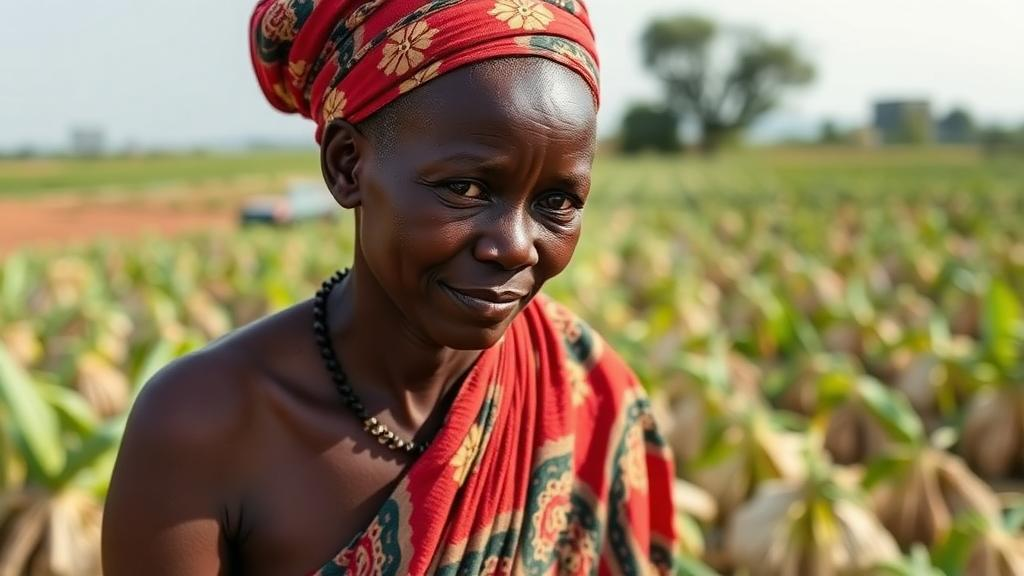
In the smallholder farming communities of Southwest Nigeria, the difference between a household that is thriving and one that is quietly struggling often cannot be seen in a bank statement. It shows up in a corrugated roof, a mobile phone, a goat in the backyard, or the number of children a woman can keep in school. Measuring that difference has long frustrated researchers and policymakers alike, because the standard tools of socioeconomic measurement—income brackets, formal employment, titled property—were built for economies that rural Nigeria does not resemble. A new study published in BMC Agriculture by Oluwafunmilola Olawunmi Makinde of the Federal University of Agriculture and Development Studies, Iragbiji, and Israel Ogunlade of the University of Ilorin, tackles this measurement gap head-on, building and statistically validating a socio-economic status scale designed specifically for rural women farmers in Ogun and Ondo States.
The stakes are higher than they might appear. Women make up nearly half of the agricultural labour force in developing regions, and in Nigeria they are central to staple food production, processing, marketing, and household food security. Yet their access to land, credit, inputs, extension services, and markets remains constrained, and their contributions frequently extend into unpaid and informal domains that conventional surveys simply do not register. When policymakers cannot measure women’s socioeconomic position accurately, interventions aimed at rural development and food security are designed on faulty maps. Socio-economic status, or SES, is known to shape farmers’ access to information, their adoption of new technologies, their resilience to shocks, and their participation in programmes, which makes a trustworthy measurement instrument a kind of prerequisite for everything else.
The methodological problem the researchers confronted is well documented. Existing SES scales for Nigerian farming populations have tended to lean heavily on income or asset ownership, overlooking education, productive capacity, and informal household resources. Earlier efforts include a standardized scale for farm families in Southwest Nigeria that relied mainly on material possessions and education without factor analysis, a scale for rural women in North-Central Nigeria that identified culturally relevant indicators such as household items and livestock but lacked comprehensive psychometric validation, a scale for male farmers in Delta State whose scope excluded women entirely, and an attempt for agropastoralists that was narrow in focus and limited in rigor. Each of these instruments captured a slice of the picture; none offered a multidimensional, statistically validated view of women’s rural livelihoods.
Makinde and Ogunlade began with an unusually large item pool: 200 candidate SES indicators drawn from a literature review, expert consultation, and focus group discussions with the women themselves. These spanned household assets, housing characteristics, access to infrastructure, family demographics, and information and communication technology access. After redundancy checks and expert review removed 26 overlapping or irrelevant items, 174 items survived for pilot testing. The pilot phase, conducted with 180 rural women farmers from communities similar to but independent of the main sample, served as a brutal first filter. Using point-biserial correlations for dichotomous items and independent-samples t-tests for continuous ones, the researchers discarded items that failed to discriminate between higher and lower scorers, along with six flagged as redundant or ambiguous. What emerged was a refined 67-item instrument with strong temporal stability: administered twice at a two-week interval, it produced a test-retest correlation of r = .899.
The validation study then moved to an independent sample of 330 rural women farmers, selected through a careful multi-stage procedure. Ogun and Ondo States were purposively chosen from the five Southwestern states to represent two distinct agro-ecological clusters—transitional forest-savannah in Ogun and rainforest-derived savannah characteristics in Ondo—while Lagos was excluded for its predominantly urban character. Within the two states, 25 percent of Local Government Areas were proportionately drawn from each of three senatorial districts, yielding eleven LGAs, from which thirty-two farming communities were randomly selected. From a sampling frame of 1,650 women compiled through local farmer associations, 20 percent were proportionately selected. Trained extension agents administered the questionnaire, a choice that improved cultural appropriateness and respondent engagement, and participants were assured of confidentiality to minimize social desirability bias.
The statistical heart of the study was an exploratory factor analysis using principal axis factoring with Varimax rotation. The Kaiser-Meyer-Olkin measure of sampling adequacy came in at 0.612—acceptable but modest, a point the authors flag candidly—and Bartlett’s test of sphericity was highly significant (χ² = 17,475.55, df = 2,145, p < .001), confirming that the item correlations justified factoring. Although the initial extraction produced 19 factors with eigenvalues above 1, inspection of the scree plot showed a clear inflection after the fourth component. The researchers retained four interpretable dimensions: Material Assets, Modern Amenities, Demographics and ICT, and Infrastructure and Resources. Together these explained 41.5 percent of total variance, within the 30 to 60 percent range commonly deemed adequate for exploratory work in the social sciences, though at the lower end. After iterative item reduction, the final scale contained 39 items, every one loading at 0.50 or above.
Reliability results were the study’s strongest showing. Cronbach’s alpha ranged from 0.75 to 0.92 across the four factors, with Material Assets performing excellently at 0.92, Modern Amenities and Infrastructure and Resources both good at 0.81, and Demographics and ICT satisfactory at 0.75—above the 0.70 threshold conventionally accepted for exploratory instrument development. The overall scale achieved an alpha of 0.87, figures comparable to other validated SES instruments in sub-Saharan Africa, which typically report alphas between 0.70 and 0.88. For scoring, the authors developed a sigma-score system in which response categories are weighted according to each item’s empirically derived ability to distinguish respondents in better and worse socioeconomic conditions, meaning items contribute unequally to the final measure. Domain scores are summed within each factor, and a composite score across all 39 items yields an overall index of socioeconomic advantage.
Preliminary evidence of validity came from known-group testing using educational attainment, a variable with clear theoretical links to socioeconomic position. Education differed significantly across SES quartile groups derived from a PCA-based wealth index (F = 26.86, p < .001), with women in the upper quartiles showing significantly higher educational attainment than those in the lower two, and post-hoc comparisons confirming a clear gradient. The quartile classification itself—Low, Lower-Middle, Upper-Middle, and High SES, each holding roughly a quarter of the 330 households—follows Demographic and Health Survey conventions and reflects the relative homogeneity of the study population, where households cluster around moderate asset security rather than extremes. The authors are careful to note that these quartiles are descriptive and relative to the sample, not absolute poverty thresholds, and that the PCA wealth index was used only for description, not in developing the validated scale itself.
The authors are equally forthright about the limits of what they have built. The borderline sampling adequacy, the modest explained variance, and the absence of convergent and discriminant validity testing—hampered by the lack of a widely accepted gold-standard SES measure for rural Nigerian women—mean the instrument should be regarded as a preliminary research tool rather than a finished policy instrument. It has been validated only against within-study measures, not against external criteria such as income, food security, or established indices, and seasonal variation in agricultural income was not captured. Self-reported data may carry recall and social desirability bias, and excluding Lagos limits generalizability to more urbanized settings. Still, the practical promise is real: unlike income- or asset-only measures, the scale integrates household items, amenities, demographics, and ICT access, allowing extension agents and policymakers to spot households that appear asset-secure but lack productive capacity or education. With further refinement, longitudinal designs to capture seasonal dynamics, and validation against outcomes like food security and health status, the instrument could sharpen baseline assessments and programme monitoring—and, ultimately, make the invisible economies of rural women farmers visible to the institutions that serve them.
Subject of Research: Development and validation of a multidimensional socio-economic status scale for rural women farmers in Southwest Nigeria
Article Title: Development and validation of a socio-economic status scale for rural women farmers in Ogun and Ondo States Nigeria
Article References: Makinde, O. O., & Ogunlade, I. (2026). Development and validation of a socio-economic status scale for rural women farmers in Ogun and Ondo States Nigeria. BMC Agriculture, 2(1), Article 29. https://doi.org/10.1186/s44399-026-00055-9
Image Credits: AI Generated
DOI: 10.1186/s44399-026-00055-9
Keywords: socio-economic status, rural women farmers, Nigeria, scale development, psychometrics, exploratory factor analysis, Cronbach's alpha, agricultural extension, rural livelihoods, wealth index, construct validity, sub-Saharan Africa
Cite Scienmag News
Alan Morgan. (October 1, 2026). New Scale Captures the Hidden Wealth of Nigeria’s Rural Women Farmers. Scienmag. https://scienmag.com/new-scale-captures-the-hidden-wealth-of-nigerias-rural-women-farmers/
Alan Morgan. "New Scale Captures the Hidden Wealth of Nigeria’s Rural Women Farmers." Scienmag, 1 October 2026, https://scienmag.com/new-scale-captures-the-hidden-wealth-of-nigerias-rural-women-farmers/. Accessed 5 October 2026.
Alan Morgan. "New Scale Captures the Hidden Wealth of Nigeria’s Rural Women Farmers." Scienmag. October 1, 2026. https://scienmag.com/new-scale-captures-the-hidden-wealth-of-nigerias-rural-women-farmers/


