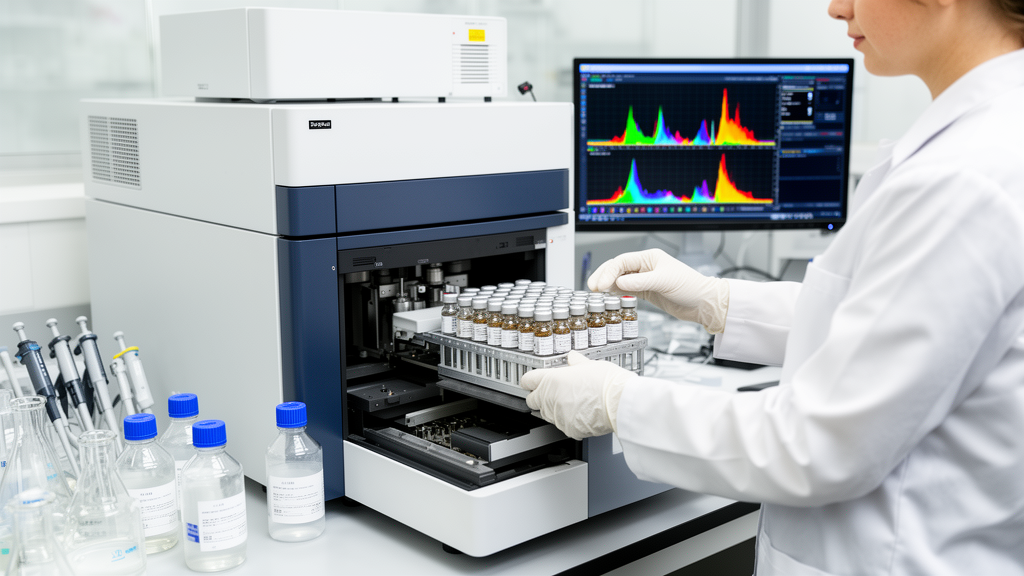
Researchers have developed and validated a stability-indicating reverse-phase high-performance liquid chromatography (RP-HPLC) method that can simultaneously quantify three active ingredients—formoterol fumarate, glycopyrrolate, and fluticasone propionate—in triple fixed-dose inhalation formulations.
The method uses a C18 column measuring 300 mm by 3.9 mm with 4 μm particles, operated in gradient elution. The mobile phases combine 0.1% formic acid in water with a 1:1 mixture of acetonitrile and methanol also containing 0.1% formic acid, at a flow rate of 1.0 mL/min. Under these conditions the three drugs separate cleanly, with retention times of 3.206 minutes for glycopyrrolate, 6.882 minutes for formoterol fumarate, and 21.960 minutes for fluticasone propionate.
A key feature of the development is its use of an Analytical Quality by Design (AQbD) framework. The team employed a Box–Behnken Design to optimize chromatographic conditions and demonstrate robustness, achieving a composite desirability of 1.000.
Analytical validation followed ICH Q2(R1) standards. The method showed linearity with r² values of at least 0.9999 over concentration ranges of 5–25 μg/mL for formoterol fumarate and glycopyrrolate, and 120–360 μg/mL for fluticasone propionate. Limits of detection ranged from 0.110 to 1.454 μg/mL and limits of quantification from 0.332 to 4.406 μg/mL. Precision was high, with relative standard deviations below 1.6%, and accuracy recoveries fell between 98.5% and 101.2%. System suitability parameters included tailing factors below 2.0, more than 18,000 theoretical plates, and resolution greater than 26.
Oxidative stress produced the greatest degradation: 18.86% for formoterol fumarate, 14.88% for glycopyrrolate, and 15.57% for fluticasone propionate. Degradation products were well resolved from the parent peaks, and mass balance exceeded 80%, supporting the method’s stability-indicating claim.
The study also evaluated the method’s environmental profile. Using the AGREE greenness metric, the method scored 0.71, and assessment under the White Analytical Chemistry framework supported its analytical efficiency.
Subject of Research: Development and validation of a stability-indicating RP-HPLC method for simultaneous quantification of three drugs in combination inhaler formulations
Article Title: Stability-indicating RP-HPLC method for simultaneous determination of formoterol fumarate, glycopyrrolate, and fluticasone propionate in pharmaceutical formulations
Article References: Christian, J., Suhagia, B. N., & Soni, T. (2026). Stability-indicating RP-HPLC method for simultaneous determination of formoterol fumarate, glycopyrrolate, and fluticasone propionate in pharmaceutical formulations. BMC Chemistry. https://doi.org/10.1186/s13065-026-01919-6
Image Credits: AI Generated
DOI: 10.1186/s13065-026-01919-6
Keywords: RP-HPLC, formoterol fumarate, glycopyrrolate, fluticasone propionate, combination inhalers, Analytical Quality by Design, forced degradation, ICH guidelines, green chemistry, pharmaceutical analysis, method validation, Stability-indicating
Cite Scienmag News
Bethany Barker. (October 29, 2026). New RP-HPLC Method Simultaneously Measures Three Drugs in Combination Inhalers. Scienmag. https://scienmag.com/new-rp-hplc-method-simultaneously-measures-three-drugs-in-combination-inhalers/
Bethany Barker. "New RP-HPLC Method Simultaneously Measures Three Drugs in Combination Inhalers." Scienmag, 29 October 2026, https://scienmag.com/new-rp-hplc-method-simultaneously-measures-three-drugs-in-combination-inhalers/. Accessed 29 October 2026.
Bethany Barker. "New RP-HPLC Method Simultaneously Measures Three Drugs in Combination Inhalers." Scienmag. October 29, 2026. https://scienmag.com/new-rp-hplc-method-simultaneously-measures-three-drugs-in-combination-inhalers/