

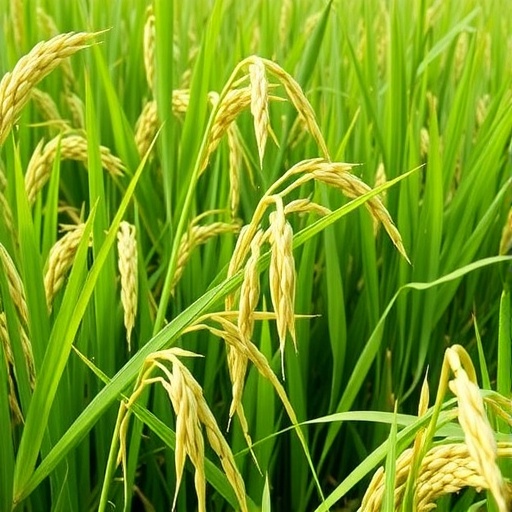
For decades, rice breeders have faced a formidable obstacle that has hampered efforts to simultaneously enhance grain yield and improve grain quality. Typically, any increases in grain productivity are paradoxically accompanied by a decline in essential quality traits. This intrinsic trade-off between yield and quality has been a critical bottleneck in the advancement of rice cultivars capable of meeting global food security demands without compromising consumer preferences for superior grain attributes. The relentless quest to reconcile these competing agronomic objectives has now found promising solutions through cutting-edge molecular genetics.
Recent groundbreaking work by a research team from the State Key Laboratory of Seed Innovation at the Institute of Genetics and Developmental Biology, Chinese Academy of Sciences, has unveiled a novel genetic determinant that holds the key to breaking this longstanding impasse. The gene, designated GSN7 and mapped to rice chromosome 7, encodes an atypical cytoplasmic kinase that orchestrates a finely tuned regulatory network balancing grain yield and quality. This discovery presents a paradigm shift in rice breeding strategies, offering a feasible pathway to produce cultivars that defy the traditional yield-quality trade-off.
By employing chromosome segment substitution lines derived from elite rice cultivars, the researchers meticulously demonstrated that loss-of-function mutations in GSN7 induce significant morphological changes in grain development. Specifically, the mutation leads to grains that are longer and slimmer, exhibiting greater translucency and markedly reduced chalkiness — a key determinant of grain quality. Concurrently, these GSN7 mutants produce a notable increase in grain number per panicle, thereby enhancing overall yield potential. Impressively, these improvements manifest without any detrimental effect on the thousand-grain weight, preserving grain mass while exponentially boosting both quality and quantity metrics.
At the molecular level, the function of GSN7 is intricately linked to the modulation of the OsGSK2 kinase, a well-established signaling node that regulates multiple facets of grain morphogenesis. GSN7 acts by competitively interacting with OsGSK2 and the inhibitor protein GW5. This interaction attenuates GW5’s suppression of OsGSK2 phosphorylation activity, leading to a sophisticated regulatory cascade that ultimately adjusts grain length-to-width ratio as well as panicle grain number. This mechanistic insight elucidates how GSN7 serves as a pivotal modulator of grain architecture and yield components, offering a precise target for genetic manipulation.
One of the study’s most compelling aspects is the identification of a naturally occurring haplotype of GSN7, termed Hap.3, which is strongly correlated with superior grain shape and elevated yield outcomes across diverse rice germplasm collections. Unfortunately, this advantageous haplotype remains largely underutilized in existing breeding programs. The revelation of Hap.3 as a genetic reservoir for elite traits opens new avenues for marker-assisted selection, facilitating the targeted introgression of this allele into commercially relevant cultivars with the aim of scalable improvements in production and grain quality.
Advancements in gene editing technologies further elevate the significance of GSN7 as a breeding target. Utilizing CRISPR-Cas9 or similar genome engineering tools, precise manipulation of GSN7 expression or functional domains could be deployed to harness its beneficial effects, accelerating the development timeline of next-generation rice varieties. This capability addresses not only the dual imperatives of yield and quality enhancement but does so with remarkable precision and efficiency, heralding a new era in crop optimization.
The implications of this discovery extend beyond just agronomic traits; improving grain translucency and reducing chalkiness bear important consequences for the food industry and consumer markets. Grain quality traits influence milling efficiency, cooking characteristics, and nutritional profiles, affecting the economic value and acceptability of rice products globally. Hence, integrating GSN7-based improvements promises a holistic enhancement package, supporting sustainability and profitability throughout the rice value chain.
Moreover, the researchers’ in-depth biochemical characterization of GSN7 enriches our understanding of kinase signaling roles in cereal crop development. As many growth regulators remain elusive or functionally uncharacterized, insights gleaned from GSN7’s interaction with OsGSK2 and GW5 deepen the molecular framework underpinning grain formation. This knowledge may facilitate cross-species applications and discovery of analogous genes in other staple cereals, further broadening the agricultural impact of the research.
This study highlights the immense value of harnessing natural genetic diversity within crop germplasms. By leveraging allelic variation that had remained cryptic until now, breeders gain access to a treasure trove of traits that reconcile long-standing genetic conflicts. The precise identification and deployment of such genetic resources align perfectly with sustainable agriculture objectives, empowering crop improvement that is both environmentally sound and economically viable.
Importantly, the collaborative nature of the research and the integration of multidisciplinary approaches—from molecular genetics and biochemistry to breeding and phenotypic evaluations—underscore a holistic model for future crop science endeavors. This integrative strategy sets a benchmark for tackling other complex traits where multiple phenotypic dimensions must be balanced to satisfy evolving agricultural challenges.
Looking ahead, commercial breeders are encouraged to incorporate GSN7-based selections into their pipelines, leveraging molecular markers associated with favorable haplotypes to expedite variety development. When coupled with gene editing technologies, this integrated approach can revolutionize rice breeding by delivering cultivars that meet escalating food demands and quality standards worldwide, ultimately contributing to global food security and improved livelihoods.
In conclusion, the identification and functional elucidation of GSN7 represent a seminal advancement in plant genetics and crop improvement. By resolving the historical antagonism between grain yield and quality, this gene offers an unprecedented opportunity to cultivate rice varieties that are both high-yielding and high-quality. The transformative potential of GSN7 heralds a new chapter in rice breeding, one that promises sustainable solutions for feeding a growing global population without compromising on the essential attributes that define rice as a dietary staple.
Subject of Research: Genetic regulation of grain yield and quality in rice through the GSN7 kinase gene
Article Title: A new rice gene, GSN7, coordinately regulates grain yield and quality
Web References: DOI: 10.1016/j.scib.2026.01.066
Image Credits: ©Science China Press
Keywords: Rice genetics, grain yield, grain quality, GSN7, OsGSK2, GW5, grain morphology, molecular breeding, gene editing, haplotype, marker-assisted selection, sustainable agriculture


