


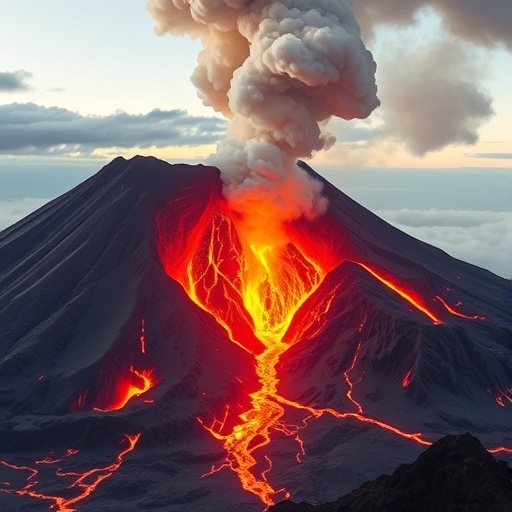
Supereruptions rank among Earth’s most cataclysmic geological phenomena, characterized by the eruption of magma volumes exceeding 1,000 cubic kilometers. These immense volcanic events sculpt landscapes, alter global climates, and impose profound effects on ecosystems and human civilizations. Despite their significance, the subsurface genesis and dynamics of supereruptions remain inadequately understood, limiting our ability to forecast and mitigate associated hazards. However, cutting-edge research spearheaded by the Institute of Geology and Geophysics of the Chinese Academy of Sciences (IGGCAS) offers revolutionary insights into the subterranean processes fueling these violent phenomena.
The research team constructed an advanced three-dimensional geodynamic model simulating the complex interactions within western North America’s lithosphere and its underlying mantle convective systems. This model unravels novel mechanisms for magma production beneath supervolcanoes, upending conventional paradigms that have long dominated volcanic science. Published recently in the prestigious journal Science, this work elucidates the intricate interplay between mantle dynamics and lithospheric architecture, bridging the gap between deep Earth processes and surface volcanic activity.
Traditionally, supervolcanoes were envisioned as hosting vast, persistent magma chambers harboring largely molten, low-density magma reservoirs situated within the crust. This classical magma chamber hypothesis posited that magma accumulation increases internal pressure until the crust fails catastrophically, triggering supereruptions. Yet, mounting geophysical and geochemical evidence challenges this notion, revealing an absence of long-lived, liquid-dominated magma bodies beneath many active supervolcanoes. Instead, these volcanic systems appear to comprise extensive, distributed mush zones of partially molten rock permeating the lithosphere, a state now conceptualized as “magma mush” systems.
The Earth’s lithosphere, encompassing the rigid crust and uppermost mantle, overlies the more ductile asthenosphere—a region of slow, convective flow in Earth’s upper mantle. Emerging data indicates that the partial melting generating supervolcanic magma originates within this shallow asthenosphere rather than deep mantle plumes. As melts migrate upward, they encounter solid lithospheric rocks, reacting and mixing to form viscous mush with effective viscosities several orders of magnitude greater than purely molten magma. This viscosity contrast challenges simplistic buoyancy-driven ascent models and reveals that magma transport occurs within a complex, semi-solid matrix rather than discrete chambers.
Yellowstone caldera, the archetypal supervolcano in western North America, exemplifies these findings. Its geological record includes two massive supereruptions within the last 2.1 million years, making it an invaluable natural laboratory. Geophysical imaging and petrological analyses have delineated a persistent, large-scale magma mush system beneath Yellowstone, featuring a southwest-dipping geometry. Interestingly, transient zones of relatively liquid-rich magma, akin to classical chambers, emerge episodically prior to eruptions but do not persist through extended timescales. Despite these insights, the geodynamic forces underpinning this extensive mush system remained elusive until this new modeling effort.
The new three-dimensional geodynamic model attributes Yellowstone’s magma source not to a deep-seated mantle plume ascending from the Earth’s core-mantle boundary, but instead to an eastward-directed “mantle wind.” This mantle flow results from the ancient subduction and ongoing remnant dynamics of the Farallon Plate beneath central and eastern North America. This broad, horizontal convective flow within the asthenosphere transports hot mantle material laterally toward the Yellowstone region, fundamentally redefining previous mantle plume-centered theories of supervolcano magma generation.
As this asthenospheric material approaches Yellowstone’s lithosphere, it is dragged downward due to the thick, buoyant lithospheric root west of Yellowstone. This vertical extensional regime induces decompression melting, generating magma within a zone previously misunderstood. The interplay of horizontal mantle flow and vertical stretching establishes a distinctive southwest-dipping conduit within the lithosphere beneath Yellowstone, facilitating magma transport, accumulation, and chemical evolution. This tearing and extension of the continental lithosphere result from the push of mantle wind eastward and a counteracting westward body force generated by buoyant lithosphere, sculpting the magmatic architecture.
This physical mechanism elegantly explains the formation and sustainability of Yellowstone’s translithospheric magma mush system, reconciling geophysical and geochemical observations with deep mantle dynamics. The mantle wind-driven lithospheric tearing creates a persistently favorable environment for magma mushes to accumulate and differentiate over million-year timescales. These mush systems are vast, interconnected, and responsible for the episodic rise of more mobile liquid magma, culminating in the explosive supereruptions recorded at the surface.
Importantly, this geodynamic framework extends beyond Yellowstone, suggesting a common genesis for magma mush systems beneath numerous supervolcanoes worldwide. It highlights a paradigm shift from classic magma chamber-centric models toward a mush-dominated architecture driven by mantle flow and lithospheric deformation. Such insights hold profound implications for volcanic hazard modeling, enabling more nuanced predictions of eruption behavior rooted in the physics of mantle-lithosphere interactions.
This research also opens avenues for utilizing seismic and geodetic monitoring to detect the subtle signatures of mantle wind activity and lithospheric tearing beneath other volcanic regions. Understanding the temporal dynamics of magma mushes could improve our ability to anticipate eruptive precursors and inform risk mitigation strategies. By linking mantle convection patterns, lithospheric mechanics, and magma system evolution, the study represents a milestone in Earth sciences and volcanology.
In summary, the emergence of mantle wind-driven lithospheric tearing offers a compelling, physically consistent explanation for the generation and longevity of magma mush systems fueling supervolcanoes. Yellowstone’s magmatic system stands as a flagship example, reshaping the conceptual model of supereruptions. The convergence of advanced modeling, petrological data, and tectonic context revealed by IGGCAS researchers charts a transformative path forward in deciphering Earth’s most violent volcanic expressions, with wide-ranging consequences for geology, hazard preparedness, and planetary science.
News Publication Date: April 9, 2024
Web References: https://doi.org/10.1126/science.ady2027
Cite Scienmag News
Violet Maxwell. (April 10, 2026). New Research Uncovers Shallow Mantle Origins of Supervolcanic Magma. Scienmag. https://scienmag.com/new-research-uncovers-shallow-mantle-origins-of-supervolcanic-magma/
Violet Maxwell. "New Research Uncovers Shallow Mantle Origins of Supervolcanic Magma." Scienmag, 10 April 2026, https://scienmag.com/new-research-uncovers-shallow-mantle-origins-of-supervolcanic-magma/. Accessed 3 September 2026.
Violet Maxwell. "New Research Uncovers Shallow Mantle Origins of Supervolcanic Magma." Scienmag. April 10, 2026. https://scienmag.com/new-research-uncovers-shallow-mantle-origins-of-supervolcanic-magma/


