


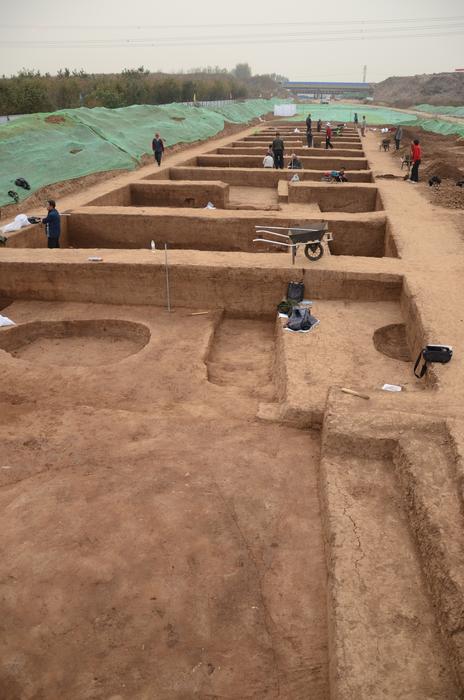
A groundbreaking discovery by researchers from Washington University in St. Louis, in collaboration with Shandong University and an international consortium of scientists from China, Japan, and South Korea, has significantly reshaped our understanding of the domestication history of the adzuki bean (Vigna angularis) in East Asia. This pivotal research reveals charred remains of adzuki beans excavated from the Xiaogao archaeological site in Shandong Province, China, dated to an astonishing 9,000 to 8,000 years before present (BP), marking one of the earliest known instances of legume cultivation in the region. These findings push the timeline for adzuki bean domestication back by approximately 4,000 years in the Yellow River basin, underscoring an advanced Neolithic agricultural system in ancient eastern China.
The Neolithic period represents a transformative epoch during which early human societies transitioned from foraging to farming lifestyles, cultivating staple crops and domesticating animals to sustain burgeoning populations. The identification of adzuki beans from this era suggests their integral role in early agricultural economies. The researchers obtained these botanical remains through meticulous stratigraphic excavation and subsequent radiocarbon dating techniques, affirming their provenance and antiquity. This new evidence challenges existing paradigms that positioned adzuki bean domestication as a later development, instead placing it firmly within the dawn of organized plant cultivation in East Asia.
Adzuki beans are revered not only for their nutritional richness—offering substantial protein, fiber, and micronutrients—but also for their nitrogen-fixing abilities, which enhance soil fertility in agroecosystems. Their cultivation has had profound impacts on sustainable agriculture and regional diets throughout East Asia. The cultural significance of adzuki beans extends beyond their agronomic value; they feature prominently in traditional culinary practices across China, Japan, and Korea, often associated with ceremonial dishes and symbolic meanings. This long-standing cultural embedment amplifies the relevance of tracing their domestication origins.
By situating adzuki beans within the context of a multi-cropping system alongside millet, rice, and soybeans, this research highlights the complexity and diversification of Neolithic agricultural practices. The early farmers of the Lower Yellow River region did not rely on a single crop but rather engaged in sophisticated polyculture techniques that optimized land use and food security. This multidisciplinary study integrates archaeobotanical data with paleoenvironmental reconstructions, providing a comprehensive framework to understand how early societies managed their crops within dynamic ecosystems.
The analytical scope of the study extends beyond the Xiaogao site. The team conducted an expansive survey of charred adzuki bean remains from 41 archaeological sites spanning East Asia, encompassing diverse ecological zones including the Yellow River basin, the Japanese archipelago, the Korean Peninsula, and southern regions of China. By synthesizing newly acquired data with extant records, the researchers constructed a robust chronology and documented spatial variability in seed morphology and usage patterns. This extensive dataset elucidates regional evolutionary trajectories and cultural adaptations influencing bean domestication processes.
One of the study’s most revealing insights pertains to the divergence in seed size evolution between Neolithic populations of the Yellow River area and those inhabiting Jomon-period Japan. The morphological differences in adzuki beans imply that domestication was not purely driven by environmental selection pressures but was equally shaped by culinary preferences and dietary traditions. Such findings advance a nuanced narrative that plant domestication is a multifaceted, context-dependent phenomenon rather than a uniform cultural milestone.
Professor Xinyi Liu, lead author and anthropologist at Washington University in St. Louis, emphasizes the growing consensus within archaeological sciences that domestication is a protracted process occurring across multiple regions rather than emanating from a single cradle of origin. The case of the adzuki bean exemplifies parallel domestication events and regional experimentation, underscoring the intertwined roles of human agency, cultural dynamics, and ecological factors in shaping early agricultural systems.
The implications of this research are wide-ranging, affecting fields from archaeobotany to agricultural history and ethnobotany. It necessitates re-evaluating the timeline and geographic scope of legume domestication in East Asia, prompting renewed archaeological investigations and interdisciplinary collaboration. Moreover, the findings have potential ramifications for modern sustainable agriculture by illuminating ancient practices that balanced crop diversity with environmental stewardship.
Technologically, the study employed advanced methodologies such as micro-CT scanning of charred seeds to non-invasively analyze seed morphology in three dimensions, alongside isotopic assays that infer ancient cultivation conditions. The integration of these techniques with traditional archaeological approaches created a powerful toolkit for reconstructing the ecological and cultural milieu of Neolithic farmers. This approach showcases the vital role that cutting-edge technology plays in unlocking ancient agricultural secrets.
The discovery of this early domestication episode also enriches our understanding of food globalization and the dissemination of crops across vast territories in prehistoric times. The movement of the adzuki bean and its integration into multiple culinary systems demonstrate intricate networks of cultural exchange and genetic adaptation. Such patterns mirror broader anthropological themes concerning migration, trade, and intercultural connectivity during the Neolithic and later periods.
Future research trajectories inspired by these findings include exploring the genetic diversity of ancient and modern adzuki bean varieties to identify domestication-related genes, further elucidating the coevolution of humans and plants. Additionally, expanding archaeological surveys and botanical sampling across underexplored regions may uncover further evidence of early crop dispersal and domestication complexity. These endeavors will continue to refine our comprehension of humanity’s agricultural origins.
This seminal work, published in the prestigious journal Proceedings of the National Academy of Sciences on September 22, 2025, not only chronicles a momentous archaeological revelation but also frames a broader discourse on how the earliest agriculturalists in East Asia harnessed botanical resources. It invites a reconsideration of the intricate interplay between culture, ecology, and technology underpinning one of humanity’s most enduring achievements—the domestication of plants.
Cite Scienmag News
Courtney Benton. (September 24, 2025). New Research Sheds Light on Neolithic Farming and Diets in East Asia. Scienmag. https://scienmag.com/new-research-sheds-light-on-neolithic-farming-and-diets-in-east-asia/
Courtney Benton. "New Research Sheds Light on Neolithic Farming and Diets in East Asia." Scienmag, 24 September 2025, https://scienmag.com/new-research-sheds-light-on-neolithic-farming-and-diets-in-east-asia/. Accessed 3 September 2026.
Courtney Benton. "New Research Sheds Light on Neolithic Farming and Diets in East Asia." Scienmag. September 24, 2025. https://scienmag.com/new-research-sheds-light-on-neolithic-farming-and-diets-in-east-asia/


