

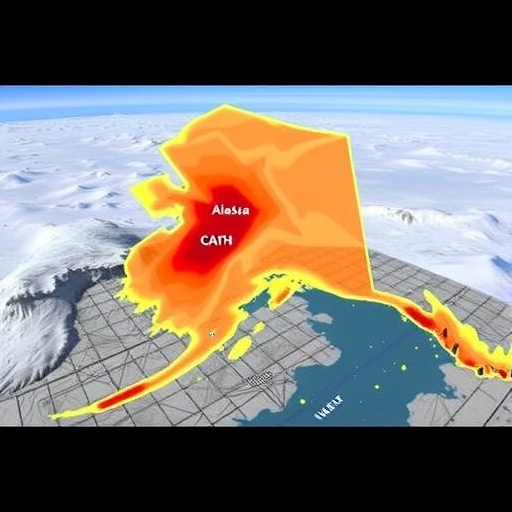
Alaska’s glaciers exhibit a remarkable sensitivity to rising temperatures, revealing a compelling narrative of climate change written in ice and snow. Recent advancements in satellite technology have enabled scientists to quantify this response with unprecedented precision, showing that for every one degree Celsius increase in the average summer temperature, Alaska’s glaciers extend their melting duration by approximately three weeks. This significant extension of the melt season underscores the profound impact even modest warming can have on glacier dynamics and ultimately on global sea levels.
The research, conducted by a collaborative team from Carnegie Mellon University and the University of Alaska Fairbanks, leverages synthetic aperture radar (SAR) technology to monitor glacier behavior year-round. Unlike traditional optical methods that can only assess glacier melt at the season’s end and are limited by daylight and weather conditions, SAR utilizes microwave pulses that penetrate clouds and darkness, providing a continuous and consistent stream of data. This breakthrough allows for a granular analysis of glacier melt progression, illuminating patterns that were previously obscured by natural variability and technological limitations.
Synthetic aperture radar operates by emitting microwave pulses from a moving satellite, such as the European Sentinel-1, which orbits the Earth approximately every 12 days. The radar waves bounce off the Earth’s surface and return to the satellite, where their echoes are processed to form detailed images. This imaging capability remains effective regardless of cloud cover or lighting, enabling researchers to detect subtle increments of melting or snow cover retreat in near real-time. Such continuous monitoring is crucial for tracking the seasonal shifts in glaciers across Alaska, which number over 3,000 individual bodies larger than half a square mile.
By analyzing SAR data collected over nearly a decade—from mid-2016 through 2024—the scientists quantified “melt days,” defined as any 24-hour period during which melting activity affects the entire glacier surface area. These melt days serve as an invaluable proxy for evaluating glacier health and mass balance, a metric that compares the amount of accumulated snow and ice against losses through melting. The study’s findings revealed a disturbing trend: the annual increase in melt days corresponds directly with rising summer temperatures, indicating that glaciers are enduring longer periods of melting each year.
This prolonged melt season accelerates glacier mass loss significantly, compounding the impacts of an already warming climate. Importantly, the team’s data showed variability in melting behavior depending on the glacier’s geographical context. Coastal glaciers exhibited a notably different melt pattern from those located farther inland, a disparity attributed to differences in local climate regimes such as humidity, snowfall rates, and temperature swings. Coastal glaciers tend to accumulate more snow in the winter and melt more in the summer, while continental glaciers experience less seasonal variation but still succumb to warming trends.
The researchers also uncovered the devastating impacts of extreme climatic events, exemplified by the intense heat wave that struck Alaska in late June to early July 2019. This short-lived but severe weather event pushed temperatures 20 to 30 degrees Fahrenheit above average across most of the state—except the Brooks Range—setting multiple all-time temperature records. The heat wave forced glacier snowlines, which mark the boundary between the accumulation zone and the ablation (melting) zone, to retreat nearly 350 feet higher in elevation than usual at that time of year. This retreat exposed the underlying ice to the atmosphere much earlier, thus intensifying mass loss.
Snowlines are critical indicators in glaciology, as they delineate regions where snowfall accumulates and transforms into firn—a transitional stage between snow and glacier ice—and where melting dominates. Traditional observations of snowline position often rely on optical satellite imagery taken near the end of the melt season. However, these measurements are vulnerable to interference from factors such as cloud cover, shading, lighting conditions, and even the cleanliness of the snow surface. These limitations hinder the timely and accurate monitoring of snowline dynamics, which is essential for forecasting glacier responses.
The application of SAR technology mitigates these challenges by offering a consistent, all-weather monitoring capability that can capture changes in snowline elevation multiple times throughout the melt season. This continuous surveillance provides scientists with dynamic insights into the progression and intensity of seasonal melting, enabling more refined models of glacier mass balance and downstream effects. The operationalization of SAR for glacier tracking, pioneered in this study, opens new avenues for global glacier monitoring and climate impact assessment in other glaciated regions.
Understanding glacier mass balance lies at the heart of predicting future sea-level rise and freshwater availability, two critical concerns in a warming world. As glaciers lose ice mass more rapidly, they contribute to rising oceans that threaten coastal communities and alter oceanic circulation patterns. Moreover, changes in glacier runoff affect ecosystems and human water supplies downstream. The detailed SAR-derived data from Alaska’s glaciers provide vital benchmarks for calibrating climate models and informing mitigation strategies aimed at preserving these icy reservoirs.
The research also emphasizes the complex interplay of regional climate processes influencing glacier melt. The observed differential behavior between coastal and continental glaciers highlights the necessity of tailoring climate models to account for localized climatic influences rather than treating glacier systems as monolithic. This nuanced understanding enhances predictive accuracy and improves resource management decisions, particularly in regions where glacier melt supports hydropower, agriculture, and drinking water supplies.
In summarizing their findings, the scientists underscore the critical importance of monitoring glacier responses to both gradual warming trends and episodic heat events. The ability to detect and quantify changes in melt duration and snowline elevation with high temporal resolution elevates our understanding of glacier-climate interactions. As climate change accelerates, these insights will prove indispensable for anticipating shifts in glacier dynamics and their far-reaching environmental consequences.
The study, published on February 4, 2026, in the highly regarded journal Nature, represents a leap forward in remote sensing applications for earth sciences. It not only demonstrates the power of synthetic aperture radar as a transformative tool for glaciology but also provides compelling evidence of how even subtle increases in temperature can drastically alter the delicate balance of glacier mass. This work champions an integrated approach, combining technological innovation with field expertise, to address one of the most pressing scientific challenges of our time: understanding and mitigating the impacts of global warming on the cryosphere.
The lead author, Albin Wells, who recently completed his Ph.D. at Carnegie Mellon University, worked alongside co-authors David Rounce and Mark Fahnestock of the University of Alaska Fairbanks. Their collaborative endeavor bridges academic disciplines and regional expertise, offering a comprehensive picture of Alaska’s glacier dynamics from spaceborne radar observations. This research sets a precedent for global monitoring networks that could extend to other glacierized environments, harnessing the power of SAR to unlock the hidden rhythms of ice in a changing climate.
Subject of Research: Glaciology, Climate Change Impact on Glaciers, Remote Sensing with Synthetic Aperture Radar (SAR)
Article Title: Seasonal progression of melt and snowlines in Alaska from SAR reveals impacts of warming
News Publication Date: 4-Feb-2026
Web References:
DOI Link: http://dx.doi.org/10.1038/s41612-026-01321-y
Keywords: Glaciology, Radar, Synthetic Aperture Radar (SAR), Glacier Melt, Climate Change, Alaska Glaciers, Snowline Retreat, Glacier Mass Balance


