


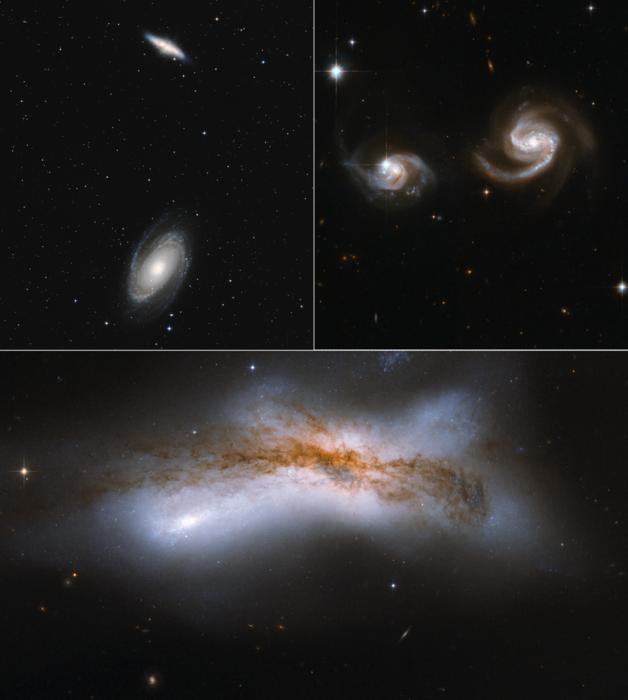
In a groundbreaking study conducted by an international team of scientists from Helsinki, Durham, and Toulouse universities, new simulations have revealed surprising insights into the future interaction between the Milky Way and Andromeda galaxies. Utilizing advanced data from NASA’s Hubble Space Telescope and the European Space Agency’s Gaia satellite, the researchers performed extensive simulations to understand the complex dynamics governing the movement of these massive galactic bodies over a 10-billion-year timeline. The findings challenge long-standing assumptions regarding their eventual fateful collision.
Currently, the Milky Way and Andromeda galaxies are careening towards each other at an astonishing speed of approximately 100 kilometers per second. Previous research had concluded that a collision was nearly inevitable within five billion years. However, with the new simulation data, the researchers discovered that there is only a 2% likelihood of a merger occurring within that same timeframe. This revelation is significant because it fundamentally alters the narrative surrounding the future of our galaxy, which has been perceived for decades as destined for a dramatic, cataclysmic encounter.
The research team conducted an impressive 100,000 simulations, taking into account a plethora of variables that influence galactic motion, including the effect of the Large Magellanic Cloud (LMC), the Milky Way’s most significant satellite galaxy. This is the first time such variables and uncertainties were incorporated in a systematic way, allowing for a more comprehensive understanding of the galaxies’ evolving trajectories. The result reveals a more nuanced interplay of gravitational forces, suggesting that the LMC’s mass, while only around 15% that of the Milky Way, exerts enough gravitational influence to alter the Milky Way’s motion, thus considerably reducing its chances of merging with Andromeda.
A remarkable aspect of the simulations shows that in over half of the analyzed scenarios, the Milky Way and Andromeda will experience at least one close encounter. However, findings indicate that a collision would likely not occur until approximately eight to ten billion years from now, beyond the lifecycle of our Sun, which will have already transitioned into a red giant stage and subsequently shed its outer layers. In many of the other simulated scenarios, the two galactic giants pass by each other at such significant distances that they can continue their independent evolution unperturbed for extended cosmic periods.
While these findings present a new outlook on the fate of the Milky Way, they also highlight the inherent uncertainties in astrophysical predictions. Dr. Till Sawala, the lead author of the study, clarified that this research does not undermine the previous works but emphasizes how incorporating more variables and advanced observational data leads to refined conclusions. This innovative approach allows scientists to explore a vast array of possibilities regarding the future cosmic scenarios, ultimately painting a more complex and less deterministic picture of galactic dynamics.
The research also echoes broader implications across the field of cosmology, as Professor Alis Deason, a co-author from Durham University, noted the research’s significance in re-evaluating what was once deemed an inevitable fate for the Milky Way. The notion of a grand merger resulting in a ‘Milkomeda’ may now be a less certain narrative, suggesting that cosmic events can often evolve in ways that were not previously anticipated.
Moreover, the ability to simulate such intricate galactic interactions illustrates the increasing sophistication of computational models in astrophysics. The findings underscore the crucial role of high-performance computing and advanced algorithms in enabling researchers to replicate and predict the behavior of vast systems of stars over billions of years. Such simulations grant critical insights into the gravitational dance between galaxies and enhance the understanding of how large-scale structures in the universe evolve.
The importance of these exploratory simulations extends beyond immediate predictions. The team plans to further build on their findings as more precise data from the Gaia space telescope becomes available. This continued exploration will refine the measurements of critical variables that contribute to galactic motion, such as the transverse motion of Andromeda—an aspect that has previously been challenging to measure directly.
As noted by Professor Carlos Frenk, a leading cosmologist at Durham University, the universe is a complex and dynamic environment where galaxies frequently collide and merge. The success of the current simulations illustrates both the power of modern physics and cutting-edge supercomputing technologies in understanding these monumental processes that govern the universe’s structure. The prospect that the Milky Way may evade a destructive merger with Andromeda provides an exhilarating shift in the understanding of our galaxy’s future.
In conclusion, the findings from this collaborative study mark a significant advancement in astrophysical research and invite further inquiry into the destiny of our galactic neighborhood. As researchers continue to dissect the vast complexities of galactic interactions, the ultimate fate of the Milky Way remains an open question, one that may further evolve with the advent of new data and technologies. This ongoing journey promises to deepen humanity’s understanding of the cosmos and our place within it over the ages.
Cite Scienmag News
Grant Pearson. (June 2, 2025). New Research Challenges Expectations of a Milky Way-Andromeda Collision. Scienmag. https://scienmag.com/new-research-challenges-expectations-of-a-milky-way-andromeda-collision/
Grant Pearson. "New Research Challenges Expectations of a Milky Way-Andromeda Collision." Scienmag, 2 June 2025, https://scienmag.com/new-research-challenges-expectations-of-a-milky-way-andromeda-collision/. Accessed 3 September 2026.
Grant Pearson. "New Research Challenges Expectations of a Milky Way-Andromeda Collision." Scienmag. June 2, 2025. https://scienmag.com/new-research-challenges-expectations-of-a-milky-way-andromeda-collision/


