


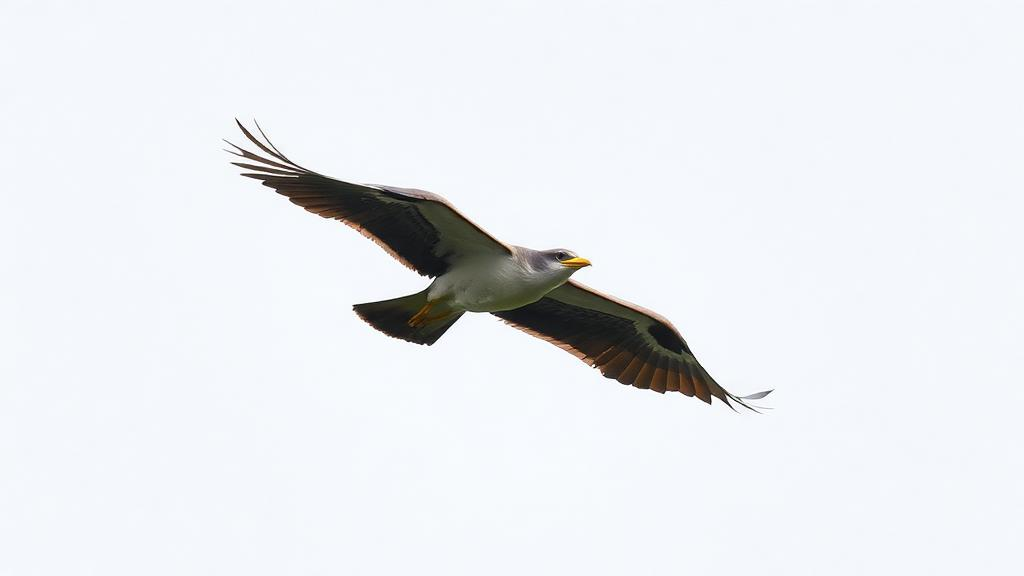
Every autumn, roughly 2.1 billion songbirds and near-passerine birds lift off from Europe and head toward Africa, crossing the Mediterranean Sea and the Sahara Desert on journeys that can span thousands of kilometres. How far any individual bird can travel on a single, non-stop flight depends on its body mass, fat reserves, muscle mass, wingspan and wing area, all of which vary enormously between species, populations, ages and sexes. A new open-source software tool called FlyingR, described in the journal SoftwareX, promises to make those calculations faster, more flexible and more reproducible than ever before, giving ornithologists a batch-processing engine for one of the most demanding computations in migration science.
The package, developed by B.K. Masinde, A. Ożarowska, G. Zaniewicz, W. Meissner and K. Bartoszek, is written in R and distributed through the Comprehensive R Archive Network under the Apache License. Its current version, 0.2.3, requires R 2.10 or later and is accompanied by a public GitHub repository, documentation and a reproducible capsule. At its core, FlyingR implements the flight range models of the late Colin James Pennycuick, the British zoologist whose aerodynamic theory of bird flight has underpinned decades of ornithological research. Crucially, it revives capabilities that were nearly lost: Pennycuick’s own Flight software, long the standard tool in the field, is no longer available along with its source code.
FlyingR offers two computational routes to estimating still-air flight range. The first is a set of equations based on the Breguet range formula, a classical approach from aeronautical engineering. The second, and the one the authors emphasise, is a time-marching simulation algorithm that computes flight distance in short intervals, stepping forward six minutes at a time until the bird runs out of fuel. The time-marching method avoids two restrictive assumptions of the Breguet approach: that the lift-to-drag ratio stays constant throughout flight, for which there is no evidence in birds, and that fat is the only fuel consumed, when migrants are known to burn protein as a supplementary energy source.
The protein question is where the model becomes genuinely sophisticated. Birds do not simply carry an engine and a fuel tank; their flight muscles are themselves partly consumable. FlyingR divides muscle mass into myofibrils, the contractile filaments that generate power, and mitochondria, the organelles that supply energy. Following Pennycuick and Battley’s celebrated 2003 concept of burning the engine, the software can withdraw protein specifically from the myofibril component as the flight proceeds, reflecting the way real birds catabolise muscle tissue to fuel fat metabolism and maintain their metabolic machinery over extreme endurance flights.
The simulation begins by describing the bird: total body mass, fat mass derived from a fat fraction, muscle mass from a muscle fraction, and the remaining airframe mass, defined as the basic structure that must carry the engine and the fuel. Thirteen constants, including fat energy density, protein energy density, mechanical conversion efficiency, air density, body drag coefficient and a protein hydration ratio, are set to default values from Pennycuick and Battley but remain fully adjustable by the user. The bird’s taxon matters too, because passerines and non-passerines have different relationships between body mass and basal metabolic rate, a distinction rooted in the classic Lasiewski and Dawson re-examination of avian metabolism.
At each six-minute interval, the bird flies at a true airspeed tied to its minimum power speed, the optimal speed that keeps muscular exertion as low as possible. Users choose between two speed management strategies: holding the true airspeed constant, or holding the ratio of true airspeed to minimum power speed constant as the bird lightens. Total mechanical power is assembled from three components, parasite power from dragging the body through the air, profile power from the wings themselves, and induced power from generating lift, and is then converted to chemical power, the rate of fuel energy consumption, via the mechanical conversion efficiency and an overhead for ventilation and circulation. The resulting U-shaped power curve is searched iteratively to find the speed that minimises power or maximises range.
Three alternative muscle burn criteria govern how protein is consumed. Under the constant muscle mass criterion, muscle stays fixed while a small, adjustable percentage of energy, five percent by default, is drawn from the airframe, with the associated water loss estimated through the protein hydration ratio. The constant specific work and constant specific power criteria instead hold the work done per wing-beat contraction, or the power produced per unit mass of contractile filaments, at their initial values, consuming just enough myofibrillar protein each interval to restore those quantities. The authors replaced the inner loop of Pennycuick’s original 1998 simulation diagram with a computationally efficient equation that solves directly for the required change in myofibrils, a change they say makes the batch processing of hundreds of birds practical.
To demonstrate the package, the team applied it to real ringing data on two long-distance migrants, the Garden Warbler and the Lesser Whitethroat, collected between 2000 and 2006 at stations along the south-eastern European flyway that funnels birds toward African winter quarters. The dataset covered four regions, the Southern Baltic, Northern Mediterranean, Eastern Mediterranean and North Eastern Africa, and included 1,044 first-year garden warblers and 848 lesser whitethroats. Fat scores were converted to fat masses using a published procedure, wingspan and wing area values came from radar-based measurements reported by Bruderer, and muscle mass was estimated with the default muscle fraction of 0.17 from the Flight programme. The resulting boxplots of flight range distributions by region reveal species-specific patterns that a single group mean would have obscured entirely.
That individual-level resolution is precisely the point. Previous software required manual, variable-by-variable entry through a graphical user interface, so most published calculations relied on mean values for a group, yielding one average flight distance with no sense of variability within a population. FlyingR’s wrapper function migrate() accepts a CSV file or an R dataset and computes ranges for every individual simultaneously, or for any subgroup defined by the researcher. Because birds routinely adjust their strategies in response to geographical barriers such as deserts, mountains and open sea, and because fuel reserves differ systematically between juveniles and adults, males and females, and early and late migrants, distributions of potential flight range carry ecological information that averages destroy.
The authors argue that these estimates will help disentangle the ecological and ecophysiological determinants of migratory behaviour, including how birds respond to changing environmental conditions, and will sharpen conservation planning by clarifying where stopover sites matter most along a flyway. Because potential flight distance is estimated from aerodynamic first principles, it also allows direct comparison of how species of very different sizes cover ground during migration, something fat scores and body condition indices cannot deliver. With the code open, versioned in git and hosted on CRAN, FlyingR turns a model that was becoming inaccessible into a living, extensible research tool, ensuring that the aerodynamics of one of nature’s greatest spectacles remain within reach of every ornithologist with a laptop and a ringing dataset.
Subject of Research: An R software package implementing aerodynamic flight range models for migratory birds
Article Title: FlyingR: An R package to analyze flight range of avian migrants
Article References: Masinde, B., Ożarowska, A., Zaniewicz, G., Meissner, W., & Bartoszek, K. (2026). FlyingR: An R package to analyze flight range of avian migrants. SoftwareX, 36, Article 103066. https://doi.org/10.1016/j.softx.2026.103066
Image Credits: AI Generated
DOI: 10.1016/j.softx.2026.103066
Keywords: bird migration, FlyingR, R package, flight range, aerodynamics, Pennycuick model, ornithology, time-marching simulation, stopover ecology, songbirds, software, ecophysiology
Cite Scienmag News
Denise Maddox. (October 2, 2026). New R package revives classic aerodynamics model to map how far migrating birds can fly non-stop. Scienmag. https://scienmag.com/new-r-package-revives-classic-aerodynamics-model-to-map-how-far-migrating-birds-can-fly-non-stop/
Denise Maddox. "New R package revives classic aerodynamics model to map how far migrating birds can fly non-stop." Scienmag, 2 October 2026, https://scienmag.com/new-r-package-revives-classic-aerodynamics-model-to-map-how-far-migrating-birds-can-fly-non-stop/. Accessed 4 October 2026.
Denise Maddox. "New R package revives classic aerodynamics model to map how far migrating birds can fly non-stop." Scienmag. October 2, 2026. https://scienmag.com/new-r-package-revives-classic-aerodynamics-model-to-map-how-far-migrating-birds-can-fly-non-stop/


