


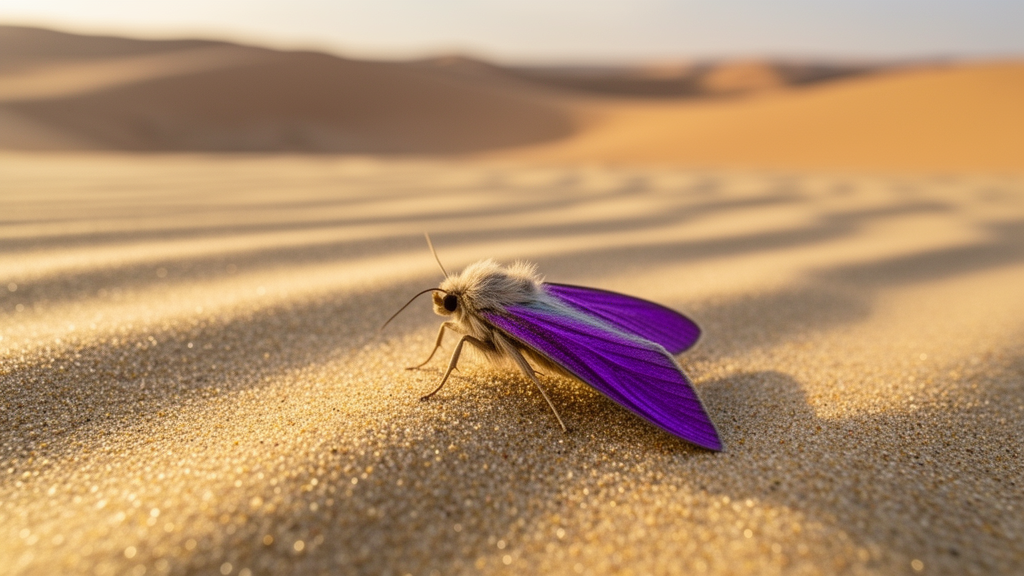
Entomologists have formally described a new species of moth, Tegostoma burtoni, discovered in the arid landscapes of Armenia. This small but strikingly colored insect belongs to the family Crambidae and the subfamily Odontiinae. The discovery highlights the ongoing potential for new species descriptions in under-studied regions of the Caucasus. The species was identified by researchers who collected specimens in the Gorovan Sands, a protected area known for its unique semi-desert ecosystem. The new moth is distinguished by its distinctive purple forewings, a feature that sets it apart from other members of the genus Tegostoma. This finding contributes to the growing body of knowledge regarding the biodiversity of the region, particularly in habitats that have historically been overlooked by major entomological surveys.
The genus Tegostoma, established by Zeller in 1847, currently comprises thirty-one recognized species according to recent taxonomic revisions. However, the classification of this genus remains a subject of ongoing debate among lepidopterists. Some researchers accept the synonymization of genera such as Anthophilodes and Anthophilopsis with Tegostoma, following the work of Amsel. Others maintain these as valid separate genera, including Aeschremon for certain species. The authors of the new description follow the systematic arrangement proposed by Nuss et al., while acknowledging that phylogenetic studies are needed to resolve these taxonomic uncertainties. The new species fits within this complex framework, adding to the diversity of the genus in the Palearctic region.
Tegostoma burtoni was collected using portable light traps equipped with ultraviolet tubes and mercury vapour bulbs. The specimens were attracted to the light in sandy habitats with sparse vegetation at an altitude of approximately 1,000 meters. The type locality, Gorovan Sands, is one of the few steppe habitats in Armenia that has not been intensively cultivated until recently. This area is characterized by sandy Artemisia semi-deserts, supporting a fauna and flora adapted to extreme drought and temperature variations. The establishment of the National Sanctuary Gorovan Sands in 1959 helped protect these unique habitats, although the area still faces pressures from grazing and the collection of plant materials.
The external appearance of the new moth is notable for its vibrant coloration. The forewings are pinkish to purplish, with a discontinuous pale postmedial fascia and a very narrow pale subterminal fascia. The hindwings are brown, darker near the margin and paler at the base. The head features a collar of yellow scales around the eyes, and the antennae are filiform with black dorsally and white ventrally. Sexual dimorphism is not pronounced, with females appearing slightly smaller and having less distinct light fasciae. The ground color varies among specimens, with some showing a more pronounced pinkish streak and others a yellowish-buff hue. This variation adds to the visual appeal of the species, making it easily recognizable in the field.
Genital morphology provides further diagnostic characters for the new species. The male genitalia feature a valva that is 1.6 times as long as it is wide, with an ovoid shape and a slightly convex dorsal margin. The aedeagus is narrow and slightly curved, with a bluntly pointed tip. The female genitalia include rectangular papillae anales and a broad, membranous ostium bursae. The ductus bursae is comparatively narrow and expands gradually into the bursa copulatrix, which is elongate and ovoid. These structural details are crucial for distinguishing T. burtoni from similar species, particularly T. lepidalis and Pyrausta gulpembe, which share some external similarities but differ in size and specific genital traits.
Molecular analysis supported the distinctiveness of the new species. DNA barcoding was performed on tissue samples from the specimens, generating sequences of the mitochondrial COI gene. The data were uploaded to the Barcode of Life Data Systems (BOLD) and analyzed using the Kimura 2-parameter model. The intraspecific average distance of the barcode region was 0.0% for the two specimens sequenced. The minimum distance to the nearest neighbor, Tegostoma lepidalis, was 3.24%, confirming the genetic separation of the new species. A neighbour-joining tree constructed from the barcode data further illustrated the phylogenetic position of T. burtoni relative to other Tegostoma species and the outgroup Pyrausta gulpembe.
The discovery of Tegostoma burtoni is named in honor of John Andrew Burton, a conservationist who has made significant contributions to the protection of natural habitats in Armenia. Burton was instrumental in establishing the Artsakh Nature Fund and ensuring that more than 30,000 hectares of unique habitats are protected within the Caucasus Wildlife Refuge. His efforts have helped preserve the biodiversity of the region, including the sandy steppe environments where the new moth was found. The naming of the species reflects the importance of conservation work in enabling scientific discovery and the protection of endangered ecosystems.
The Gorovan Sands sanctuary, where the new species was found, is the largest of its type in Armenia, covering roughly 175 hectares. The vegetation is dominated by tussocks of Artemisia fragans and other salt-resistant plants adapted to the harsh conditions. About 160 species of vascular plants have been recorded in the area, including at least 12 species listed in the Armenian Red List. The sanctuary is also the only known site in Armenia for Calligonum polygonoides, the food plant of the local endemic beetle Pharaonus caucasicus. Despite its ecological significance, the area faces threats from overgrazing, the collection of edible plants, and potential industrial activities such as sand mining. Protecting this habitat is crucial for the survival of the unique species that depend on it.
The description of Tegostoma burtoni adds to the list of Tegostoma species recorded in Armenia, which now includes T. albizonalis, T. comparalis, T. disparalis, T. lepidalis, and T. ruptilineale. The new species is endemic to Armenia, with no records from other countries. Its discovery underscores the need for continued entomological surveys in the region, particularly in protected areas that harbor unique biodiversity. The combination of morphological and molecular data provides a robust foundation for the identification and classification of the new species, contributing to the broader understanding of moth diversity in the Palearctic region.
Subject of Research: Description of a new moth species Tegostoma burtoni in Armenia
Article Title: The genus Tegostoma in Armenia, with description of a new species ( Crambidae , Odontiinae )
Article References: Šumpich, J., Karsholt, O., Savenkov, N., & Roweck, H. (2022). The genus Tegostoma in Armenia, with description of a new species (Crambidae, Odontiinae). Nota Lepidopterologica, 45, 269-278. https://doi.org/10.3897/nl.45.87795
Image Credits: AI Generated
DOI: 10.3897/nl.45.87795
Keywords: Lepidoptera, Crambidae, Tegostoma, Armenia, New Species, Biodiversity, Entomology, DNA Barcoding, Conservation, Gorovan Sands, genus, description
Cite Scienmag News
Margaret Porter. (October 18, 2026). New Purple Moth Species Discovered in Armenian Sands. Scienmag. https://scienmag.com/new-purple-moth-species-discovered-in-armenian-sands/
Margaret Porter. "New Purple Moth Species Discovered in Armenian Sands." Scienmag, 18 October 2026, https://scienmag.com/new-purple-moth-species-discovered-in-armenian-sands/. Accessed 18 October 2026.
Margaret Porter. "New Purple Moth Species Discovered in Armenian Sands." Scienmag. October 18, 2026. https://scienmag.com/new-purple-moth-species-discovered-in-armenian-sands/


