
Saturday, February 28, 2026
Science
No Result
View All Result
  • Login
  • HOME
  • SCIENCE NEWS
  • CONTACT US
  • HOME
  • SCIENCE NEWS
  • CONTACT US
No Result
View All Result
Scienmag
No Result
View All Result
Home Science News Biology

New project explores warfare in animal societies

April 11, 2024
in Biology
Reading Time: 2 mins read
0
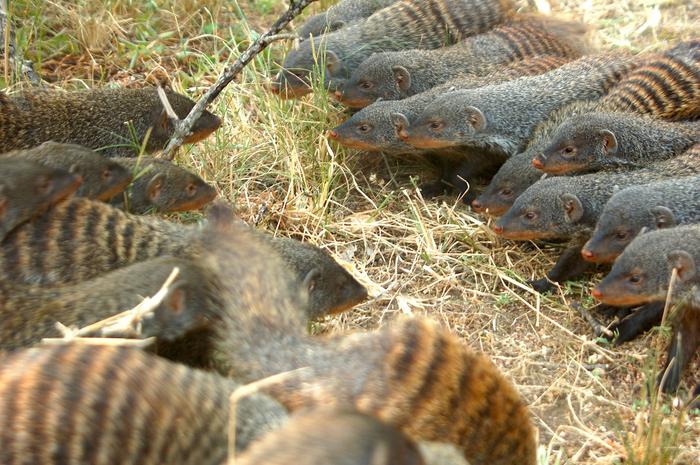
Mongoose warfare
66
SHARES
596
VIEWS
Share on FacebookShare on Twitter
ADVERTISEMENT

A major new research project will investigate how and why groups of animals from the same species fight one another.

Mongoose warfare

Credit: Harry Marshall

A major new research project will investigate how and why groups of animals from the same species fight one another.

By focussing on warlike species – mongooses and termites – researchers aim to understand how evolution can lead to extreme aggression between groups, the consequences of this and the factors that can lead to peace.

The results will help to explain why violence between rival groups evolves in some species but not others, or between some groups and not others – with implications for our understanding of human evolution.

The research team, led by Professor Michael Cant at the University of Exeter, includes the universities of Cambridge, York, Swansea and Bielefeld, Germany, and a field team based in Uganda.

Professor Cant and his team have been awarded a €3 million Advanced Grant by the European Research Council (ERC).

“An outstanding problem in evolutionary biology is to explain how cooperative groups evolve by natural selection,” said Professor Cant, from the Centre for Ecology and Conservation on Exeter’s Penryn Campus in Cornwall.

“Classic research on this question has shown that factors that operate within the group, such as kinship and reciprocity, can select for altruism.

“Yet there is now substantial evidence from humans and other social animals that conflict between groups – or warfare – can also exert a profound influence on social behaviour.

“Intergroup conflict could in principle act as a fundamental moulding force in the evolution of animal societies, shaping not just behaviour but also life history and social organisation, but this idea has not been tested.

“We will test this hypothesis through an integrated theory, field and lab study using two animal societies as model systems.

“The outcome will be a significant advance in our understanding of how social life forms and societies evolve.”

The researchers will study a wild population of banded mongooses in Uganda and a lab population of dampwood termites in Cornwall.

This project, entitled “Intergroup conflict and the evolution of animal societies”, is one of 255 included in new grants awarded by the ERC to outstanding researchers across Europe.

Iliana Ivanova, Commissioner for Innovation, Research, Culture, Education and Youth, said: “These grants will not only support leading researchers in pushing the boundaries of knowledge, but also create some 2,500 jobs for postdoctoral fellows, PhD students and other research staff across Europe.

“This investment nurtures the next generation of brilliant minds.

“I look forward to seeing the resulting breakthroughs and fresh advancements in the years ahead.”



Share26Tweet17
Previous Post

Groundbreaking treatment approach shows promise in hard-to-treat cancers

Next Post

Can we crack the code of cartilage?

Related Posts

blank
Biology

Host Factors Trump Kidney Function in Gut Microbiome

February 28, 2026
blank
Biology

Innate Immune Therapy vs Antibiotics for Cystitis

February 28, 2026
blank
Biology

HIV-Linked Gut Microbiome Drives Infection Risk

February 28, 2026
blank
Biology

AI Powers the Creation of Next-Generation Super Catalyst for Hydrogen Cars

February 28, 2026
blank
Biology

Study Finds Collagen Enhances Skin Health but Does Not Improve Physical Performance

February 28, 2026
blank
Biology

Candida auris Pump Drives Fluconazole Resistance Evolution

February 28, 2026
Next Post
Professor Jos Malda in his lab

Can we crack the code of cartilage?

  • Mothers who receive childcare support from maternal grandparents show more parental warmth, finds NTU Singapore study

    Mothers who receive childcare support from maternal grandparents show more parental warmth, finds NTU Singapore study

    27618 shares
    Share 11044 Tweet 6902
  • University of Seville Breaks 120-Year-Old Mystery, Revises a Key Einstein Concept

    1022 shares
    Share 409 Tweet 256
  • Bee body mass, pathogens and local climate influence heat tolerance

    665 shares
    Share 266 Tweet 166
  • Researchers record first-ever images and data of a shark experiencing a boat strike

    532 shares
    Share 213 Tweet 133
  • Groundbreaking Clinical Trial Reveals Lubiprostone Enhances Kidney Function

    517 shares
    Share 207 Tweet 129
Science

Embark on a thrilling journey of discovery with Scienmag.com—your ultimate source for cutting-edge breakthroughs. Immerse yourself in a world where curiosity knows no limits and tomorrow’s possibilities become today’s reality!

RECENT NEWS

  • Botulinum Toxin Causes Masseter Atrophy via Autophagy Impairment
  • Creating Effective Fall Programs for Older Adults
  • Spinal Cord Organoids Reveal Injury and Therapy Insights
  • In-Memory Wireless Neural Networks Enhance Communication

Categories

  • Agriculture
  • Anthropology
  • Archaeology
  • Athmospheric
  • Biology
  • Biotechnology
  • Blog
  • Bussines
  • Cancer
  • Chemistry
  • Climate
  • Earth Science
  • Editorial Policy
  • Marine
  • Mathematics
  • Medicine
  • Pediatry
  • Policy
  • Psychology & Psychiatry
  • Science Education
  • Social Science
  • Space
  • Technology and Engineering

Subscribe to Blog via Email

Success! An email was just sent to confirm your subscription. Please find the email now and click 'Confirm Follow' to start subscribing.

Join 5,190 other subscribers

© 2025 Scienmag - Science Magazine

Welcome Back!

Login to your account below

Forgotten Password?

Retrieve your password

Please enter your username or email address to reset your password.

Log In
No Result
View All Result
  • HOME
  • SCIENCE NEWS
  • CONTACT US

© 2025 Scienmag - Science Magazine