


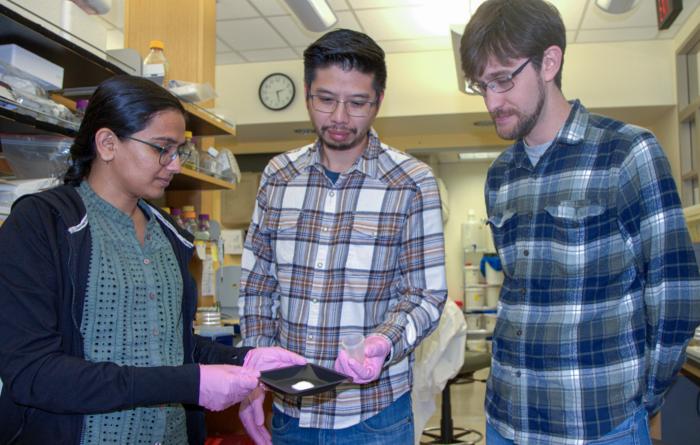
Bryan Hsu is tackling an area of research that has long been neglected – menstrual products.

Credit: Photo by Jenise Jacques for Virginia Tech.
Bryan Hsu is tackling an area of research that has long been neglected – menstrual products.
“It’s something that people don’t feel comfortable talking about, and that’s maybe an indication of why it hasn’t gotten enough attention,” said Hsu, assistant professor of biological sciences.
Matter, Hsu and his team, which includes postdoctoral associates Rogerio Bataglioli and Harsimran Kaur that led the project, have created an eco-friendly, blood absorbent biomaterial that improves the performance of menstrual products by minimizing blood leakage and spilling, while also helping prevent infection. Their work was published in the Cell Press journal.
Menstrual products have evolved little during the last century. The primary products available today were developed nearly 100 years ago: the disposable menstrual pad in 1888, the tampon in 1933, and the menstrual cup in 1937.
“Developing new products serves several purposes, including addressing women’s different needs and preferences, promoting sustainability, and addressing leakage and cost issues with current products,” said Carrie Champine, board-certified obstetrician and gynecologist who collaborated with the team.
An improvement in women’s sanitary products is beneficial to women’s health in general.
“There is very little awareness about the importance of good menstrual care, and poor practices can negatively affect women’s health. This is an area that impacts women but isn’t often given attention,” Kaur said.
Improved effectiveness
Hsu and the team used an alginate-glycerol powder formula that, when added to a traditional menstrual pad, allows the accumulated blood to turn into a gel. The pad can then absorb more blood and leak less than a traditional pad.
“A pad with the powder formula absorbs the blood, and if you squeeze it, it doesn’t come back out. But in a normal menstrual pad, if you do the same experiment, it comes right back out,” said Hsu, who is also an affiliate of the Fralin Life Sciences Institute. “Leakage occurs 1.2 times per cycle.”
When the powder formula is added to a cotton coil and inserted into a menstrual cup or disc, the blood collected there also turns into a gel, eliminating the mess when removing or changing the cup or disc.
“Leakage is a fear for all users of menstrual hygiene products. All of us have experienced it, leading to embarrassment and missed school days and workdays,” said Champine, who is also an associate dean in the Edward Via College of Osteopathic Medicine. “Users of menstrual products are always looking for products that are comfortable and tailored to their body and flow patterns, with minimal risk of leakage or menstrual product failure.”
Preventive measure
When period products are not available or sanitary period products unaffordable, women may improvise with managing menstruation. Those substitutions may cause more harm than good by increasing vaginal infections.
Included in the powder formula is an antimicrobial polymer to impair the growth of Staphylococcus aureus, a bacterium associated with toxic shock syndrome. This is a rare but potentially fatal illness caused by a bacterial infection related to the use of period products.
Test results indicate the inclusion of the polymer was effective in inhibiting bacteria, while also not decreasing the blood absorption capability of the powder formula.
Biodegradable option
Derived from natural sources, seaweed, and sugar alcohol, the alginate-glycerol powder formulation is biodegradable and safe to use.
“It’s found everywhere in foods and it’s approved by the Food and Drug Administration, so it’s considered safe,” said Hsu, an affiliated faculty member of the Center for Emerging, Zoonotic, and Arthropod-borne Pathogens. “It is in the boba tea or the cheap sushi you get in restaurants.”
Most used period products take over 500 years to biodegrade, and each woman may use up to 15,000 period products in a lifetime, according to Hsu, who also said women’s menstrual product waste is one of the most frequently collected trash.
“In talking to patients, it has become evident that they are looking for more sustainable, eco-friendly and reusable options,” Champine said.
Women’s health progress
“Women are half the population and go through menstruation every month,” Hsu said. “It’s a natural process that dramatically affects quality of life. For some, it can be debilitating.”
According to Hsu, 46 percent of women in Virginia are of menstrual age, which is 26 percent of all Virginians,as of 2020 and roughly a fourth of the state’s total population. While menstruation is not a disease, it does impact absenteeism in the workplace and in school.
“A woman will have a period for approximately five days every 30 days throughout her lifetime, which is roughly 2,200 days, or 6.2 years of her life,” Hsu said. “For comparison, the average American spends 8.3 years watching television and 4.5 years eating.”
The research is funded by Virginia’s Commonwealth Health Research Board, and Hsu sees this as just the beginning of his venture into promoting women’s health issues. Bataglioli is hopeful for new opportunities in the design of menstrual products. “Using biomaterials can expand the potential functionality of these menstrual products. Women face an array of challenges related to menstrual health, and we think using advanced functional materials can help us come up with innovative solutions.”
“I think women’s health is becoming more and more something people want to research. This is kind of my first step in a series of things to take care of women,” Hsu said.
In addition to Hsu, Bataglioli, and Kaur, biological sciences undergraduate Elizabeth Geddes and John Muller, postdoctoral associate in the Department of Entomology were involved in the project.
Article Publication Date
10-Jul-2024
Cite Scienmag News
Denise Maddox. (July 10, 2024). New period product offers progress in women’s health. Scienmag. https://scienmag.com/new-period-product-offers-progress-in-womens-health/
Denise Maddox. "New period product offers progress in women’s health." Scienmag, 10 July 2024, https://scienmag.com/new-period-product-offers-progress-in-womens-health/. Accessed 5 September 2026.
Denise Maddox. "New period product offers progress in women’s health." Scienmag. July 10, 2024. https://scienmag.com/new-period-product-offers-progress-in-womens-health/

