


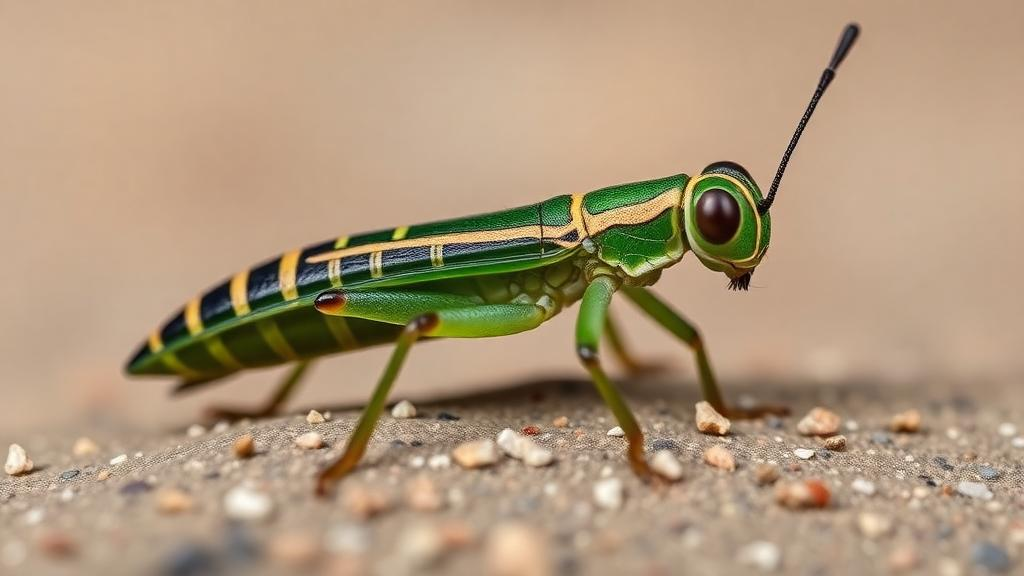
A new genus and species of pygmy groundhopper discovered in Nepal combines distinctive head and leg anatomy with a name celebrating iconic Nepali satirist Bhairav Aryal, known as the Emperor of Laughter. Researchers described Aryalidonta itishreea after a year of fieldwork near Amaldarchaur in Gorkha District, where the insects inhabit subtropical forest beside a freshwater stream, mossy footpaths and agricultural land. The animal belongs to Tetrigidae and is currently known only from its type locality and surrounding areas.
Its unusual combination of head, pronotal and leg characters distinguishes it from the recognized genera in the tribe Thoradontini. The taxonomic and ecological study followed the species from October 2021 through September 2022 in a subtropical climate zone strongly influenced by the summer monsoon. Researchers photographed and filmed adults and nymphs in their natural habitat, collected specimens by hand and measured them from calibrated macro photographs.
The type series comprises one female holotype and three paratypes—two males and one female—collected on 30 August 2022 at approximately 465 ± 10 metres above sea level. The specimens were deposited at the Annapurna Natural History Museum in Pokhara. Four additional adults, two males and two females, were maintained in a one-litre plastic container and supplied with moss and detritus so their feeding and excrement could be examined.
Several anatomical features support the new taxon’s placement in Thoradontini. Viewed from the front, the vertex, or upper surface of the head, bears u- or v-shaped carinae, while the frontal costa divides high on the compound eye. The triangular vertex narrows toward the front, the eyes lie close to the anterior margin of the pronotum, and paired lateral lobes project from the sides of the body.
The wings reach approximately the same length as the pronotum, whose dorsal surface is nodular. Yet A. itishreea did not fit the established diagnoses of Thoradonta, Loxilobus or Eucriotettix. The authors therefore established Aryalidonta as a new genus, with A. itishreea designated as its type species and the only species currently included.
The generic name combines “Aryal,” honoring the late Nepali writer and satirist Bhairav Aryal, with the Greek word “odón,” meaning “tooth,” a reference to Aryal’s iconic smile. The genus name is feminine. The specific epithet “itishree,” Latinized with the suffix “-a” as itishreea, derives from the Nepali title of one of Aryal’s books and translates as “The End.” The authors also connected it to the tragic end of Aryal’s life and to his belief that an end can be an invitation to a new beginning.
The proposed English common name, Aryal’s Ten Avatar Groundhopper, draws on another of Aryal’s works, Dash Autar, or Ten Avatars, and symbolically reflects the many color forms recorded among individual insects. Adult A. itishreea are small in body length but possess a conspicuously extended pronotum. In the reported measurements, body length was 10.75 mm for the female holotype, 8.39 and 7.97 mm for the male paratypes and 10.59 mm for the female paratype.
Pronotum length ranged from 12.06 to 16.73 mm across the four specimens. The head has oval eyes, a flat vertex with a low median carina, shallow elongated fossulae and paired ocelli positioned slightly below half the compound eye’s height. The frontal costa bifurcates in the upper quarter of eye height.
The macropronotal surface is largely flat and covered with small nodules and larger tubercles, while weakly elevated prozonal carinae converge toward the rear. The wings reach the pronotal apex, and the proximal halves of the middle femora are enlarged, especially in males. The groundhopper displays extensive variation in appearance.
Some adults are nearly uniform in color, whereas others have a contrasting anterior section of the pronotum or differently colored legs. These cryptic patterns resemble the moss, soil, algae and other surfaces occupied by the insects. Nymphs resemble adults in general form and coloration, making them relatively easy to recognize, but they are brachypronotal, lack wings and antegenicular teeth, have more strongly expressed carinae and often show more saturated colors.
Adult structure also varies: the lateral lobes are generally rectangular but may carry short lateral or caudal teeth, and sections of the vertex carinae close to the median carina can differ in development. The expanded proximal portion of the middle femur occurs in both sexes but is much more pronounced in males. The type locality is a steep, red-soil landscape where sal-dominant subtropical forest meets agricultural land.
Sal, Schima wallichii, Castanopsis indica and bamboo provide canopy cover, while ground vegetation includes Chromolaena odorata, Oplismenus undulatifolius, Urena lobata and Murraya koenigii. The Tirtire khola freshwater stream runs through the forest, and the groundhoppers were commonly found along its banks and on desire paths that developed moss and algae during the monsoon. They also occurred on stones around water and on the bunds bordering rice fields.
The population was abundant during the hot, humid period from March to September, when conditions favor moss and algal growth, before the cooler, drier months from October to February. Other pygmy grasshoppers recorded nearby included Coptotettix annandalei, Hebarditettix quadratus, Teredorus carmichaeli, Thoradonta, Criotettix and Xistra angusta. Field observations and captive feeding indicated that A. itishreea consumes moss, algae, lichens and detritus.
Adults and nymphs were photographed feeding on these materials along wet paths, stones and surfaces surrounding water. The four captive insects produced feces in the form of pear-shaped, oval or elongated pellets. The pellets contained apparent undigested plant fibers and had the appearance of mud, suggesting that detritus constitutes a major component of their diet.
The authors noted that the proportion of total plant intake represented by detritus, along with how effectively these insects digest cellulose and hemicellulose, remains uncertain. The study also documented two unusual animal associations. Small wasps were seen singly or in groups gripping the pronotum of the groundhoppers, sometimes remaining attached while the insects jumped or flew.
The wasps appeared to feed on a substance or fluid on the pronotal surface, but the material could not be resolved with a macro lens, and the insects were only tentatively assigned to the family Eulophidae. The authors could not conclusively explain the interaction. Separately, some groundhoppers on rice-field bunds were heavily covered by unidentified mites.
These infestations hindered movement, and affected insects kicked with their forelegs in an apparent attempt to dislodge the mites. Taxonomic uncertainty also remains: available molecular data for Thoradontini cover few genes and a limited sample of taxa, and the study’s placement of Aryalidonta within the tribe was based on morphology. The new genus is therefore a documented starting point for future revision rather than a final resolution of the group’s relationships.
Subject of Research: Taxonomic and ecological description of a new pygmy groundhopper genus and species from Nepal
Article Title: Aryalidonta itishreea , a new genus and species of Thoradontini ( Orthoptera , Tetrigidae ) from Nepal honors the Emperor of Laughter
Article References: Subedi, M., & Kasalo, N. (2023). Aryalidonta itishreea, a new genus and species of Thoradontini (Orthoptera, Tetrigidae) from Nepal honors the Emperor of Laughter. Journal of Orthoptera Research, 32(1), 63-80. https://doi.org/10.3897/jor.32.94918
Image Credits: AI Generated
DOI: 10.3897/jor.32.94918
Keywords: Aryalidonta itishreea, pygmy groundhopper, Tetrigidae, Thoradontini, Nepal, new species, insect taxonomy, Bhairav Aryal, subtropical forest, ecological observations, Aryalidonta, itishreea
Cite Scienmag News
Margaret Porter. (October 19, 2026). New Nepal groundhopper genus and species honor satirist Bhairav Aryal. Scienmag. https://scienmag.com/new-nepal-groundhopper-genus-and-species-honor-satirist-bhairav-aryal/
Margaret Porter. "New Nepal groundhopper genus and species honor satirist Bhairav Aryal." Scienmag, 19 October 2026, https://scienmag.com/new-nepal-groundhopper-genus-and-species-honor-satirist-bhairav-aryal/. Accessed 19 October 2026.
Margaret Porter. "New Nepal groundhopper genus and species honor satirist Bhairav Aryal." Scienmag. October 19, 2026. https://scienmag.com/new-nepal-groundhopper-genus-and-species-honor-satirist-bhairav-aryal/


