


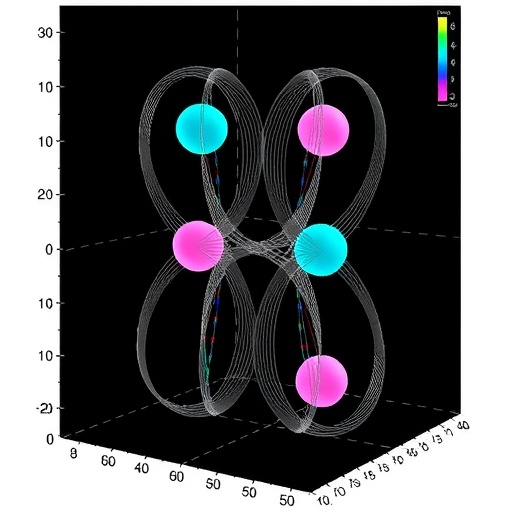
Quantum physicists have developed a new framework for understanding how entanglement can be shared—and strategically redistributed—inside a three-party quantum system. The study, published in Quantum Information Processing, examines monogamy inequalities for the entanglement of assistance in systems with the structure (2\otimes2\otimes d). In practical terms, two of the parties are quantum bits, while the third may be a quantum system of arbitrary finite dimension (d). This arrangement appears repeatedly in quantum communication, distributed computation and networked quantum devices, where information is not held by two isolated qubits but is mediated by a larger quantum environment. The work by Xue-Na Zhu, Gui Bao, Zhi-Xiang Jin, Shao-Ming Fei and Tao Li focuses on a central challenge in quantum information science: determining how much correlation can exist between different pairs of particles at the same time, and how a third party can influence that correlation through measurement and classical communication.
Entanglement is one of the most counterintuitive features of quantum mechanics. When two systems are entangled, their joint state cannot be described as two independent states, even when the systems are separated by a large distance. Yet entanglement is not an unlimited resource. The well-known idea of monogamy captures this restriction: if one quantum system is strongly entangled with another, the amount of entanglement it can independently share with a third system is constrained. The classic Coffman–Kundu–Wootters relation expresses this limitation through the squared concurrence, or tangle, for three qubits. The new research explores a more nuanced situation involving entanglement of assistance, in which a third party can perform measurements designed to help two other parties establish or increase their average entanglement. Rather than treating the third system merely as a source of unwanted noise, the study considers it an active participant capable of shaping the correlations available to the remaining pair.
The phrase “entanglement of assistance” refers to the maximum average entanglement that two parties can obtain when a third party performs an optimal measurement on its part of a shared quantum state and communicates the measurement result. A mixed state shared by two observers can often be interpreted as arising from many possible pure-state decompositions. Without information about which pure state was prepared, the observers may have access only to a limited amount of entanglement. A helper who measures a purifying system can reveal information about that decomposition and steer the two-party state into an ensemble with a larger average concurrence. This operational interpretation is particularly important for quantum networks, where intermediate nodes may assist distant users. However, the ability to increase pairwise entanglement through assistance creates a complementary question: how should the assisted correlations involving different pairs be bounded so that the description remains mathematically consistent?
The authors analyze this question specifically for (2\otimes2\otimes d) states, a setting broad enough to include a high-dimensional assisting system but structured enough to permit explicit formulas. Their discussion centers on three related quantities: concurrence, tangle and concurrence of assistance. Concurrence is a two-party entanglement measure that ranges from zero for separable states to its maximum for a maximally entangled pair of qubits. The tangle is commonly defined as the square of concurrence and is useful because its algebraic behavior allows monogamy relations to be written as inequalities involving sums of squared terms. Concurrence of assistance reverses the optimization used in ordinary concurrence: instead of selecting a decomposition that minimizes average entanglement, it seeks one that maximizes it. Distinguishing these measures is essential, because a relation that is valid for concurrence may change direction, strength or interpretation when applied to its assisted counterpart.
The study presents explicit relations connecting these measures and uses them to derive rigorous monogamy inequalities. Although the research is theoretical, its importance lies in converting abstract statements about multipartite entanglement into criteria that can be evaluated for concrete quantum states. In a three-party system, one may ask how the entanglement between the first and second qubits compares with the correlations that each can share with the (d)-dimensional subsystem. The answer depends not only on the reduced density matrices of the individual pairs but also on the structure of the full tripartite state. By expressing the constraints through concurrence-based quantities, the authors provide a route for testing whether a proposed distribution of assisted entanglement is physically achievable. These inequalities also help identify when a high-dimensional helper can genuinely enhance pairwise correlations and when the global state imposes an unavoidable ceiling.
One of the technically significant features of the work is its attention to systems in which the third subsystem is not restricted to another qubit. Many familiar monogamy formulas were first established for three-qubit states, where the Hilbert space has a particularly simple structure. Realistic quantum platforms, however, often contain systems with several energy levels, multiple modes or effective dimensions larger than two. The (d)-dimensional component in the new analysis can represent such a subsystem, allowing the framework to encompass (2\otimes2\otimes3), (2\otimes2\otimes4) and higher-dimensional configurations. Extending concurrence-related constraints into this setting is not automatic, because higher-dimensional mixed states can possess more complicated decompositions and entanglement structures. The reported formulas therefore address a useful intermediate regime: the two qubit parties retain tractable concurrence properties, while the assisting party is allowed to carry substantially richer quantum information.
The results may also clarify the tension between monogamy and what is sometimes called polygamy in quantum correlations. Ordinary monogamy says that strong direct entanglement with one partner limits direct entanglement with others. Assisted entanglement can appear to work in the opposite direction because a third party’s measurement may help multiple observers extract correlations from a shared state. These ideas are not contradictory: they refer to different optimization procedures and different operational tasks. A system can obey strict limits on unassisted pairwise entanglement while still allowing a helper to increase the average entanglement obtained after measurement. The inequalities studied by Zhu and colleagues are designed to describe this balance quantitatively. By examining concurrence, its square and the assisted version, the paper separates the intrinsic entanglement already present in reduced states from the additional structure that can be unlocked through information held by the third party.
To illustrate the proposed relations, the authors include detailed examples involving specific tripartite quantum states. Such examples are valuable because multipartite inequalities can otherwise remain difficult to interpret. They show how the formulas behave under different patterns of entanglement, including cases where the two qubits are directly correlated, cases where the third subsystem acts as an effective mediator, and situations in which assistance changes the optimal decomposition of a mixed state. The examples also provide checks on the sharpness and applicability of the derived bounds. In quantum information theory, a rigorous inequality is most useful when it can be applied without reconstructing an entire high-dimensional wave function from scratch. Concurrence-based expressions can potentially be estimated from density-matrix data or experimentally accessible observables, making the framework relevant to laboratory tests as quantum processors and communication networks become increasingly multipartite.
The implications extend beyond a single family of mathematical inequalities. Reliable accounting of entanglement is necessary for designing quantum repeaters, where intermediate stations help distribute entangled states over long distances; for measurement-based quantum computation, where measurements transform a shared resource into computational operations; and for quantum-network certification, where researchers must verify that observed correlations are genuinely quantum. A high-dimensional assisting system may be useful in these applications, but it also introduces more ways for correlations to be distributed across the network. The new framework offers theoretical tools for determining whether those correlations respect fundamental limits. It does not claim that entanglement can be created from nothing or that assistance eliminates quantum constraints. Instead, it shows how the available resource can be allocated, optimized and bounded when one participant is allowed to act as a helper. That distinction could become increasingly important as future quantum networks move beyond simple two-node links.
The authors describe their work as a study of explicit relations satisfied by concurrence, tangle and concurrence of assistance in (2\otimes2\otimes d) systems, with the resulting inequalities supported by worked examples. The paper adds to a long line of research on the distribution of quantum correlations, while addressing a specialized problem at the intersection of qubit entanglement and higher-dimensional quantum systems. Its broader message is that entanglement is not merely a property assigned to one pair of particles; it is a structured resource whose measurable strength depends on the entire multipartite state and on what operations are permitted. As quantum technologies evolve from isolated demonstrations toward interconnected devices, such accounting principles may help researchers decide which correlations can be shared, which can be recovered with assistance, and which are ruled out by the geometry of quantum mechanics itself.
Cite Scienmag News
Denise Maddox. (August 26, 2026). New Monogamy Inequalities for Entanglement of Assistance in Two-Qubit d-Dimensional Systems. Scienmag. https://scienmag.com/new-monogamy-inequalities-for-entanglement-of-assistance-in-two-qubit-d-dimensional-systems/
Denise Maddox. "New Monogamy Inequalities for Entanglement of Assistance in Two-Qubit d-Dimensional Systems." Scienmag, 26 August 2026, https://scienmag.com/new-monogamy-inequalities-for-entanglement-of-assistance-in-two-qubit-d-dimensional-systems/. Accessed 4 September 2026.
Denise Maddox. "New Monogamy Inequalities for Entanglement of Assistance in Two-Qubit d-Dimensional Systems." Scienmag. August 26, 2026. https://scienmag.com/new-monogamy-inequalities-for-entanglement-of-assistance-in-two-qubit-d-dimensional-systems/


