


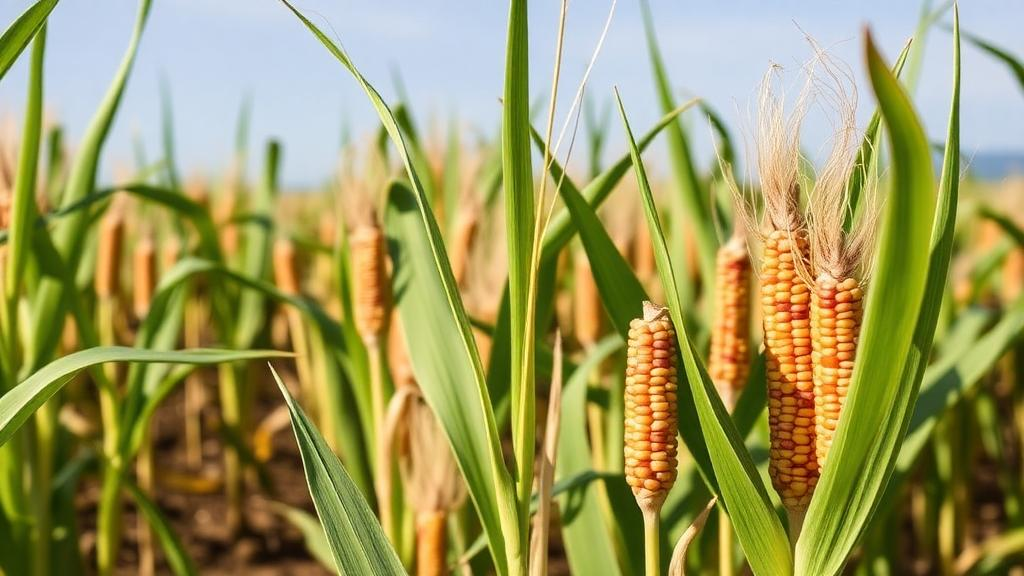
Beneath every cornfield lies an ancient partnership that scientists have struggled to measure for decades. Arbuscular mycorrhizal fungi, or AMF, thread their way into the roots of roughly ninety percent of all terrestrial plants, trading soil nutrients for plant sugars in one of evolution’s oldest and most consequential bargains. Yet despite the ubiquity of this symbiosis, farmers and researchers have lacked a practical way to answer a deceptively simple question: how much good is the fungus actually doing? A new study published in Discover Ecology by Mohsen Jahan and Mehdi Nassiri-Mahallati of Ferdowsi University of Mashhad in Iran offers a striking answer, using a blend of field measurements, factor analysis and structural equation modeling to quantify, for the first time, the eco-physiological contribution of mycorrhizal fungi to a growing maize crop.
The conventional method for assessing mycorrhizal colonization, known as the gridline intersect method, has remained the standard for decades. It requires fixing, dyeing and microscopically examining host plant roots to determine the percentage of root length containing fungal structures such as mycelia, vesicles and arbuscules. The approach is not only time-consuming, laborious and costly, but also prone to error, since staining can color root cortex vessels in ways that mimic false mycorrhizal structures. More fundamentally, the method cannot distinguish between natural, neutral and even parasitic symbiotic relationships, and it ignores entirely the question of fungal effectiveness, that is, whether the colonization actually improves the plant’s performance. Earlier attempts to find alternatives, including the magnified intersections method and the detection of mycorrhiza-specific isozymes, improved objectivity but still fell short of quantifying the functional benefits of the partnership.
The new approach flips the problem on its head. Rather than counting fungal organs inside roots, Jahan and Nassiri-Mahallati measured the eco-physiological consequences of symbiosis in the plant itself. Their reasoning was straightforward: if the fungus genuinely benefits its host, that benefit should reveal itself in improved growth, better resource capture and higher yield. By measuring a comprehensive suite of plant and soil traits in inoculated and non-inoculated maize, and then applying mathematical modeling to the resulting data, the researchers could trace exactly which plant functions the fungi enhanced and by how much. This multidisciplinary framework draws together plant ecophysiology, soil ecology, multivariate statistics and mathematical modeling into a single analytical pipeline that goes beyond observation to causal understanding.
The evidence base came from two years of field experiments conducted at the research farm of Ferdowsi University of Mashhad, in the semi-arid Kashaf River watershed of northeastern Iran, where mean annual precipitation is just 252 millimeters. The experiments followed a split-plot arrangement within a randomized complete block design with three replications, spanning four different cropping systems ranging from high-input to ecological management. Maize seeds of the single cross 704 cultivar were coated with powdered inoculum containing propagules of two fungal species, Rhizophagus intraradices and Funneliformis mosseae, at a concentration of one million colony-forming units per gram, while control seeds were left uninoculated. The team then measured everything from leaf area index, dry matter yield and seed yield to maximum photosynthesis rate, leaf chlorophyll content via SPAD readings, canopy temperature, plant phosphorus content, specific root length, soil respiration and the chlorophyll fluorescence ratio Fv/Fm.
Analysis of variance confirmed that mycorrhizal inoculation significantly affected nearly every trait measured, with mycorrhizal plants showing significantly higher values than their non-mycorrhizal counterparts for maximum photosynthesis rate, leaf area index, dry matter, seed yield, plant height, stem diameter, soil respiration, specific root length, root colonization, SPAD readings and plant phosphorus. But the real innovation lay in what came next. Confirmatory factor analysis divided the fourteen measured variables into two coherent groups, which the researchers named on eco-physiological grounds. The first factor, containing leaf area index, SPAD readings, dry matter, root colonization and stem diameter, was labeled the resource capture construct. The second, comprising specific root length, plant height, maximum photosynthesis rate, canopy temperature, cob number, seed yield, plant phosphorus, soil respiration and Fv/Fm, was named the resource utilization construct. The reliability of both constructs was confirmed by Cronbach’s Alpha values of 0.77 and 0.74 respectively, exceeding the conventional threshold of 0.70.
With the two latent constructs established, the team employed structural equation modeling, a statistical technique that tests networks of hypothesized causal relationships against observed covariance patterns. SEM has grown increasingly popular in ecology since 2000 precisely because it can partition direct and indirect effects along multiple pathways, something regression and analysis of covariance cannot achieve when the goal is understanding biological mechanisms. The fitted model proposed a causal path running from resource capture to resource utilization, with the capture construct driving the utilization construct and both jointly shaping final yield. The model’s goodness of fit was assessed through several indices: a normalized chi-square of 2.33, comfortably within the accepted range of one to three, and a coefficient of determination of R squared equal to 0.37, which by the classification standards of Hair and colleagues falls within the good range of 0.25 to 0.50.
That R squared value carries the study’s headline finding: thirty-seven percent of the total variance in maize performance can be explained by resource capture and utilization through the mycorrhizal collaboration. In other words, the direct advantages of AMF symbiosis, quantified through the eco-physiological machinery of the plant, account for a substantial and now measurable share of what makes an inoculated crop thrive. The standardized path coefficients revealed which traits mattered most. Leaf area index showed a direct effect of 0.888 on the resource capture construct, meaning that a one standard deviation increase in capture translates into a 0.888 standard deviation increase in leaf area. Dry matter showed a squared multiple correlation of 0.718 with resource utilization, indicating that the construct explains nearly seventy-two percent of dry matter variation. Stem diameter ranked highest after leaf area and dry matter at 0.707, reflecting its role in the vascular transport of assimilates between sources and sinks.
The placement of root colonization and SPAD readings within the resource capture construct proved particularly telling. From an eco-physiological standpoint, mycorrhizal colonization of roots increased leaf chlorophyll content, which in turn plays an essential role in capturing and utilizing radiation in the photosynthetic system. Plant height correlated strongly with specific root length, canopy temperature and leaf area index, defining the canopy architecture that governs how efficiently a crop intercepts sunlight. The analysis also showed that the effect of AMF on yield was largely indirect, mediated through increases in leaf area and plant height rather than acting directly on yield itself. Meanwhile, the negative effect of resource utilization on specific root length, a coefficient of minus 0.534, is consistent with a well-known trade-off: when fungal hyphae effectively extend the root’s absorption network, the plant can afford to invest less in its own root length per unit of soil volume.
The practical implications extend well beyond maize. Because the method relies on farm-measured traits rather than laboratory microscopy, it can in principle be applied to most crop plants, with results varying by plant species, fungal species and environmental conditions. The authors suggest that identifying the plant characteristics involved in symbiosis makes it possible to manage and strengthen them, improving final performance. As an agroecological management tool, for example, farmers could synchronize the timing of maximum leaf area index with the long sunny days of summer by adjusting planting density, planting date, irrigation and fertilization, thereby maximizing the efficiency of the photosynthetic system when radiation capture is at its peak. The approach could also help quantify the effects of inputs and treatments on yield formation across different cropping systems, since structural equation modeling works on correlation and variance-covariance matrices that can pool data across management regimes.
The study does carry caveats. The experiments evaluated the effect of two exogenous fungal species on the plant, not the entire indigenous AMF community in the soil, and native fungi could not be eliminated from the field, so the reported functions rest on exogenous measurements alone. The RMSEA value of 0.169, while above the commonly cited cut-off of 0.06, is considered mediocre in models with small samples and few variables, where the index tends to inflate; the authors note that chi-square provides a sufficient measure of model accuracy in such cases. Still, the broader vision is ambitious: a fast, reliable and low-cost method to identify causal paths and quantify symbiotic efficacy, giving farmers, advisors, researchers and policymakers a practical foundation for deploying mycorrhizal technology across agroecosystems. At a time when phosphorus fertilizers face supply restrictions, rapid fixation in soils, high costs and pollution concerns, a tool that measures exactly what fungi contribute to crop productivity, while pointing the way to reduced inputs, cost and labor, may prove one of the more quietly revolutionary developments in sustainable agriculture.
Subject of Research: Quantifying the eco-physiological benefits of arbuscular mycorrhizal fungal symbiosis with maize using structural equation modeling
Article Title: Discovering and quantifying the eco-physiological advantages of plant-soil-Arbuscular Mycorrhizal Fungi (AMF) system: a promising eco-math-statistical modelling approach
Article References: Jahan, M., & Nassiri-Mahallati, M. (2025). Discovering and quantifying the eco-physiological advantages of plant-soil-Arbuscular Mycorrhizal Fungi (AMF) system: a promising eco-math-statistical modelling approach. Discover Ecology, 1(1), Article 2. https://doi.org/10.1007/s44396-025-00001-0
Image Credits: AI Generated
DOI: 10.1007/s44396-025-00001-0
Keywords: arbuscular mycorrhizal fungi, maize, symbiosis, structural equation modeling, eco-physiology, resource capture, resource utilization, sustainable agriculture, soil ecology, phosphorus uptake, crop yield, agroecology
Cite Scienmag News
Alan Morgan. (October 2, 2026). New Model Puts a Number on How Much Mycorrhizal Fungi Help Maize Grow. Scienmag. https://scienmag.com/new-model-puts-a-number-on-how-much-mycorrhizal-fungi-help-maize-grow/
Alan Morgan. "New Model Puts a Number on How Much Mycorrhizal Fungi Help Maize Grow." Scienmag, 2 October 2026, https://scienmag.com/new-model-puts-a-number-on-how-much-mycorrhizal-fungi-help-maize-grow/. Accessed 4 October 2026.
Alan Morgan. "New Model Puts a Number on How Much Mycorrhizal Fungi Help Maize Grow." Scienmag. October 2, 2026. https://scienmag.com/new-model-puts-a-number-on-how-much-mycorrhizal-fungi-help-maize-grow/


