


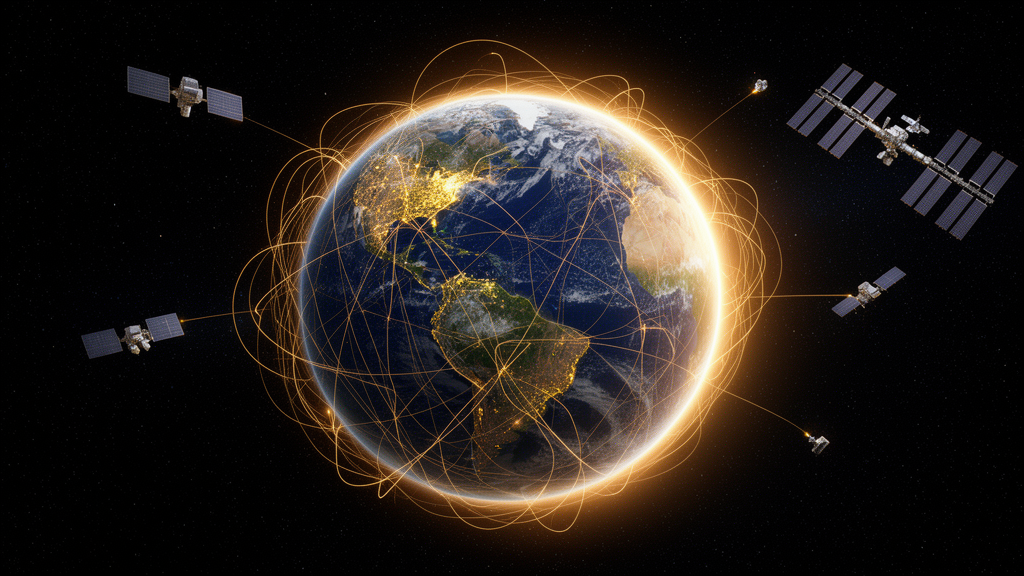
For more than half a century, scientists have modeled humanity’s future on Earth as a closed system. From the Club of Rome’s landmark 1972 report The Limits to Growth to modern integrated assessment models, the planet has been treated as a bounded domain—finite resources, finite atmosphere, finite room to expand. Now, a team of researchers spanning psychology, physics, systems engineering, and space policy argues that this framing may no longer be sufficient. In a perspective article published in Frontiers in Space Technologies, Annahita Nezami of Birkbeck College, University of London, together with Frank White, David Peterson, Greg Barr, Stanley Rosen, Ian A. Crawford, Kevin Russell, and Elisa R. Ferre, proposes a multi-level system dynamics architecture that treats Earth and space as a single coupled socioecological system. The work arrives at a moment when converging pressures—climate change, environmental degradation, urbanization, and resource constraints—are colliding with rapidly advancing capabilities in launch systems, robotics, and orbital infrastructure.
The central premise is deceptively simple but technically consequential: system boundaries are analytical constructs, not fixed physical realities. As technologies, interaction patterns, and forms of environmental modification evolve, the effective boundary of the human system can shift. The authors define Large-Scale Space Migration, or LSSM, as a system-level process involving the redistribution of populations, resources, and infrastructure across terrestrial and off-world environments within the solar system. Rather than treating space settlement as a collection of separate engineering projects, the framework models it as an interconnected dynamic—one in which feedback loops, delays, accumulations, and nonlinear behavior span both planetary and extraterrestrial domains. This reframing matters because established modeling traditions, from the World3 model to space logistics frameworks, have each addressed relevant components of this picture but rarely integrated material, institutional, and psychosocial feedbacks within a single architecture.
The proposed architecture is organized across three interacting analytical levels. Level I represents material and infrastructure dynamics: population growth and migration, resource systems, environmental processes, economic activity, space infrastructure, and the flows of materials, energy, and information between Earth and off-world environments. Level II represents governance and institutional dynamics, capturing how institutions shape coordination, regulation, and resource allocation, and how trade-offs among liberty, equality, and security play out across emerging Earth-space arrangements. Level III represents psychological and social dynamics, using aggregate variables such as perceived system security, institutional legitimacy, and social cohesion to model how individuals and groups adapt collectively to constrained and increasingly complex conditions. These levels are linked through recursive feedbacks rather than one-directional causation—material conditions shape governance requirements, governance arrangements shape perceptions of fairness and safety, and those perceptions in turn feed back into cooperation, compliance, and support for alternative institutional arrangements.
At present, only the Level I material and infrastructure layer has been developed as an operational prototype. The Human Space Program collaborated with Ventana Systems to build an initial LSSM model using Vensim system dynamics software, a platform chosen for its ability to represent stocks, flows, feedback loops, delays, and nonlinear relationships over long time horizons. The prototype adapts the core World3 subsystems—population, resources, environmental pressure, industrial activity—into an Earth-space architecture. Scenario domains include orbital and free-space habitats, Lagrange-point communities, lunar and Martian surface settlements, in-situ resource utilization sites, and asteroid-resource systems. The model can explore alternative settlement-capacity scenarios, including off-world population scales of 1 million, 10 million, or 1 billion people, subject to assumptions about infrastructure capacity, resource availability, energy systems, transport costs, and technological capability. Level II and Level III remain proposed extensions requiring further operationalization, parameterization, and validation.
One technically notable feature of the Level I prototype is its treatment of energy and environmental feedbacks across both domains. The model allows Earth-system dynamics to be considered in relation to climate processes, the carbon cycle, greenhouse gases, solar radiation, population trajectories, energy technologies, and economic growth. In long-term high-energy scenarios, human energy use may contribute directly to waste heat, including from energy sources that do not emit carbon. This makes off-world energy production, industrial activity, and resource use relevant scenario variables for examining whether Earth-space development reduces, displaces, or intensifies environmental pressures over the long term. The prototype also includes an economic subsystem capturing how launch costs, transportation efficiency, infrastructure investment, industrial capacity, energy production, in-situ resource utilization capacity, resource extraction viability, off-world manufacturing, trade, and value-added activity may shape Earth-space system development through stocks such as capital, industrial capacity, and infrastructure capacity, and flows such as investment, production, resource exports, and transport-cost reduction.
The Level II governance layer addresses a domain that existing international space law frameworks were never designed to handle. Those frameworks emerged when space activity was largely limited to scientific missions and satellite operations, providing limited guidance for large-scale permanent settlements, commercial resource extraction, or increasingly interconnected Earth-space systems. The authors warn that, in the absence of stronger governance arrangements, future space activities could become a source of competition and conflict. Within the framework, governance dimensions are represented initially as ordinal scenario states—low, medium, and high—before being mapped onto measurable proxy variables. Liberty could be approximated through a regulatory burden index or the proportion of decisions made locally rather than centrally; equality through a Gini coefficient or per capita resource allocation; and security through an infrastructure redundancy index, life-support failure rates, or conflict incidence. Trade-offs among these dimensions could later be represented through weighted indices, constraint functions, or thresholds, allowing changes in one dimension to be tested against possible effects on institutional legitimacy and social cohesion.
The Level III psychological and social layer draws on spaceflight human factors research, isolated and confined environment studies, and established psychological theory. The selection of perceived system security, institutional legitimacy, and social cohesion as aggregate variables is informed by Social Identity Theory, which links group identification to cooperation; Self-Determination Theory, which emphasizes autonomy, competence, and relatedness as conditions for motivation; Conservation of Resources Theory, which frames stress and coping in relation to perceived resource threat; and legitimacy theory, which connects perceived fairness to compliance and cooperation. These variables are not intended to capture the full complexity of human psychology but serve as system-level proxies for social adaptation and collective response, operating at the interface between individual perception, group coordination, and system-level behavior.
Cross-level integration is where the framework’s most interesting dynamics emerge. The authors treat complexity, constraint, and Earth-space interdependence as cross-cutting scenario conditions that can be varied using ordinal states. Outcome dimensions such as sustainability, resilience, system stability, adaptive capacity, human wellbeing, and institutional resilience are conceptualized as possible emergent properties rather than predefined goals. These dimensions may increase or decrease, stabilize or destabilize, and converge or diverge across alternative Earth-space trajectories. The framework is explicitly designed to support scenario analysis, hypothesis generation, and staged model development rather than prediction—a deliberate methodological stance reflecting the substantial parameter uncertainty involved in modeling a hypothetical systems scenario with unknown future technologies, launch economics, life-support closure, radiation mitigation, and governance evolution.
Future validation would require a combination of structural, behavioral, and stress-test approaches. Structural validation would compare model boundaries, stocks, flows, and feedback assumptions with World3, NASA architecture studies, and relevant space logistics models. Behavioral calibration could draw on isolated, confined, and extreme-environment analogs including Antarctica, the Hawai’i Space Exploration Analog and Simulation, Mars500, and NASA Extreme Environment Mission Operations. Historical stress testing could use the coronavirus pandemic, the Fukushima Daiichi nuclear accident, and supply-chain crises to examine infrastructure dependency, resource constraint, institutional response, and social coordination under conditions of complexity and interdependence. These comparisons would not validate LSSM directly but would test whether component relationships and feedback assumptions behave plausibly.
The framework’s relevance extends beyond large-scale settlement scenarios. Developments in cislunar space, low Earth orbit, and in-space economic activity already present governance, coordination, infrastructure, and sustainability challenges. Modeling LSSM provides a structured way to examine how linked Earth-space systems may adapt, fail to adapt, or reproduce unsustainable growth dynamics under increasing complexity, constraint, and interdependence, while identifying feedbacks that could shape future resilience or instability. The authors caution that the work should proceed cautiously through staged and modular expansion, beginning with further refinement of the Level I prototype before incorporating selected Level II and Level III variables. It should not be understood as predicting future civilizations or social forms. Instead, alternative pathways can be examined through scenario design, sensitivity testing, and model structures representing different assumptions about technological change, governance evolution, resource availability, off-world autonomy, and Earth-space interdependence—potentially revealing threshold effects, path dependence, or transitions between alternative system states as humanity’s footprint extends beyond a single planet.
Subject of Research: A multi-level conceptual system dynamics architecture for examining sustainability and resilience in coupled earth–space systems
Article Title: A multi-level conceptual system dynamics architecture for examining sustainability and resilience in coupled earth–space systems
Article References: Nezami, A., White, F., Peterson, D., Barr, G., Rosen, S., Crawford, I. A., Russell, K., & Ferre, E. R. (2026). A multi-level conceptual system dynamics architecture for examining sustainability and resilience in coupled earth–space systems. Frontiers in Space Technologies, 7, Article 1876220. https://doi.org/10.3389/frspt.2026.1876220
Image Credits: AI Generated
DOI: 10.3389/frspt.2026.1876220
Keywords: system dynamics, space migration, sustainability, resilience, Earth-space systems, governance, space economy, modeling, multi-level, conceptual, system, dynamics
Cite Scienmag News
Sloane Callahan. (October 16, 2026). New Model Maps Earth and Space as One Interconnected Civilization System. Scienmag. https://scienmag.com/new-model-maps-earth-and-space-as-one-interconnected-civilization-system/
Sloane Callahan. "New Model Maps Earth and Space as One Interconnected Civilization System." Scienmag, 16 October 2026, https://scienmag.com/new-model-maps-earth-and-space-as-one-interconnected-civilization-system/. Accessed 16 October 2026.
Sloane Callahan. "New Model Maps Earth and Space as One Interconnected Civilization System." Scienmag. October 16, 2026. https://scienmag.com/new-model-maps-earth-and-space-as-one-interconnected-civilization-system/


