


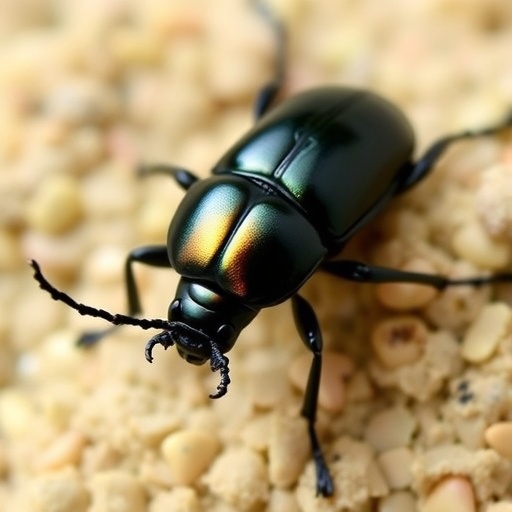
The Japanese rhinoceros beetle, Trypoxylus dichotomus, has long fascinated entomologists and evolutionary biologists due to its remarkable size and the prominent horn exhibited by males. This horn is not just a striking morphological feature but a dynamic model for understanding developmental biology, sexual selection, and evolutionary innovation. A multidisciplinary research team led by Professor Teruyuki Niimi at the National Institute for Basic Biology (NIBB) has recently made a groundbreaking advance in the molecular study of this beetle by developing a novel gene functional analysis method utilizing electroporation in Trypoxylus dichotomus larvae.
This pioneering approach represents a significant leap forward for developmental genetics in non-model insects. Unlike traditional techniques such as RNA interference (RNAi), which Professor Niimi’s team has previously employed, electroporation enables localized manipulation of gene expression within specific tissues or body regions. This spatial precision opens new doors to unraveling the genetic orchestration behind the intricate formation of the beetle’s horn, a process still enigmatic despite intensive study.
Electroporation is a technique that transiently permeabilizes cell membranes using electric pulses, allowing exogenous molecules like plasmid DNA or RNA to be introduced into cells. Despite its widespread usage in other model organisms, adapting this method for Trypoxylus dichotomus larvae involved overcoming substantial technical challenges, including optimizing the electrical parameters to ensure cell viability and efficient gene delivery while minimizing tissue damage.
In their latest publication in Scientific Reports, Professor Niimi’s group detailed their successful establishment of electroporation-mediated transfection using a plasmid encoding Green Fluorescent Protein (GFP) as a reporter. Upon electroporation, they observed robust and localized green fluorescence precisely at the site of DNA introduction, confirming effective gene transfer into larval tissues. This critical proof-of-concept highlights the method’s potential for dissecting spatial and temporal gene function during beetle development.
The Japanese rhinoceros beetle provides an exceptional platform for studying sexually dimorphic traits because the male horn is a highly exaggerated secondary sexual characteristic that develops from imaginal discs during larval and pupal stages. The genetic pathways regulating this horn formation intersect with hormonal signals, morphogen gradients, and epigenetic modifications. By employing electroporation to manipulate gene activity in targeted horn primordium cells, researchers can directly interrogate these complex regulatory networks in vivo.
Furthermore, this technique surpasses previous approaches that often relied on systemic gene knockdowns or germline transformations, which lack regional specificity and have limited temporal control. Electroporation enables rapid and flexible functional assays, accelerating hypothesis testing about candidate genes identified via genome sequencing and transcriptomic analyses. This capacity to perform localized gain- or loss-of-function experiments promises to deepen our mechanistic understanding of horn morphogenesis and its evolutionary diversification.
Professor Niimi emphasized that this method could be adapted to study other novel insect traits beyond the horn, thus expanding its applications within evolutionary developmental biology (evo-devo). As many insects with extraordinary morphological features lack established genetic tools, electroporation-mediated gene functional analysis presents a versatile and accessible platform for probing gene function in diverse taxa.
The success of this electroporation protocol was underpinned by the comprehensive genomic resources that the Niimi laboratory had already established. Having decoded the entire genome of Trypoxylus dichotomus, they possessed an extensive repository of genetic sequences to design precise plasmid constructs and RNA molecules for targeted gene manipulation. This integrative genomic and experimental framework exemplifies the contemporary approach to functional genomics in emerging model systems.
Notably, the electroporation method described is an “in vivo” technique, meaning it can be performed directly on living larval specimens without the need to establish transgenic lines, which is laborious and time-consuming in beetles. This feature accelerates experimental throughput and enhances the capacity for fine-scale developmental analysis during critical time windows of horn growth.
From a broader biological perspective, understanding the genetic control of horn development in Trypoxylus dichotomus provides insights into the evolution of exaggerated traits governed by sexual selection, a central question in evolutionary biology. Such knowledge contributes to deciphering the molecular drivers behind biodiversity and species adaptation.
The groundbreaking nature of this electroporation approach lies not only in its technical innovation but also in the fundamental biological questions it can address. By delivering plasmid DNA or RNA into specific larval tissues, researchers can modulate gene expression patterns dynamically, illuminating the role of developmental genes, signaling pathways, and gene-environment interactions that sculpt the rhinoceros beetle’s signature horn.
As researchers continue refining the electroporation parameters and expanding the range of genetic constructs introduced, this technique is poised to become a cornerstone of functional genetics in coleopteran insects. Consequently, it opens avenues for comparative studies with other beetle species and arthropods, facilitating a better grasp of how complex traits arise and diversify.
In conclusion, the work led by Professor Teruyuki Niimi and his team at NIBB, published in Scientific Reports, marks a major advance in entomological genetic methodologies. Their electroporation-mediated gene function analysis method in the giant Japanese rhinoceros beetle heralds a transformative tool for developmental and evolutionary biology, with implications reaching far beyond the horn itself. This innovation not only propels Trypoxylus dichotomus to the forefront of insect genetics research but also sets a new standard for functional gene analysis in emerging model organisms.
Cite Scienmag News
Juliet Wilcox. (August 8, 2025). New Method Developed for Analyzing Gene Function in Japanese Rhinoceros Beetles Using Electroporation. Scienmag. https://scienmag.com/new-method-developed-for-analyzing-gene-function-in-japanese-rhinoceros-beetles-using-electroporation/
Juliet Wilcox. "New Method Developed for Analyzing Gene Function in Japanese Rhinoceros Beetles Using Electroporation." Scienmag, 8 August 2025, https://scienmag.com/new-method-developed-for-analyzing-gene-function-in-japanese-rhinoceros-beetles-using-electroporation/. Accessed 4 September 2026.
Juliet Wilcox. "New Method Developed for Analyzing Gene Function in Japanese Rhinoceros Beetles Using Electroporation." Scienmag. August 8, 2025. https://scienmag.com/new-method-developed-for-analyzing-gene-function-in-japanese-rhinoceros-beetles-using-electroporation/


