

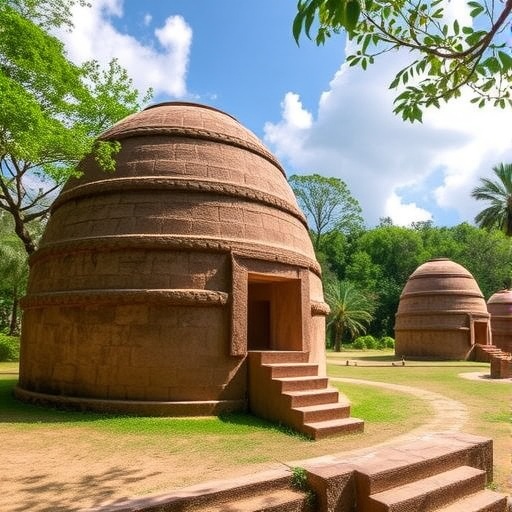
In a significant stride towards understanding the ancient civilizations of Southeast Asia, a recent fieldwork report highlights groundbreaking findings of megalithic jar sites in the Lao People’s Democratic Republic. Conducted by a dedicated team of researchers, including Skopal, Bounxaythip, and O’Reilly, this study provides invaluable insights into the cultural and historical contexts of these enigmatic structures. The report sheds light on the megalithic jar sites that have received limited scholarly attention until now, marking a pivotal moment in the field of Asian archaeology.
The megalithic jar sites, often shrouded in mystery, were initially believed to be remnants of ancient burial practices. However, the recent exploration reveals a complexity that transcends burial customs. The jars, made of stone and varying in size, display considerable craftsmanship, suggesting a sophisticated understanding of stonework by the people who created them. The researchers aimed to document these sites comprehensively, utilizing both field observations and technological advancements in archaeology.
The sites themselves are characterized by clusters of jars, some reaching heights of up to three meters. The dimensions and shapes of the jars vary significantly, which raises important questions about their functions and the cultures that produced them. Some jars feature broad, circular openings, while others are more elongated, indicating diverse uses or possibly symbolic meanings. Through a meticulous analysis of these variations, researchers hope to gain a clearer understanding of the societies that inhabited this region.
One of the most intriguing aspects of the research involves the geographic distribution of these jars across Laos. The team conducted extensive surveys across different provinces, mapping the locations of the jars and establishing potential connections between sites. This geographic analysis not only provides insights into the movement of people and goods during ancient times but also reveals how intertwined the societies were in terms of trade, cultural exchange, and social interactions. Such interdisciplinary studies will likely inspire future research endeavors aimed at uncovering more about the Forgotten Era of Southeast Asia.
Moreover, the team employed cutting-edge technology to aid in the documentation and study of these megalithic sites. The use of aerial photography, LiDAR scanning, and 3D modeling has allowed researchers to gather data that would be otherwise unattainable. These techniques enabled them to create precise topographical maps of the landscape, thereby enhancing their ability to interpret the spatial relationships of the jars and associated archaeological features. Such methodologies represent a shift towards a more technological approach in the field of archaeology, bringing forth new possibilities for exploration and discovery.
Throughout their investigation, the researchers also focused on the environmental context surrounding the jar sites. Insights garnered from palynology, which studies pollen grains, provide important clues about the ancient climate and the flora that existed during the time of the jars’ use. By analyzing sediment samples surrounding the jars, they aim to reconstruct the ecological conditions of the past. Understanding the natural environment plays a crucial role in contextualizing human activity and the usage patterns of these monumental structures.
In addition to their environmental analysis, the research team took a closer look at the cultural implications of the jars. Interviews with local communities provided a depth of perspective on how these historical artifacts are perceived today. Many locals hold these sites as sacred, associating them with ancestral practices and regional folklore. This cultural engagement illustrates a continuity of tradition, offering a modern lens through which to view the significance of the jars in the eyes of their descendants.
The complexity of the findings suggests that the megalithic culture spread across the region with various influences and interactions, giving rise to a rich tapestry of traditions. Analysis of artifacts found in proximity to the jars has led to discussions about the potential reliance on different resources, such as agriculture and trade, that would have supported large populations capable of undertaking such monumental construction projects.
The report also emphasizes the importance of interdisciplinary collaboration among archaeologists, historians, and local communities. The involvement of local experts not only aids in the authentication and preservation of these sites but also fosters a sense of pride and ownership among the inhabitants. Engaging communities in archaeological practices has shown to yield beneficial results, enhancing the narrative surrounding these ancient structures and their significance in contemporary society.
Furthermore, the findings from this study hold implications beyond academic circles. They herald opportunities for promoting sustainable tourism in the region. The megalithic jar sites can serve as tourist attractions, promoting public interest in Laos’ rich heritage while simultaneously contributing to community development. However, care must be taken to minimize the impact of tourism on these irreplaceable sites, ensuring that they are preserved for future generations.
The research sheds light on broader themes of globalization and cultural exchange in ancient times. The interaction among different cultures, evident from the artifacts found at the jar sites, invites a re-evaluation of historical narratives that often depict civilizations as isolated. Instead, this interconnectedness highlights the dynamic nature of cultures, where ideas, goods, and technological innovations were shared across distances, leading to a flourishing of creativity and craftsmanship.
In conclusion, the report on the megalithic jars of Laos opens a fascinating window into an ancient world that has long remained elusive. By unraveling the intricacies of these sites, Skopal, Bounxaythip, O’Reilly, and their colleagues are not only preserving a vital piece of Southeast Asian heritage but are also propelling forward our understanding of the ancient societies that inhabited the region. Their work exemplifies a blend of archaeological rigor, technological advancement, and community involvement, serving as a model for future research in the field. The implications of these findings extend well beyond academia, offering pathways for cultural appreciation, heritage management, and understanding human history in all its complexity.
Subject of Research: Newly discovered megalithic jar sites in Laos.
Article Title: A field work report on newly discovered and documented megalithic jar sites in the Lao People’s Democratic Republic.
Article References:
Skopal, N., Bounxaythip, S., O’Reilly, D. et al. A field work report on newly discovered and documented megalithic jar sites in the Lao People’s Democratic Republic.
asian archaeol 7, 221–233 (2023). https://doi.org/10.1007/s41826-023-00071-7
Image Credits: AI Generated
DOI: 10.1007/s41826-023-00071-7
Keywords: Megalithic jars, archaeology, Southeast Asia, cultural heritage, interdisciplinary research, Laos.


