


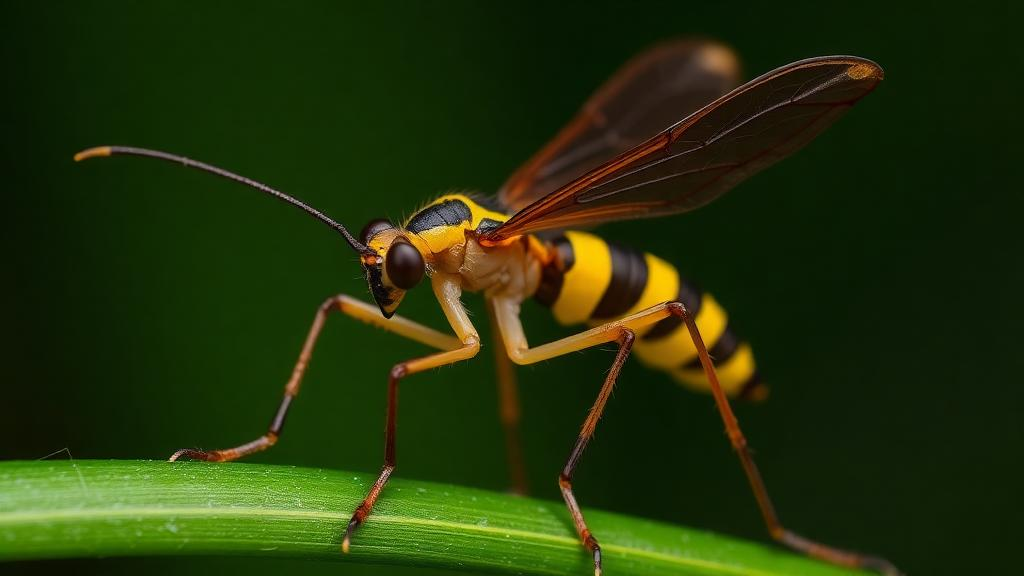
Deep in the forests of Vietnam, a small predator with raptorial forelegs and a wasp-like swagger has been hiding in museum drawers for more than a decade. Scientists have now formally described it as Euclimacia radioquaesentis, a new species of mantidfly, and in an unusual twist, the public helped choose its scientific name. The description, published in the Deutsche Entomologische Zeitschrift, raises the number of valid species in the genus Euclimacia to 34 and offers one of the most complete anatomical portraits of any member of this enigmatic group.
Mantidflies are among the most visually confusing insects in nature. Despite the name, they are not related to praying mantises at all. They belong to the order Neuroptera, the holometabolous lineage that also includes lacewings and antlions. Adult mantispids have evolved a triangular head, an elongated tubular prothorax and spiny raptorial forelegs that make them near-perfect ecological doppelgängers of mantises, a textbook case of convergent evolution. They are ambush predators, snatching other insects from foliage, and some species supplement their diet with pollen and nectar. Many also mimic stinging wasps, borrowing the warning colours of species they could never hope to fight.
The biology of the group is stranger still. Larvae of the largest subfamily, Mantispinae, are predatory on spider eggs. In a behaviour known as spider boarding, a mobile first-instar larva climbs onto a female spider and waits until she begins to spin her egg sac, then slips inside and feeds on the eggs as it develops through a hypermetamorphic life cycle. Later instars have dramatically reduced legs, effectively locking the larva into its stolen nursery. By contrast, larvae of the subfamily Symphrasinae, which recent studies have shown actually belongs within the family Rhachiberothidae, attack insect pupae instead. Recent morphological and molecular work has revealed that Mantispidae as traditionally defined is paraphyletic, and the relationships among its remaining subfamilies are still contested.
Euclimacia itself is a small but morphologically flamboyant genus within the diverse subfamily Mantispinae, which comprises roughly 320 species in 35 genera. Adults can be recognised by disc-like and symmetrical flagellomeres in the antennae, a short pronotum about as long as the pterothorax, pronounced dorsal humps and a forked 2A vein in the fore-wing. What makes the genus famous among entomologists is its colour variation. Some species are almost entirely black with blue-shimmering wings, echoing spider wasps of the family Pompilidae, while others are bright yellow and black-striped, resembling social wasps of the family Vespidae. The new Vietnamese species adds yet another palette to this collection of living costumes.
The type series consists of seven males and one female, collected at light traps in the Huong Hoa Nature Reserve in Quang Tri province in November 2007, with additional specimens from the Kon Chu Rang Nature Reserve in Gia Lai province and Cuc Phuong National Park in Ninh Binh. The specimens had been held in the large Southeast Asian mantispid collection of the Royal Belgian Institute of Natural Sciences in Brussels, with one paratype deposited in the Museum für Naturkunde in Berlin. For a genus in which 30 of the previously known species were described from a single specimen, a series of eight is comparatively luxurious, and the presence of both sexes allowed the authors to document sexual differences in rare detail.
The colour pattern of Euclimacia radioquaesentis is unique within the genus. The head and prothorax are a distinct yellow, while the rest of the thorax is almost uniformly black, creating a striking contrast along the body. The male abdomen is nearly completely black with only a few brown markings, whereas the female has a brownish abdomen with a black base. Most distinctive of all are the pterostigmata, the thickened cells near the leading edge of the wings: the fore-wing pterostigma is yellow, while the hind-wing pterostigma is brown. Six other Euclimacia species share this two-toned pterostigma character, but all differ in body colouration, with heads and prothoraces that are ferruginous, reddish-brown or completely black rather than markedly yellow.
The anatomical description goes far beyond colour. The authors measured the head width, pronotal proportions, femoral dimensions and wing venation of every specimen, revealing consistent ratios alongside notable variation. The number of subcostal veinlets in the costal space ranged from 11 to 16, and five of the seven males carried at least one bifurcated subcostal veinlet, a branching never seen on both fore-wings of the same individual. Such asymmetry within a single specimen appears to be the norm in this genus. The male genitalia, prepared by carefully perforating the abdomen and clearing it in potassium hydroxide, revealed an elongated arched mediuncus with a bifid apex, a strongly curved pseudopenis and s-shaped parameres, structures illustrated in fine detail for future comparisons.
The sexes of the new species differ in subtle but telling ways. The dark transverse band across the prothorax is reduced in the female, whose pronotal humps are barely developed, while in the male the hump is fully covered by a dark mark that merges with the marking over the macula. The female’s abdomen shows far more brown, and her wings appear more contrasting, with a darker posterior margin and an oblique band that reaches the wing edge. The authors note that they cannot yet determine whether these differences reflect true sexual dimorphism or simply the smaller body size of the female, a question that will require more material to resolve.
Even the name of the new species tells a story. The epithet radioquaesentis combines radio with the Latin quaesentis, meaning searched for, and was chosen through a collaboration between the Museum für Naturkunde Berlin and Inforadio vom rbb, one of Berlin’s local radio stations. Listeners were invited to propose a scientific name after a species profile was broadcast, and radioquaesentis, searched for on the radio, was judged the most fitting suggestion. Three other species from different taxa were named in the same event, including a shrimp and a rove beetle whose descriptions have already been published. The goal was to raise awareness of the vast number of still undescribed species and to let citizens participate directly in taxonomy.
Much about Euclimacia remains unknown. Individual specimens can reach up to three centimetres in body length, yet scientific collections hold very few examples, and almost nothing is recorded about their behaviour or habitats by day or night. They often turn up as by-catch in light traps set for other insects, though there is no firm evidence that they are truly nocturnal, and targeted trapping has yielded disappointingly few specimens. The authors suspect that, like the related genus Climaciella, they feed on pollen and nectar at flowers during the day and may forage in higher tree levels. An ongoing revision of the genus aims to gather as much material as possible, since the emerging picture suggests some species, like the new radioquaesentis, show hardly any variation, while others, like the Taiwanese E. badia with its reddish and black morphotypes, vary dramatically, possibly in adaptation to different wasp mimicry models across regions.
Subject of Research: Taxonomic description of a new mantidfly species, Euclimacia radioquaesentis, from Vietnam
Article Title: A new species of the mantidfly genus Euclimacia from Vietnam ( Neuroptera , Mantispidae )
Article References: Ehlers, S., Li, H., Kirschey, L., & Ohl, M. (2024). A new species of the mantidfly genus Euclimacia from Vietnam (Neuroptera, Mantispidae). Deutsche Entomologische Zeitschrift, 71(2), 255-264. https://doi.org/10.3897/dez.71.123553
Image Credits: AI Generated
Keywords: mantidfly, Neuroptera, Mantispidae, Euclimacia, new species, Vietnam, taxonomy, wasp mimicry, sexual dimorphism, citizen science, species, genus
Cite Scienmag News
Gavin Prescott. (October 19, 2026). New mantidfly species from Vietnam named by radio listeners. Scienmag. https://scienmag.com/new-mantidfly-species-from-vietnam-named-by-radio-listeners/
Gavin Prescott. "New mantidfly species from Vietnam named by radio listeners." Scienmag, 19 October 2026, https://scienmag.com/new-mantidfly-species-from-vietnam-named-by-radio-listeners/. Accessed 19 October 2026.
Gavin Prescott. "New mantidfly species from Vietnam named by radio listeners." Scienmag. October 19, 2026. https://scienmag.com/new-mantidfly-species-from-vietnam-named-by-radio-listeners/


