


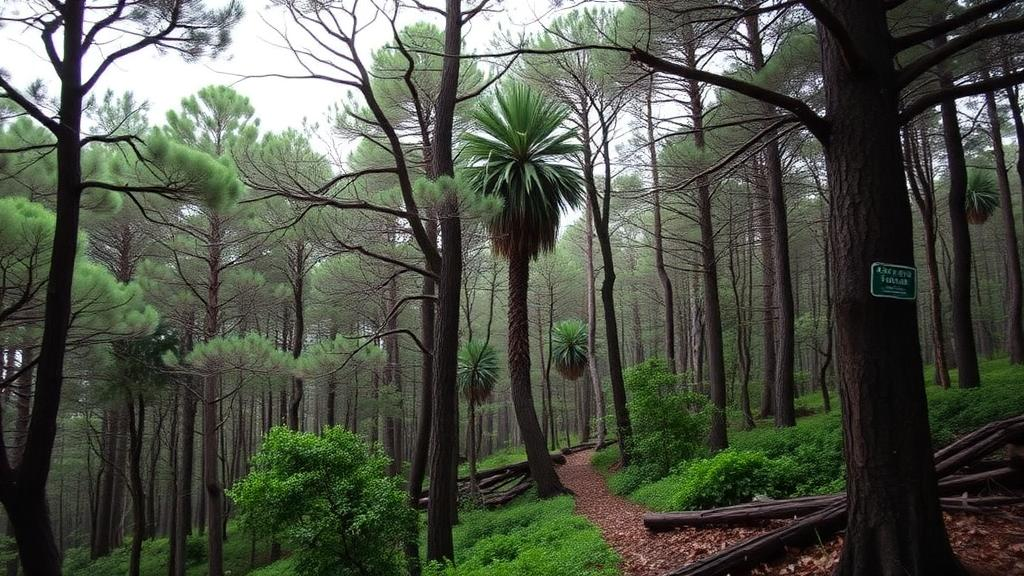
Deep in the Coastal Range of southern Chile, where temperate rainforest cloaks the hills in a tangle of ancient evergreens and dense bamboo understorey, a quiet ecological experiment is unfolding. Over two consecutive spring-summer seasons, researchers deployed camera traps in paired landscapes of native forest and commercial Eucalyptus plantations in Osorno Province, and the photographic record tells a stark story: the native forest shelters roughly twice the diversity of wild terrestrial mammals found in the exotic tree farms. With species richness of seven to eight species in native forest plots compared with just three to four in the plantations, the study offers some of the most direct evidence yet that Chile’s booming forestry industry is hollowing out the mammal communities of one of the world’s great biodiversity hotspots.
The research, published in Neotropical Biology and Conservation, focused on two localities in the Coastal Range of Osorno Province. The first, near Los Riscos west of the Purranque district, spans nearly 2,700 hectares, more than half of which is mature Eucalyptus nitens plantation, interspersed with fragments of evergreen and mixed native forest. The second lies west of the Río Negro district, pairing native forest near the Huellelhue Indigenous Community with a plantation at the neighboring Putrihue site, where Eucalyptus covers about 85 percent of 221 hectares. The team installed five camera traps in each habitat type at each locality, rotating them monthly among subareas to widen coverage, and accumulated 1,060 camera-trap days in native forest and 960 in plantations. No bait or attractant was used, so every photograph represented an animal moving through its landscape on its own terms.
The camera traps painted an intimate portrait of a cryptic fauna. In the native forest, the detectors caught the diminutive pudú (Pudu puda), the world’s smallest deer and a vulnerable species, slipping through the undergrowth; the guigna (Leopardus guigna), a small, near-threatened wild cat endemic to temperate South American forests; pumas (Puma concolor); culpeo foxes (Lycalopex culpaeus); hog-nosed skunks (Conepatus chinga); the monito de monte (Dromiciops gliroides), a living relic and the sole surviving member of the ancient order Microbiotheria; and even the invasive American mink. The plantations, by contrast, hosted a much thinner cast, dominated by generalists such as the culpeo fox, the guigna and, in one locality, the pudú.
Quantitatively, the difference was unambiguous. Using the framework of true diversity, which converts raw counts into effective numbers of species, the native forest at Huellelhue yielded a value of 7.00 against 4.08 in the adjacent Putrihue plantation, while at Los Riscos the figures were 8.25 versus 3.02, a statistically significant gap at the 95 percent confidence level. Mean abundance followed the same pattern: 0.011 occurrences per camera-trap day in the Huellelhue native forest against 0.004 in the plantation, and 0.008 versus 0.004 at Los Riscos. In plain terms, an animal walked past a camera in the native forest roughly two to three times as often as in the Eucalyptus stands, even though the cameras worked equally hard in both habitats.
Perhaps the most intriguing result concerned community similarity, a measure of how alike two animal assemblages are in composition. The two native forest sites, separated by kilometers of terrain, resembled each other strongly, with a similarity index of 0.728, sharing five species. The two Eucalyptus plantations, however, shared only a single species and scored just 0.211, a value significantly lower than the forest-to-forest comparison. This asymmetry is ecologically meaningful: it suggests native forests across the region support a coherent, predictable mammal community, while plantation communities are idiosyncratic, assembled from whichever generalists happen to wander in from nearby fragments. The plantations are not simply diluted versions of the forest; they are fundamentally different and far less consistent worlds.
The identity of the species that do use plantations reveals which traits permit survival in these simplified habitats. Culpeo foxes and hog-nosed skunks, both dietary and habitat generalists, appeared at comparable frequencies in native forest and plantation at the Huellelhue site, and the pudú was recorded equally often in both habitats at Los Riscos, even dominating plantation records there with 66.7 percent of relative occurrence. The researchers point to the understorey as a decisive factor. Previous experimental work in central Chile showed that pine plantations with well-developed undergrowth support native mammals including guignas, foxes, skunks and pudús, and the same logic likely applies here: where light penetrates to the floor of a Eucalyptus stand and undergrowth is sparse, most forest-adapted mammals simply will not enter.
The guigna provided the study’s most striking conservation subplot. All eight occurrences of this cat in Eucalyptus plantations involved typical-colored individuals, whereas melanic guignas, those wearing the dark, melanistic coat that makes the species something of a ghost cat, accounted for 22.2 percent of occurrences in native forest but were entirely absent from the plantations. The frequency fitted a latitudinal gradient already documented across Chile: statistically consistent with melanism rates at the Senda Darwin Biological Station (28.6 percent) and Chiloé Island (15.8 percent) at similar latitudes, but significantly lower than at reserves further south, such as Huinay (50 percent) and Añihue (48.1 percent). The pattern supports the hypothesis that dark fur confers a camouflage advantage in the dim, densely shaded understorey of temperate rainforest, where quila bamboo and ferns screen out most light at ground level.
Why, then, do melanic cats vanish from the plantations? The authors suggest that the open, bright floor of a Eucalyptus stand makes a dark-coated predator conspicuous, both to prey and potentially to competitors, effectively filtering out the melanistic phenotype. Given that guignas roam home ranges of roughly 261 hectares, individuals of both color morphs certainly have the mobility to reach the plantations. Their selective absence implies that exotic plantations are not merely suboptimal habitat but actively unsuitable for maintaining the full spectrum of phenotypic diversity within this near-threatened species, a subtle cost of plantation forestry that conventional species counts alone would miss entirely.
Activity patterns added a temporal dimension to the picture. In both native forest sites, detections peaked between noon and midnight, with 60 percent of records at Huellelhue and 76.9 percent at Los Riscos falling in that window, consistent with the crepuscular and nocturnal habits of Chilean mammals. The pudú intensified its movements at twilight, plausibly an evasion strategy against diurnal predators, while the guigna showed elevated crepuscular activity that may track the availability of small mammal prey at dusk. In the plantations, activity shifted differently at each site, concentrating in the evening hours at Putrihue and in the late night and pre-dawn hours at Los Riscos, further evidence that these are not functional replicas of the forest environment.
The broader context makes the findings urgent. The Valdivian rainforest ecoregion of the Chilean Coastal Range is listed among the world’s most endangered, a recognized biodiversity hotspot harboring ancient phylogenetic lineages and high endemism. Yet native forest in the Los Ríos and Los Lagos regions has shrunk by roughly a quarter in recent decades, and in Osorno Province alone the area under exotic plantations grew by more than 20 percent between 2006 and 2013, much of it at the direct expense of native forest. The study’s conclusion is measured but firm: native forests are the primary habitat for most terrestrial mammals of the Coastal Range, while Eucalyptus plantations function only as complementary or surrogate habitat for a handful of generalist species. As the forestry industry, which operates under certification schemes such as FSC and CERTFOR/PEFC, continues to expand, the authors argue that companies should implement specific management practices, above all fostering understorey development within plantations, to blunt the damage to the mammals that persist there. Without such measures, the dark-furred ghosts of Chile’s rainforest, and much of the fauna around them, will increasingly have nowhere left to hide.
Subject of Research: Diversity of terrestrial mammal communities in native forests versus exotic Eucalyptus plantations in the Coastal Range of southern Chile
Article Title: Comparing diversity of the terrestrial mammal communities inhabiting native forests and exotic plantations in southern Chile
Article References: Colihueque, N., Vidal, V., Vásquez, C., & Gantz, A. (2023). Comparing diversity of the terrestrial mammal communities inhabiting native forests and exotic plantations in southern Chile. Neotropical Biology and Conservation, 18(4), 261-282. https://doi.org/10.3897/neotropical.18.e110272
Image Credits: AI Generated
DOI: 10.3897/neotropical.18.e110272
Keywords: camera trapping, mammal diversity, native forest, Eucalyptus plantations, temperate rainforest, Chile, guigna, melanism, biodiversity hotspot, conservation, pudú, habitat use
Cite Scienmag News
Margaret Porter. (October 19, 2026). Camera Traps Reveal Native Chilean Forests Outshine Eucalyptus Plantations for Mammals. Scienmag. https://scienmag.com/camera-traps-reveal-native-chilean-forests-outshine-eucalyptus-plantations-for-mammals/
Margaret Porter. "Camera Traps Reveal Native Chilean Forests Outshine Eucalyptus Plantations for Mammals." Scienmag, 19 October 2026, https://scienmag.com/camera-traps-reveal-native-chilean-forests-outshine-eucalyptus-plantations-for-mammals/. Accessed 19 October 2026.
Margaret Porter. "Camera Traps Reveal Native Chilean Forests Outshine Eucalyptus Plantations for Mammals." Scienmag. October 19, 2026. https://scienmag.com/camera-traps-reveal-native-chilean-forests-outshine-eucalyptus-plantations-for-mammals/


