


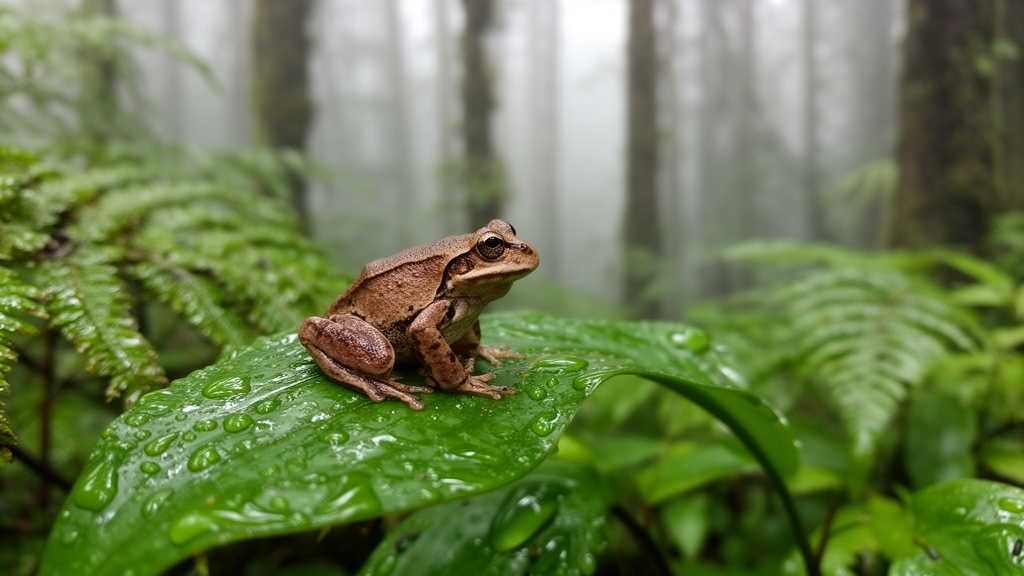
Deep in the montane evergreen broadleaf forests of Jinzhongshan National Nature Reserve, on the southern rim of the Yunnan–Guizhou Plateau in Longlin County, Guangxi, China, a small brown frog has been hiding in plain sight. Researchers surveying the reserve in 2024 and 2025 collected ten adult specimens of a leaf-litter frog that, upon closer inspection, did not match anything previously recorded there. Integrative morphological and molecular analyses now confirm the animals belong to an entirely new species, formally described as Leptobrachella jinzhongshanensis sp. nov. in the journal Zoosystematics and Evolution. The discovery, proposed with the English common name Jinzhongshan Leaf-litter Frog, adds another branch to one of Asia’s most rapidly expanding amphibian family trees.
The genus Leptobrachella, a group of small megophryid frogs distributed across southern and eastern Asia from Peninsular Malaysia and Borneo to north-eastern India, Vietnam and southern China, has undergone a remarkable taxonomic explosion. Recognised diversity rose from 72 species in 2020 to 121 species in 2026, a clear signal that the genus remains incompletely documented. China alone harbours fifty recorded species, roughly 41.3 percent of the genus total, and Guangxi has emerged as a particular hotspot. With the new species included, twenty Leptobrachella species are now known from Guangxi, representing 39.2 percent of the fifty-one species recognised from China. The sheer pace of these descriptions suggests that many more lineages await detection in poorly sampled montane habitats.
What makes the Jinzhongshan population so intriguing is how it was found. Only one congener, Leptobrachella ventripunctata, had previously been reported from the reserve. During fieldwork, the research team encountered the new species entirely away from streams, at elevations of 1,700 to 1,800 metres, while L. ventripunctata was recorded along hill streams below 1,000 metres. No advertisement calls were heard from the upland animals. This ecological and elevational separation between two species sharing the same reserve illustrates how topographically complex subtropical mountains can partition frog diversity into narrow vertical bands, each harbouring distinct evolutionary lineages.
The molecular evidence rests on the mitochondrial 16S rRNA gene, a standard workhorse for amphibian species delimitation. The team generated six new sequences from the Jinzhongshan specimens and combined them with 111 sequences retrieved from GenBank, producing a dataset of 117 sequences and 1,507 aligned base pairs. Maximum-Likelihood and Bayesian Inference analyses, run in IQ-TREE 2.2.2 with 5,000 ultrafast bootstrap replicates and 30 million generations respectively, recovered congruent topologies. The Jinzhongshan specimens formed a strongly supported monophyletic lineage, with Bayesian posterior probability of 1.00 and ultrafast bootstrap support of 99, sister to L. dorsospina, a species described from Yushe Forest Park in Guizhou Province. The uncorrected p-distance between the two lineages was 1.4 percent.
That 1.4 percent figure may sound small, but in the world of Leptobrachella it sits comfortably within the range reported for several pairs of recognised congeners. L. jinshaensis and L. yeae differ by only 0.6 percent, L. jinshaensis and L. xishuiensis by 1.0 percent, L. bourreti and L. dushanensis by 1.3 percent, and L. dong and L. dushanensis by 1.6 percent. In other words, mitochondrial divergence alone cannot settle the question. The researchers therefore treated the genetic lineage as one strand of an integrative taxonomic argument, weaving it together with consistent external morphological differences rather than relying on any single line of evidence.
The morphological case is built on a distinctive combination of characters. The new species is a medium-sized frog, with snout-vent length of 30.4 to 32.5 millimetres in males and 40.3 to 42.8 millimetres in females. It bears narrow lateral fringes on the toes but lacks toe webbing entirely, and the dermal ridges beneath the toes are continuous rather than interrupted. When the thighs are held at right angles to the body axis, the heels do not meet. The flanks carry irregular black spots, the iris is copper above and silver below, and the venter displays interwoven creamy-white and light-grey markings. The tibiotarsal articulation reaches the posterior corner of the eye, and relative finger lengths follow the pattern IV less than II approximately equal to I less than III.
Compared with its sister species L. dorsospina, the differences are consistent and externally visible. The new species has snout length approximately equal to eye diameter, whereas L. dorsospina shows a snout-to-eye ratio of 1.29. The dermal ridges beneath the toes are continuous in the new species but interrupted in L. dorsospina, which also possesses rudimentary toe webbing absent from the Jinzhongshan animals. The heels overlap in L. dorsospina but do not meet in the new species, and the ventral pattern differs from a greyish-white venter with black spots and orange pigmentation to the interwoven creamy-white and light-grey markings of the new frog. Compared with L. ventripunctata, the new species is considerably larger, with male snout-vent length of 30.4 to 32.5 millimetres versus 25.5 to 28.0 millimetres, and female length of 40.3 to 42.8 millimetres versus 31.5 to 35.0 millimetres.
The team also ran exploratory statistical analyses on morphometric data, focusing on females because only two adult males were available. Measurements were size-adjusted using a logarithmic correction in GroupStruct2, and an exploratory t-test identified differences between females of the Jinzhongshan sample and published measurements of L. dorsospina in eleven characters, including snout-vent length, head length, head width, interorbital distance, eye diameter, tympanum diameter, tympanum-eye distance, lower arm and hand length, pes length, tibia length and hind-limb length. Principal component analysis of size-adjusted data showed the first three components explaining 83.2 percent of total variance, with PC1 loading most strongly on head length, eye diameter and tibia length. The samples separated along PC1 but overlapped along PC2. Because the measurements were obtained by different observers, the researchers interpreted these results cautiously, treating them as supporting rather than decisive evidence for species delimitation.
The type series comprises ten adults, two males and eight females, all collected in Jinzhongshan National Nature Reserve. The holotype, an adult male with snout-vent length of 32.5 millimetres, was collected on 17 May 2025 at 1,776 metres elevation. Voucher specimens were fixed in 10 percent formalin, transferred to 75 percent ethanol and deposited in the zoological collection of Nanning Normal University. Fieldwork was conducted under permit from the reserve’s Administration Bureau, and all procedures followed the ethical guidelines of Nanning Normal University’s Ethics Committee. The specific epithet jinzhongshanensis refers to the type locality, Mount Jinzhongshan, with the Chinese common name Jīn Zhōng Shān Zhǎng Tū Chán.
The reserve itself is a substantial protected area, covering 20,924 hectares and spanning elevations of 780 to 1,819 metres. It lies in the western part of the southern subtropical monsoon zone, with a warm, humid climate, mean annual temperature of 18.3 degrees Celsius and mean annual precipitation of 1,200 millimetres. Females collected in May and July contained ova of visibly different sizes, with larger ova in a May specimen and smaller ova in a July specimen, though the researchers note these observations rest on two individuals and do not establish breeding phenology. The new species is currently known only from a small area within the reserve, and its population size, geographic distribution and conservation status remain poorly understood. Targeted surveys are needed before its conservation status can be assessed robustly, and broader fieldwork across the region’s montane habitats is likely to reveal further hidden diversity in a genus that continues to surprise scientists with each new description.
Subject of Research: Taxonomy and biodiversity of Asian amphibians
Article Title: A new species of Leptobrachella ( Anura , Megophryidae ) from Jinzhongshan National Nature Reserve, Guangxi, China
Article References: A new species of Leptobrachella ( Anura , Megophryidae ) from Jinzhongshan National Nature Reserve, Guangxi, China. (n.d.). https://doi.org/10.3897/zse.102.195575
Image Credits: AI Generated
Keywords: Leptobrachella, new species, Guangxi, China, amphibians, herpetology, taxonomy, 16S rRNA, phylogenetics, biodiversity, species, Anura
Cite Scienmag News
Margaret Porter. (October 16, 2026). New leaf-litter frog species emerges from Guangxi’s Jinzhongshan cloud forests. Scienmag. https://scienmag.com/new-leaf-litter-frog-species-emerges-from-guangxis-jinzhongshan-cloud-forests/
Margaret Porter. "New leaf-litter frog species emerges from Guangxi’s Jinzhongshan cloud forests." Scienmag, 16 October 2026, https://scienmag.com/new-leaf-litter-frog-species-emerges-from-guangxis-jinzhongshan-cloud-forests/. Accessed 16 October 2026.
Margaret Porter. "New leaf-litter frog species emerges from Guangxi’s Jinzhongshan cloud forests." Scienmag. October 16, 2026. https://scienmag.com/new-leaf-litter-frog-species-emerges-from-guangxis-jinzhongshan-cloud-forests/


