


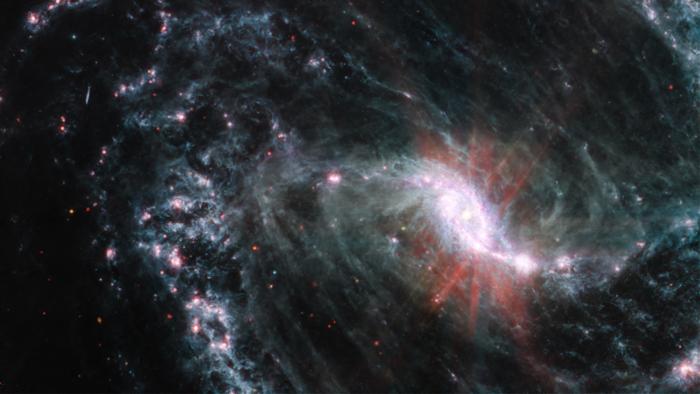
The universe is a vast and complex expanse that continually expands, showcasing profound mysteries that scientists have been striving to unravel. In recent years, an ongoing debate about the rate of this expansion—known as the Hubble Constant—has captured the attention of physicists and astronomers alike. Tensions arose as two distinct methods of measurement yielded differing results: one approach based on ancient fossilized light from the Big Bang and the other derived from contemporary observations of nearby galaxies. This apparent discord presented a significant challenge to the Standard Model of cosmology, raising concerns about the completeness of our current understanding of the universe.
Thanks to the revolutionary capabilities of the James Webb Space Telescope, which is vastly superior in terms of resolution and sensitivity compared to its predecessor, the Hubble Space Telescope, researchers from the University of Chicago have proposed new insights that may harmonize these conflicting measurements. The data retrieved from Webb has invigorated existing hypotheses regarding the universe’s expansion while assuring scientists that their foundational models remain robust. According to professor Wendy Freedman, a prominent figure in this field, there is growing evidence that the discrepancies previously noted may not be as problematic as they once appeared.
The debate surrounding the Hubble Constant centers on two primary measurement techniques. The first involves studying the cosmic microwave background radiation—an echo of the Big Bang that bathes the universe. This remnant light provides astronomers with detailed information about the universe’s infancy, illuminating conditions that prevailed early in cosmic history. The second methodology, which Freedman specializes in, focuses on the present-day rate of expansion observed in our cosmic neighborhood. Despite the seemingly straightforward nature of contemporary observations, accurately gauging distances to nearby astronomical bodies remains an intricate challenge.
Over the last few decades, researchers have developed a variety of techniques for measuring distances in the cosmic neighborhood. One prominent method depends on the observation of specific types of stars, particularly supernovae—stellar explosions characterized by a well-defined peak brightness. Once scientists establish the intrinsic luminosity of a supernova, they can assess its apparent brightness from Earth, effectively calculating its distance. Freedman’s team has also innovated other techniques that leverage the unique properties of certain star types, including red giants and carbon stars.
However, these measurements are not straightforward. Numerous adjustments must be made before scientists can accurately declare a distance. These include corrections for cosmic dust, which can obscure and dim light traversing space, as well as accounting for variations in luminosity that may arise over vast periods of cosmic time. Furthermore, researchers must also address subtle uncertainties related to the instruments they utilize for measurement. The refinement of these approaches has been greatly aided by the innovations embodied in the Webb Telescope, a powerful toolkit that allows astronomers to probe depths of space previously unimaginable.
Freedman’s analysis incorporates cutting-edge data from both the James Webb Space Telescope and the Hubble Telescope, yielding a new estimation of the Hubble Constant at 70.4 kilometers per second per megaparsec, with an uncertainty of plus or minus 3%. This newfound figure aligns more closely with measurements derived from cosmic microwave background studies, which identified a value of 67.4, plus or minus 0.7%. The implication of this harmonious outcome is significant: it suggests that the disparities among the various methodologies may soon find resolution as scientists refine their approaches.
The Webb Space Telescope’s capabilities revolutionize our capacity for distance measurement in the cosmos. With four times the resolution of Hubble and ten times greater sensitivity, it can elucidate individual stars in regions previously muddled through cosmic dust. As Freedman’s co-author, Taylor Hoyt remarked, current technological advancements empower scientists to visualize and assess distances with unprecedented clarity and accuracy. Together with its advanced infrared detectors, Webb enables astronomers to penetrate through the light-muffling dust that has traditionally prompted inaccuracies in celestial distance measurements.
Despite the rigorous efforts within the field to examine and reconcile the conflicting expansion rates, Freedman has expressed her frustration over the myriad challenges encountered in efforts to formulate a cohesive theory explaining how the expansion rate could vary with time. Scholarly discourse around this dilemma is extensive, with over 1,000 papers having been published in pursuit of theoretical frameworks capable of explaining the phenomena observed. Yet, resolving this question remains extraordinarily challenging, leading scientists to broaden their inquiries into other fundamental aspects of the cosmos.
At this juncture, researchers remain committed to investigating alternative avenues that may expose underlying issues within the Standard Model, especially concerning the enigmatic forces of dark matter and dark energy. Although there has been no conclusive evidence to suggest that the Hubble Constant represents a critical fault line in our understanding, Freedman’s team, bolstered by their access to Webb’s instruments, is optimistic about the results of their forthcoming observations. They plan to investigate the Coma cluster of galaxies in the following year, which may allow for direct measurements of the Hubble Constant without necessitating the intermediary step of supernova observations.
In conclusion, as scientists continue to build on the legacy of the Hubble and James Webb Space Telescopes, the hope of resolving discrepancies in measurements of the Hubble Constant shines bright. Freedman expresses confidence that improved methodologies and further studies will soon bring clarity to this vital aspect of our universe’s nature, leading to a deeper understanding of its dynamics and origins. The integration of advanced technologies alongside interdisciplinary collaboration promises to unlock secrets that lie at the very heart of cosmic existence, possibly revealing the answers needed to navigate these complex astrophysical puzzles.
Keywords
Universe, Hubble Constant, Expansion Rate, James Webb Space Telescope, Astronomical Measurements, Cosmology, Supernova, Cosmic Microwave Background
Cite Scienmag News
Grant Pearson. (June 3, 2025). New Insights into Universal Expansion Offer Potential Resolution to Ongoing Conflict. Scienmag. https://scienmag.com/new-insights-into-universal-expansion-offer-potential-resolution-to-ongoing-conflict/
Grant Pearson. "New Insights into Universal Expansion Offer Potential Resolution to Ongoing Conflict." Scienmag, 3 June 2025, https://scienmag.com/new-insights-into-universal-expansion-offer-potential-resolution-to-ongoing-conflict/. Accessed 4 September 2026.
Grant Pearson. "New Insights into Universal Expansion Offer Potential Resolution to Ongoing Conflict." Scienmag. June 3, 2025. https://scienmag.com/new-insights-into-universal-expansion-offer-potential-resolution-to-ongoing-conflict/


