


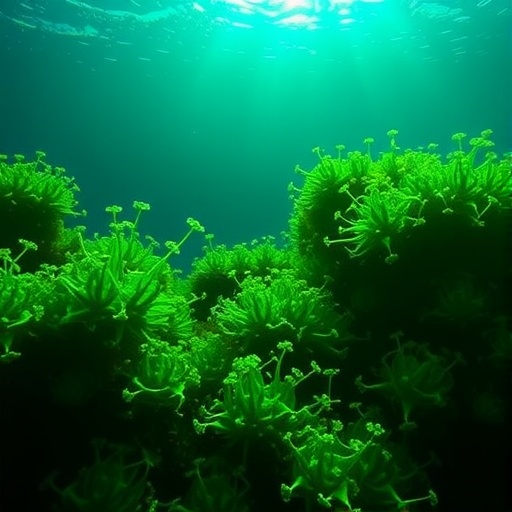
In a groundbreaking study published in Commun Earth Environ, researchers led by M. Amirian delve into the complexities of photoinhibition in phytoplankton, offering a new parameterization that holds vast implications for understanding aquatic ecosystem dynamics and climate change. This exploration is particularly vital as phytoplankton are foundational to marine food webs and play a crucial role in carbon cycling. Despite their significance, the mechanisms that drive photoinhibition—a process where excessive light reduces photosynthetic efficiency—have remained elusive and poorly defined.
Phytoplankton are not just a mere component of the ocean. They are pivotal players in the Earth’s ecosystem, responsible for a substantial fraction of the planet’s primary production. They capture sunlight and convert it into energy through photosynthesis, supporting marine life and regulating atmospheric gases. However, under extreme light conditions, these microscopic plants experience stress. Photoinhibition can lead to a decrease in their photosynthetic capability, thereby affecting overall marine productivity and health of marine ecosystems.
The team’s research zeroes in on how different light conditions affect the photosynthetic performance of various phytoplankton species. Utilizing sophisticated models and parameterization techniques, they strive to quantify the relationship between light intensity and the resulting inhibition rates. Through their study, they challenge the existing paradigms and introduce new parameters that could refine predictions of phytoplankton productivity under varying environmental conditions.
One of the key takeaways from their research is that photoinhibition is not uniform across phytoplankton species. The researchers have demonstrated that specific taxa exhibit unique responses to light intensity, which significantly complicates the current understanding of photosynthetic efficiency in these organisms. This finding has profound implications for future climate models that include phytoplankton dynamics. If models fail to acknowledge these nuanced responses, they risk making inaccurate predictions about carbon cycling and climate feedback loops.
Another important aspect of this work is its potential applications in oceanographic studies. By offering a more detailed approach to modeling how light affects phytoplankton, the research opens new avenues for assessing ecosystem health and productivity. This could facilitate better management practices in fisheries and marine conservation efforts, as understanding phytoplankton health is crucial for maintaining the balance in marine food webs.
The authors also focus on the implications of their findings in the context of global climate change. With changing light conditions due to altered weather patterns and increased particulate matter in the water, the traditional models of phytoplankton responses may be obsolete. The new parameterization framework developed by Amirian and colleagues provides a pathway to revising these models, potentially allowing scientists to predict how phytoplankton populations will adapt to future environmental shifts.
In addition, the study touches on the ecological ramifications of phytoplankton decline. As they become less efficient at photosynthesis due to photoinhibition, there may be a cascading effect on marine food chains and carbon sequestration rates. This could exacerbate existing challenges within marine environments, including elevated carbon dioxide levels and ocean acidification. Thus, understanding and adequately modeling phytoplankton responses to light stress could greatly inform climate policy and conservation strategies.
The researchers utilized a plethora of field data and laboratory experiments to support their findings, ensuring that their parameterization is robust and applicable under a range of conditions. Through careful calibration and validation, they have made strides in developing a tool that has the potential to be widely adopted in marine ecological studies. The implications of this research extend beyond theoretical discussions; they provide actionable insights for policymakers and conservationists aiming to protect marine ecosystems under the duress of climate change.
As the dialogue around climate change evolves, studies like this illuminate the often-overlooked intricacies of marine ecosystems. The research emphasizes the urgent need to incorporate biological responses into climate models, which have historically prioritized physical parameters over biological ones. This shift toward a more integrative approach could revolutionize our understanding of marine ecology and help predict future scenarios more accurately.
The research team is now looking to collaborate with ecologists and climatologists globally to expand the application of their parameterization. By melding different expertise, they aim to refine their models even further and explore various scenarios that could emerge in future climate conditions. This interdisciplinary approach could unveil new insights and foster innovations in ecological modeling.
Awareness is growing around the critical importance of phytoplankton as carbon sinks amid climate efforts. The work of Amirian et al. can serve as a keystone for several initiatives targeting marine conservation and carbon management. As scientific communities focus on actionable insights for combating climate change, studies such as this can pave the way for informed decision-making and strategic interventions.
In closing, the research conducted by Amirian and colleagues stands as a significant advancement in our understanding of phytoplankton dynamics. By elucidating the complexities of photoinhibition through innovative parameterization, the authors are not only enhancing scientific knowledge but also arming policymakers with the necessary tools to tackle pressing environmental challenges. Future research will undoubtedly build upon these findings, further shaping our comprehension of aquatic systems in the face of a rapidly changing world.
M. Amirian, M., Finkel, Z.V., Devred, E. et al. Parameterization of photoinhibition for phytoplankton. Commun Earth Environ 6, 707 (2025). https://doi.org/10.1038/s43247-025-02686-3
Cite Scienmag News
Violet Maxwell. (August 27, 2025). New Insights into Phytoplankton Photoinhibition Dynamics. Scienmag. https://scienmag.com/new-insights-into-phytoplankton-photoinhibition-dynamics/
Violet Maxwell. "New Insights into Phytoplankton Photoinhibition Dynamics." Scienmag, 27 August 2025, https://scienmag.com/new-insights-into-phytoplankton-photoinhibition-dynamics/. Accessed 4 September 2026.
Violet Maxwell. "New Insights into Phytoplankton Photoinhibition Dynamics." Scienmag. August 27, 2025. https://scienmag.com/new-insights-into-phytoplankton-photoinhibition-dynamics/


