

Title: Unveiling the Secrets of Jezero Crater’s Aluminum-Rich Rocks on Mars
Mars, often dubbed as the Red Planet, has been a subject of continuous fascination and investigation by scientists and astronomers alike. Recent studies, particularly one conducted by a team led by Broz et al., have offered remarkable insights into the alteration history of aluminum-rich rocks located within the enigmatic Jezero Crater. As humanity stands at the brink of interplanetary exploration, understanding the geological transformations Mars has endured is essential for contextualizing its past and anticipating its future.
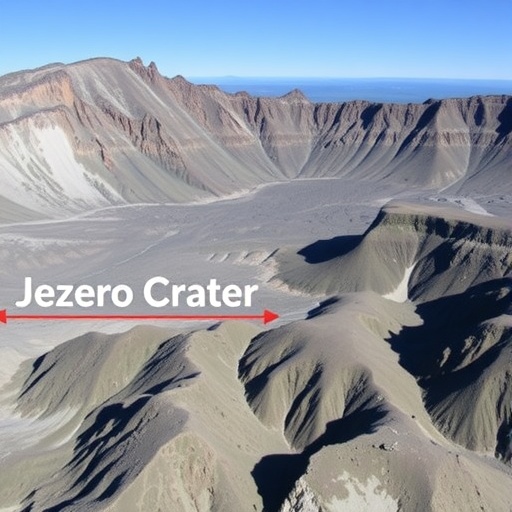
Jezero Crater—a site of immense interest for astrobiologists and geologists—was chosen as a primary landing area for NASA’s Perseverance Rover due to its rich geologic history and potential to harbor signs of ancient microbial life. This 45-kilometer-wide crater is believed to have once contained a lake, making it an ideal candidate for studies focused on astrobiology, sedimentology, and planetary geology. The implications of findings from this area may not only shed light on Mars’ past environments but also influence our understanding of terrestrial processes.
Broz and colleagues centered their research on aluminum-rich rocks because these rocks can provide essential clues about the past conditions on Mars. Aluminum is a key element in igneous and sedimentary rocks, and its abundance can indicate significant chemical processes that may have occurred over millions of years. The research team employed a variety of methods to analyze these rocks, including remote sensing, geochemical analyses, and mineralogical assessments aimed at reconstructing the conditions under which these rocks formed.
Using data obtained from orbiters, landers, and rovers, the research integrated multiple datasets to garner a holistic view of the geological history. This multi-faceted approach highlighted the complex interaction between water and minerals, suggesting that the aluminum-rich rocks might have undergone extensive alteration due to aqueous processes. The team’s findings indicated that water was a significant agent in reshaping these rocks, leading to mineral transformations that could either bolster or challenge the hypothesis of ancient life-friendly environments.
One of the noteworthy elements of this research is its contemplation of the processes of mineral weathering in Martian conditions. The study explored how variations in temperature, pressure, and atmospheric compositions could influence the stability of aluminum-bearing minerals. Insights into these factors are indispensable for understanding not only the suitability of Jezero Crater for life in its ancient past but also the broader habitability of Mars as we venture into future exploration.
Another critical aspect of the research involved a detailed examination of the spatial distribution of aluminum-rich rocks within Jezero Crater. The mapping indicated that these rocks are not evenly distributed but are instead clustered in deposits that suggest specific paleoenvironmental conditions. By associating geological features with water activity, the team painted a vivid picture of past aqueous processes, adding depth to our understanding of Mars’ environmental evolution.
The implications of understanding these aluminum-rich rocks extend beyond mere historical curiosity. Insights gained from Jezero Crater may have practical applications in future manned missions to Mars, guiding astronauts in identifying potential resources such as water and minerals necessary for sustaining life. Moreover, this research underscores the potential for discovery in unexplored Martian terrains, reminding us of the vastness of knowledge still to be uncovered.
As researchers continue to analyze data from Jezero Crater and other Martian locales, new technologies are paving the way for unprecedented exploration. Future missions could employ advanced rovers and landers equipped with state-of-the-art instruments to conduct real-time analysis on Martian rock and soil. Such developments in planetary science technology could expedite our understanding of Martian geology and enhance our direct knowledge about the planet’s habitability.
Broz et al.’s research contributes significantly to a growing body of literature that seeks to decode the Martian geological narrative. Simulating various scenarios of past water presence and its interactive effects on rock types, this study advances our comprehension of how Mars’ environmental conditions may have fluctuated over eons. As scientists consolidate information from diverse investigations, they can develop robust models to predict future discoveries regarding the Martian landscape.
Astrobiology takes center stage in these findings, as understanding the historical presence of water and its capacity to facilitate chemical reactions is pivotal in assessing the feasibility of life on Mars. The alteration histories illustrated in the study bring forth the idea that Martian surfaces were once dynamic environments, undergoing changes that could have supported microbial life.
The sustained interest in Mars studies is not only propelled by the excitement of potential findings but also by the collaborative efforts of international space agencies and research institutions. The influx of data from various missions enables a convergent approach to research, fostering an environment where scientific findings can be validated across different studies. Such synergy is essential in painting a cohesive picture of Mars’ geological and astrobiological prospects.
In conclusion, the exploration of aluminum-rich rocks in Jezero Crater has opened new avenues for understanding Mars’ rich geological history. The research spearheaded by Broz et al. represents just a fragment of ongoing efforts to unveil the secrets of the Red Planet. The quest to comprehend Mars’ past continues to captivate scientists worldwide, with each new discovery echoing the boundless intrigue of what lies beyond our own Earth, just waiting to be discovered.
As technology advances and more data becomes available, the hope is that future explorations will yield profound discoveries, enhancing our cosmic understanding not only of Mars but of planetary processes that may be common across the solar system. The ongoing journey into Mars’ history will surely fuel both scientific and public imagination for generations to come.
Subject of Research: Alteration history of aluminum-rich rocks at Jezero Crater, Mars
Article Title: Alteration history of aluminum-rich rocks at Jezero crater, Mars
Article References:
Broz, A.P., Horgan, B.H.N., Bedford, C. et al. Alteration history of aluminum-rich rocks at Jezero crater, Mars.
Commun Earth Environ 6, 935 (2025). https://doi.org/10.1038/s43247-025-02856-3
Image Credits: AI Generated
DOI: https://doi.org/10.1038/s43247-025-02856-3
Keywords: Mars, Jezero Crater, aluminum-rich rocks, alteration history, astrobiology, planetary geology.


