


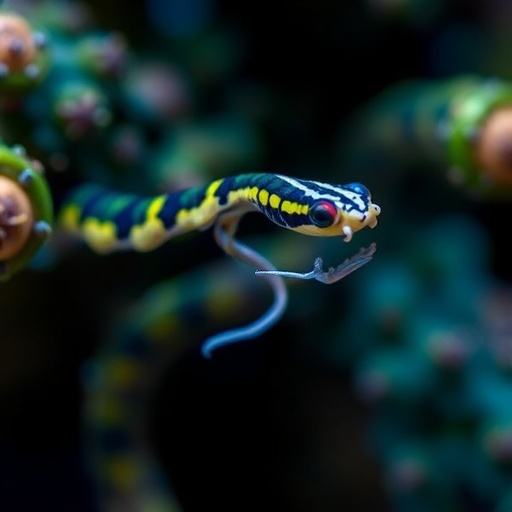
In a groundbreaking study published in BMC Genomics, a team of researchers led by Lai, J., alongside Wang, Z., and Li, G., undertook an extensive comparative transcriptomic analysis that illuminates the ecological adaptations of the enigmatic amphibian species, Ichthyophis bannanicus. This work not only advances the understanding of the evolutionary mechanics at play within this distinct organism but also serves as a pivotal foundation for future investigations into biodiversity and ecological resilience.
The research marks a significant contribution to the field of evolutionary biology and ecology, particularly given the rising concerns about biodiversity loss and the urgent need to understand how species adapt to changing environments. Through an in-depth transcriptomic approach, the scientists explored the intricate genetic frameworks governing I. bannanicus, providing critical insights into the molecular functions that enable survival in various ecological niches.
Comparative transcriptomics, the approach employed in this study, involves analyzing RNA transcripts to uncover the gene expression patterns that differ between species or populations. This methodology is vital for understanding the functional adaptations in species that thrive under distinct ecological pressures. By examining the transcriptomes of I. bannanicus across various habitats, the researchers were able to draw correlations between gene expression and ecological adaptability, providing a clearer picture of how this species interacts with its environment.
Ichthyophis bannanicus, a species native to Southeast Asia, inhabits niche environments ranging from moist forests to urban areas. This adaptability is particularly crucial in an era marked by rapid climate change and habitat fragmentation. The team’s findings reveal a striking array of gene expression changes that are activated in response to environmental stimuli, showcasing the plasticity of its genetic makeup.
One notable discovery from the transcriptomic analysis involves the identification of genes related to stress response and metabolic processes that are uniquely expressed in I. bannanicus. These genes play a vital role in facilitating the species’ ability to withstand various environmental stresses, such as changes in temperature and humidity, providing an evolutionary advantage in its natural habitat. The research illuminates a complex interplay between genetic predispositions and environmental conditions, underscoring the importance of genetic adaptability for survival.
Furthermore, the study delved into the role of epigenetic factors in the ecological adaptations of I. bannanicus. Epigenetics, which involves changes in gene expression without alterations to the underlying DNA sequence, adds another layer of complexity to our understanding of how organisms adapt to their surroundings. The authors propose that epigenetic mechanisms may allow for rapid, reversible adaptations to fluctuating environmental conditions, offering a survival strategy that could be crucial given the unpredictable nature of contemporary ecosystems.
Another significant aspect of the research is its potential implications for conservation efforts. By shedding light on the genetic and epigenetic mechanisms that empower Ichthyophis bannanicus to thrive amidst ecological challenges, researchers hope to inform conservation strategies. Protecting the genetic diversity within this species could be key to maintaining its resilience in the face of ongoing environmental changes.
The findings from this study also resonate with current global efforts to enhance understanding of amphibian biology in the context of climate change. Amphibians are particularly sensitive indicators of ecological health, and research like this provides essential knowledge to help mitigate the impacts of climate shifts on various species. Through the lens of I. bannanicus, we can glean insights into the broader implications of adaptability in response to environmental stressors throughout amphibian populations worldwide.
Emerging from these findings is a renewed call for interdisciplinary approaches that unite genetics, ecology, and conservation biology. The integration of transcriptomic data with ecological studies can create a more comprehensive understanding of not only I. bannanicus but also the countless other species facing similar challenges. This research emphasizes the importance of continuing to unravel the complexities of genetic adaptability in a rapidly changing world.
Moreover, as scientists grapple with the ramifications of biodiversity loss, studies like this highlight the urgency of understanding organisms’ adaptive mechanisms. In light of increasing habitat destruction and climate alteration, augmenting our comprehension of genetic adaptations can inspire new conservation practices that are rooted in genetic insights, potentially leading to more effective strategies to protect at-risk species.
The potential benefits of this research extend beyond Ichthyophis bannanicus, providing a framework that can be applied to other amphibian species and even broader taxonomic groups. By adopting a comparative transcriptomic lens, we open doors to exploring evolutionary responses across various organisms, thereby enhancing our overall understanding of biodiversity.
In conclusion, the comparative transcriptomic analysis conducted on Ichthyophis bannanicus represents a significant advancement in our comprehension of ecological adaptations. With its revelations about gene expression, environmental stress response, and the role of epigenetics, this study paves the way for future research endeavors focused on understanding the genetic underpinnings of survival in a rapidly changing world. As we continue to confront the challenges of biodiversity loss and climatic shifts, the insights gained from this unique amphibian species may serve as a critical resource for enhancing conservation efforts worldwide.
Lai, J., Wang, Z., Li, G. et al. A comparative transcriptomic analysis provides new insights into the ecological adaptations in Ichthyophis bannanicus.
BMC Genomics (2025). https://doi.org/10.1186/s12864-025-12305-2
Cite Scienmag News
Juliet Wilcox. (December 1, 2025). New Insights into Ichthyophis bannanicus Ecological Adaptations. Scienmag. https://scienmag.com/new-insights-into-ichthyophis-bannanicus-ecological-adaptations/
Juliet Wilcox. "New Insights into Ichthyophis bannanicus Ecological Adaptations." Scienmag, 1 December 2025, https://scienmag.com/new-insights-into-ichthyophis-bannanicus-ecological-adaptations/. Accessed 5 September 2026.
Juliet Wilcox. "New Insights into Ichthyophis bannanicus Ecological Adaptations." Scienmag. December 1, 2025. https://scienmag.com/new-insights-into-ichthyophis-bannanicus-ecological-adaptations/


