


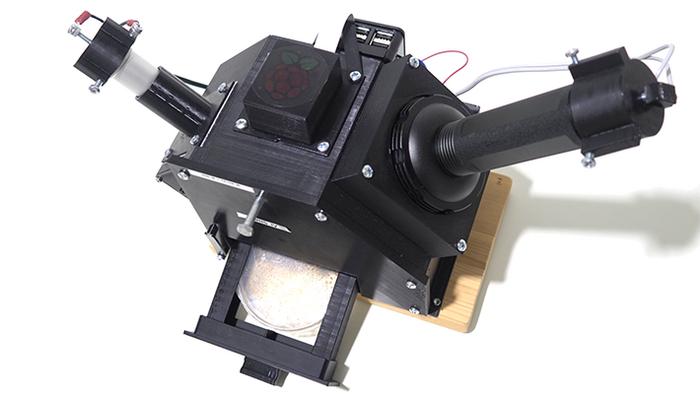
Researchers at the University of Jyväskylä have developed an imaging device for schools and research centres to study microbes. The 3D-printed device “NIRis” enables schools to observe and study natural phenomena. Researchers will gain useful and new knowledge about the light-activated bacteria.

Credit: Project researcher Ole Franz from the University of Jyväskylä.
Researchers at the University of Jyväskylä have developed an imaging device for schools and research centres to study microbes. The 3D-printed device “NIRis” enables schools to observe and study natural phenomena. Researchers will gain useful and new knowledge about the light-activated bacteria.
The “Shared Light” (Jaettu Valo) project at the University of Jyväskylä aims to understand the role of photosynthetic bacteria inside plants and utilizes citizen science.
– Seven different high-schools across Finland, from Utsjoki to Turku, collected hundreds of plant samples for the researchers who then isolated bacteria from the plants, tells project researcher Ole Franz from the University of Jyväskylä.
High-quality instrument for research
In order to facilitate fast detection of the bacteriochlorophyll-containing bacterial colonies of interest, the researchers developed a low-cost imaging device, a ”Near-infrared imaging system” (NIRis) to analyze bacteria. NIRis has two imaging modes resulting in an overlay of all bacteria colonies and selectively identified near-infrared fluorescent colonies. The identified bacteria can then be easily isolated for further studies. The 3D-printed device houses regular flashlights and detects bacterial colonies with a small raspberry pi computer and camera module.
– The aim was to keep the costs low and make it easy to operate. The low costs – less than thousend euros - and easy operation allowed production of multiple devices so they could be sent to high-schools participating in the project, says Heikki Häkkänen, the main designer of NIRis from the University of Jyväskylä.
Practical experience for schools
NIRis makes it possible to realize new types of multidisciplinary research and teaching at schools and research institutes. Teachers could utilize the device for example in biology, physics, programming, material design or even art education.
– This is a great opportunity for teachers to link regular courses to relevant academic research and investigate materials collected from nature, says Kati Heikkilä-Huhta, the coordinating teacher from Oulu Steiner school.
The project is looking forward to continue developing courses and research projects which utilize this type of devices.
New information on phototrophic bacteria
As of now, the Shared Light research group has used NIRis to isolate over 1000 new strains of phototrophic bacteria from a variety of plants in different seasons and locations.
– The easy detection allowed sampling of large collections and accelerated our research considerably. This is especially exciting as the prevalence of this type of bacteria in and on plants has been very little studied, especially with cultivation-based approaches, explains Riitta Nissinen, University lecturer from University of Turku. As a phenomenon this is highly interesting if one thinks that inside (photosynthetic) plants exist bacteria which also perform bacterial photosynthesis. Here, they do not produce sugars, but only chemical energy utilizing light energy, continues professor in nanosciences Janne Ihalainen from University of Jyväskylä.
The description of NIRis was published on 21.5.2024 in the journal PLOS One (https://doi.org/10.1371/journal.pone.0287088). The Shared Light project is funded by the KONE foundation.
Further information:
- Professor Janne Ihalainen University of Jyväskylä, janne.ihalainen@jyu.fi, +358400247979
- University lecturer Riitta Nissinen University of Turku, riitta.nissinen@utu.fi
Journal
PLoS ONE
Method of Research
Experimental study
Subject of Research
Not applicable
Article Title
A low-cost, versatile imaging system for near-infrared fluorescence detection of phototrophic cell colonies used in research and education
Article Publication Date
21-May-2024
Cite Scienmag News
Courtney Benton. (June 10, 2024). New imaging device combines education and microbial research. Scienmag. https://scienmag.com/new-imaging-device-combines-education-and-microbial-research/
Courtney Benton. "New imaging device combines education and microbial research." Scienmag, 10 June 2024, https://scienmag.com/new-imaging-device-combines-education-and-microbial-research/. Accessed 4 September 2026.
Courtney Benton. "New imaging device combines education and microbial research." Scienmag. June 10, 2024. https://scienmag.com/new-imaging-device-combines-education-and-microbial-research/

