


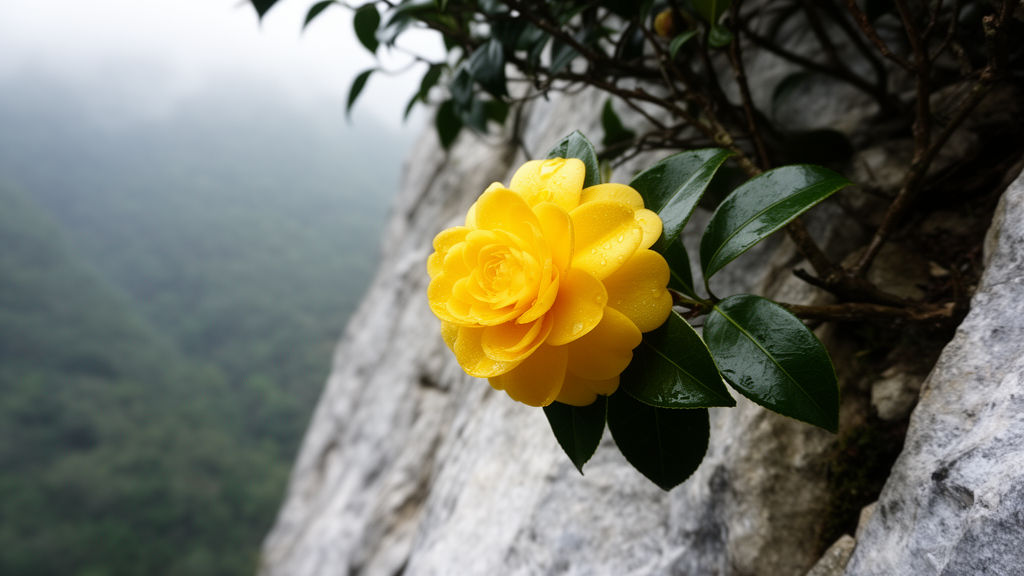
Deep in the limestone mountains of southern Yunnan, China, botanists have identified a striking new species of yellow-flowered camellia, formally described as Camellia guiliangii in the journal PhytoKeys. The discovery adds a fresh branch to one of the plant world’s most celebrated lineages, the golden camellias of southern China and Vietnam, and it comes with an urgent warning: fewer than 100 individuals of the new species are known to exist, placing it squarely in the Critically Endangered category of the IUCN Red List.
Yellow camellias hold an almost legendary status among plant collectors and horticulturists. For decades, the only camellias known to science bore flowers in shades of white, pink, and red, and the revelation in the twentieth century that wild populations of golden-flowered camellias existed in the karst landscapes of Guangxi transformed the ornamental horticulture industry and triggered intense conservation attention. Today, botanists estimate that China hosts between 21 and 24 yellow-flowered Camellia species, most of them confined to narrow ranges in Guangxi, with only a handful recorded in Yunnan and Guizhou. Vietnam, by comparison, supports nearly 50 species, and new ones continue to be described regularly. Every yellow camellia in China is currently listed as a Grade-II National Protected Wild Plant, a legal status that reflects both their scientific value and their vulnerability.
The new species came to light through field investigations conducted between 2020 and 2025 in Hekou Yao Autonomous County, Yunnan, with additional material from Miechang town in Maguan County. What immediately set the plant apart was where it grew. Yellow camellias typically occupy elevations from 125 to 1,600 meters, and the highest Chinese record had been Camellia mingii at 1,300 meters. The newly discovered species was found growing at 1,650 meters, in evergreen broad-leaved forests on limestone hills, making it the highest-elevation yellow camellia recorded anywhere. Its companions in these forests include Carya sinensis, Michelia lacei, Phoebe macrocarpa, and Itoa orientalis, a community characteristic of the region’s distinctive karst flora.
Morphologically, Camellia guiliangii is a shrub or small tree reaching two to four meters in height, with leathery elliptic to oblong leaves measuring 11 to 18 centimeters long. Its flowers, three to five centimeters across, bear seven to nine pale yellow petals arranged in three whorls, with numerous stamens about two centimeters long whose outer filaments are fused at the base. Flowering runs from October to January, peaking in November and December, and the fruits ripen from October to November. The species is named in honor of Mr. Guiliang Zhang of the Daweishan National Nature Reserve, one of its discoverers, in recognition of his contributions to investigating and conserving plant diversity in the Daweishan area. Its Chinese name is Guì liáng jīn huā chá.
The closest relative in appearance is Camellia fascicularis, but three decisive characters separate the two. The new species has a connate style, meaning the styles are fused into a column about 1.8 centimeters long that divides into three arms only near the tip, whereas C. fascicularis has distinct, free styles. The fruit of the new species is oblate, or flattened like a sphere squeezed at the poles, rather than globose. And the seeds tell their own story: those of Camellia guiliangii are densely covered with short, yellowish-brown pubescence, while those of C. fascicularis carry long, yellow hairs. Further differences appear in the details, including the ovary shape, which is globose in the new species and ovoid in its relative, and the leaf margin, which bears dense sharp teeth on the distal half of the blade.
To test whether these morphological distinctions reflected genuine evolutionary separation, the research team assembled a phylogenomic dataset of unprecedented depth for the group. They sampled 20 yellow-flowered Camellia species, using Camellia hiepii from section Piquetia as an outgroup. Fresh leaf tissues from 11 species were flash-frozen on dry ice and processed for RNA extraction and transcriptome sequencing, generating at least 6 gigabytes of clean data per sample. For the remaining 10 species, the team resequenced DNA extracted from silica-dried leaves on the BGI DNBSEQ-Tx platform, yielding approximately 60 gigabytes of clean data per sample.
The computational pipeline then went to work. Transcriptomes were assembled de novo with Trinity, redundant transcripts removed with CD-HIT, and coding sequences predicted with TransDecoder. OrthoFinder generated reference sets of single-copy orthologous genes, and after filtering out possible paralogs, the team assembled 881 single-copy nuclear genes using HybPiper. Each gene was aligned with MAFFT and trimmed with Gblocks before maximum likelihood analysis in IQ-TREE with 1,000 ultrafast bootstrap replicates. The result was a phylogenetic tree with most nodes receiving full support, 100 percent bootstrap values, and relationships consistent with previous phylogenomic studies of the group.
The verdict from the molecular data was unambiguous. Camellia guiliangii forms its own distinct clade, not closely related to or nested within any other yellow camellia in the analysis. Combined with the morphological evidence, this confirms the plant as a genuinely new species with a deep evolutionary history of its own, a finding that matters far beyond taxonomy. Each narrowly endemic species like this one represents a unique branch of the camellia family tree, and its loss would erase millions of years of independent evolution.
That risk is very real. The species is provisionally assessed as Critically Endangered under IUCN criteria B1ab(iii) and B2ab(iii), based on a very limited extent of occurrence and area of occupancy combined with continuing decline in habitat quality. Fewer than 100 individuals have been recorded in Miechang town, within only two populations across a very restricted range. Limestone karst forests in southern Yunnan face ongoing pressure from habitat conversion, and species confined to such small patches are exceptionally vulnerable to stochastic events, from landslides to drought, that could eliminate entire populations at once.
The discovery also reshapes what botanists know about the elevational limits of yellow camellias. By pushing the recorded ceiling to 1,650 meters, Camellia guiliangii hints that karst mountains may harbor more undiscovered golden camellias in cooler, higher forests than previously suspected. For conservationists, the message is clear: protecting the limestone forests of Maguan County is now essential to the survival of one of the rarest flowering plants in China, a golden camellia found nowhere else on Earth and known from fewer than 100 living individuals.
Subject of Research: Botany
Article Title: Camellia guiliangii ( Theaceae ), a new yellow-flowered Camellia species from limestone mountains of southern Yunnan, China
Article References: Zhang, R., Qin, Q., Zhang, G., He, D., Zhang, J., Tang, S., & Wei, S. (2026). Camellia guiliangii (Theaceae), a new yellow-flowered Camellia species from limestone mountains of southern Yunnan, China. PhytoKeys, 277, 153-160. https://doi.org/10.3897/phytokeys.277.198822
Image Credits: AI Generated
DOI: 10.3897/phytokeys.277.198822
Keywords: Camellia guiliangii, yellow camellia, new species, Yunnan, limestone karst, phylogenomics, Critically Endangered, Theaceae, plant conservation, China, Camellia, guiliangii
Cite Scienmag News
Margaret Porter. (October 18, 2026). New Golden Flower: A Critically Endangered Yellow Camellia Discovered on Yunnan’s Limestone Mountains. Scienmag. https://scienmag.com/new-golden-flower-a-critically-endangered-yellow-camellia-discovered-on-yunnans-limestone-mountains/
Margaret Porter. "New Golden Flower: A Critically Endangered Yellow Camellia Discovered on Yunnan’s Limestone Mountains." Scienmag, 18 October 2026, https://scienmag.com/new-golden-flower-a-critically-endangered-yellow-camellia-discovered-on-yunnans-limestone-mountains/. Accessed 18 October 2026.
Margaret Porter. "New Golden Flower: A Critically Endangered Yellow Camellia Discovered on Yunnan’s Limestone Mountains." Scienmag. October 18, 2026. https://scienmag.com/new-golden-flower-a-critically-endangered-yellow-camellia-discovered-on-yunnans-limestone-mountains/


