


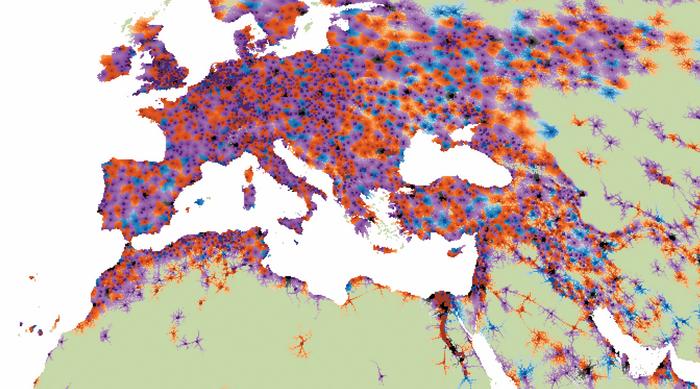
Rome – Rural livelihoods are quite intertwined with urban centers, with mid-sized cities playing an extraordinary role in providing required services, including for food security, agricultural livelihoods and viable rural development, according to a new study by researchers at the Food and Agriculture Organization of the United Nations (FAO) and other institutions.
Some two-thirds of the world’s population, or more than 5 billion people, live within one hour of travel time – using locally available means of transportation – of an urban center with a population of at least 250,000. Of these, about half have access to more than one urban center, relying on smaller nearby centers for basic services.
Often, the paper notes, “large cities are found to be less relevant than smaller ones in engaging populations.” About three times as many people live in or have easier access to urban centers with populations under one million compared to larger metropolitan areas.
Those are key takeaways from “Worldwide Delineation of Multi-Tier City-Regions,” published in the journal Nature Cities.
“Our approach represents the first systematic worldwide delineation of city-regions across multiple urban tiers,” said lead author Andrea Cattaneo, who is Senior Economist at FAO. “This unprecedented dataset offers a powerful tool for understanding how societies are organized around urban centers, unlocking new insights for sustainable development strategies.”
The study is accompanied with a robust data base that greatly deepens earlier research by Cattaneo and co-authors on spatial patterns that impact rural livelihoods. That previous pioneering work found that 92 percent of people live within an hour of an urban centre. That so many in fact live within one hour of several such centres has major ramifications for policy makers and planners assessing where to locate various services ranging from specialized full-spectrum hospitals and international airports to cultural institutions, supermarkets and employment opportunities.
Exploring the data
The new data set aggregates 219 million land-based locations into 130,000 territorial ‘patches’ describing locations served by the same set of urban centres. “Delineating city–regions by assembling the patches was akin to completing a gigantic puzzle,” Cattaneo noted. As the data spans 213 countries and territories, it enables more granular territorial planning in countries where such data was not available.
“In a world where commuting is on the rise and the climate crisis is intensifying, such territorial approaches are increasingly imperative for assuring energy-efficient and equitable transportation, as well as effective natural resource management,” Cattaneo said. Where income levels allow, the perspective can also contribute to enabling urban residents to enjoy outdoor activities, raising the prospect for tourism-related jobs in rural areas.
The importance of these approaches is further highlighted by national histories and infrastructure development patterns. For instance, the data show that Germany, Italy and the United Kingdom have the highest share of population living within one hour of travel time from more than one urban tier, followed by China, Nigeria and South Asian countries. On the other side, remoteness from an urban center is greatest in Madagascar, South Sudan, and Zimbabwe where it poses great challenges for more than half the population.

Credit: FAO
Rome – Rural livelihoods are quite intertwined with urban centers, with mid-sized cities playing an extraordinary role in providing required services, including for food security, agricultural livelihoods and viable rural development, according to a new study by researchers at the Food and Agriculture Organization of the United Nations (FAO) and other institutions.
Some two-thirds of the world’s population, or more than 5 billion people, live within one hour of travel time – using locally available means of transportation – of an urban center with a population of at least 250,000. Of these, about half have access to more than one urban center, relying on smaller nearby centers for basic services.
Often, the paper notes, “large cities are found to be less relevant than smaller ones in engaging populations.” About three times as many people live in or have easier access to urban centers with populations under one million compared to larger metropolitan areas.
Those are key takeaways from “Worldwide Delineation of Multi-Tier City-Regions,” published in the journal Nature Cities.
“Our approach represents the first systematic worldwide delineation of city-regions across multiple urban tiers,” said lead author Andrea Cattaneo, who is Senior Economist at FAO. “This unprecedented dataset offers a powerful tool for understanding how societies are organized around urban centers, unlocking new insights for sustainable development strategies.”
The study is accompanied with a robust data base that greatly deepens earlier research by Cattaneo and co-authors on spatial patterns that impact rural livelihoods. That previous pioneering work found that 92 percent of people live within an hour of an urban centre. That so many in fact live within one hour of several such centres has major ramifications for policy makers and planners assessing where to locate various services ranging from specialized full-spectrum hospitals and international airports to cultural institutions, supermarkets and employment opportunities.
Exploring the data
The new data set aggregates 219 million land-based locations into 130,000 territorial ‘patches’ describing locations served by the same set of urban centres. “Delineating city–regions by assembling the patches was akin to completing a gigantic puzzle,” Cattaneo noted. As the data spans 213 countries and territories, it enables more granular territorial planning in countries where such data was not available.
“In a world where commuting is on the rise and the climate crisis is intensifying, such territorial approaches are increasingly imperative for assuring energy-efficient and equitable transportation, as well as effective natural resource management,” Cattaneo said. Where income levels allow, the perspective can also contribute to enabling urban residents to enjoy outdoor activities, raising the prospect for tourism-related jobs in rural areas.
The importance of these approaches is further highlighted by national histories and infrastructure development patterns. For instance, the data show that Germany, Italy and the United Kingdom have the highest share of population living within one hour of travel time from more than one urban tier, followed by China, Nigeria and South Asian countries. On the other side, remoteness from an urban center is greatest in Madagascar, South Sudan, and Zimbabwe where it poses great challenges for more than half the population.
Journal
Nature Cities
Method of Research
Data/statistical analysis
Subject of Research
People
Article Title
‘Worldwide delineation of multi-tier city–regions’
Article Publication Date
26-Jun-2024
Cite Scienmag News
Alan Morgan. (June 26, 2024). New global study unveils city-region networks, highlights role of intermediate cities. Scienmag. https://scienmag.com/new-global-study-unveils-city-region-networks-highlights-role-of-intermediate-cities/
Alan Morgan. "New global study unveils city-region networks, highlights role of intermediate cities." Scienmag, 26 June 2024, https://scienmag.com/new-global-study-unveils-city-region-networks-highlights-role-of-intermediate-cities/. Accessed 7 September 2026.
Alan Morgan. "New global study unveils city-region networks, highlights role of intermediate cities." Scienmag. June 26, 2024. https://scienmag.com/new-global-study-unveils-city-region-networks-highlights-role-of-intermediate-cities/

