


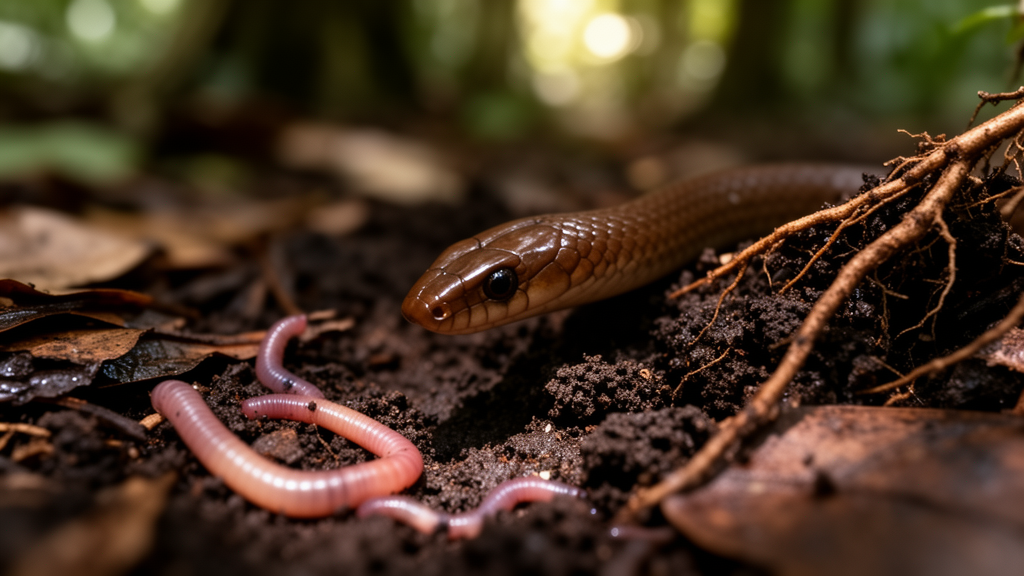
Deep in the forested hills of Mizoram, near the India–Myanmar border, a slender brown snake slipped across a muddy road shortly after nightfall on 5 June 2025. The animal, collected by hand at 21:45 h in Murlen National Park, has now been formally described as a new species: Trachischium lalremsangai, a fossorial natricine snake from one of the planet’s most biologically rich yet understudied regions. The discovery, published in the journal Herpetozoa, adds a tenth recognized species to a genus of secretive, worm-like snakes that spend most of their lives hidden beneath leaf litter and soil.
Trachischium snakes, often called worm-eating snakes, are among the least studied members of the colubrid family. They inhabit mid- to high-elevation forests between roughly 800 and 2,500 metres across the eastern Himalayas, northeast India and the wider Indo-Burma region. Their burrowing lifestyle makes them extraordinarily difficult to detect, and even experienced herpetologists rarely encounter them. As a result, four of the ten species now assigned to the genus have been described only within the last seven years, almost entirely as a consequence of surveys pushing into previously unexplored terrain.
The path to the new species began when researchers noticed that the Murlen specimen resembled members of Trachischium but did not match either of the two species previously recorded from Mizoram, T. hmuifang and T. reticulata. A search through the herpetology collection of the California Academy of Sciences in San Francisco revealed a second, matching specimen: an adult male collected on 13 July 2003 at Chunchuone village in Haka Township, Chin State, Myanmar, at an elevation of 1,953 metres. The two localities lie approximately 90 kilometres apart in a straight line, yet they share strikingly similar habitats, forest types and elevational bands.
Morphology alone set the new snake apart. It possesses 13 dorsal scale rows throughout the body, a feature that distinguishes it from T. monticola and T. apteii, which carry 15 rows. It has two postocular scales, whereas T. fuscum, T. guentheri, T. reticulata and T. laeve each have one. It bears two prefrontal scales, in contrast to the single prefrontal of T. fuscum, T. guentheri and T. nyalamense. Its temporal formula of one anterior and two posterior temporals differs from the single anterior temporal of T. monticola and T. apteii, and its 28 to 29 paired subcaudal scales fall outside the ranges of its closest relatives. Even its colouration is diagnostic: in preservative, the underside is brown with sparse white speckles, unlike the bright orange-red venter of T. hmuifang or the black underside of T. reticulata.
The holotype, an adult male deposited at Mizoram University in Aizawl under catalogue number MZMU 3757, measures 409 millimetres in total length, with a snout-to-vent length of 351 millimetres and a tail comprising 14 percent of its total length. The paratype, CAS 233200, is larger at 506 millimetres total length. Both animals display smooth, iridescent dorsal scales arranged in 13 rows at the neck, mid-body and anterior to the vent, with 135 ventral scales and a tapering apical spine at the tail tip. In life, the dorsum carries a lustrous blue iridescence that becomes even more vivid than in the preserved specimens.
To probe the species’ evolutionary relationships, the team extracted genomic DNA from the holotype’s preserved liver tissue and amplified fragments of the mitochondrial 16S rRNA gene and the nuclear oocyte maturation factor mos (c-mos) gene. These new sequences were combined with downloaded data for cytochrome b and the nuclear recombination activating gene 1 (RAG-1), producing a dataset of 98 sequences covering 32 species, with three outgroup taxa. Maximum likelihood analysis performed with IQ-Tree, using 100,000 ultrafast bootstrap replicates, recovered a phylogeny in which the genus formerly known as Blythia is nested firmly within Trachischium, supporting the recent proposal to treat Blythia as a junior synonym.
The phylogeny revealed three major clades within Trachischium. Clade 1 contains species from north of the Brahmaputra River, while Clade 2, the T. reticulata group to which the new species belongs, represents lineages south of the river. Clade 3 comprises species from Arunachal Pradesh and Medog County in China. Clades 2 and 3 are sister lineages with strong support, at 96 percent ML clade support, while the placement of the Murlen sample near T. reticulata received weaker support of 69 percent, hinting at further complexity within the group. The new species shows 2 to 5 percent uncorrected p-distance divergence from its congeners at the 16S gene, a level consistent with species-level distinctness.
Perhaps the most technically striking element of the description is the use of computed tomography. The paratype’s skull, scanned and made available through MorphoSource, was volume-rendered and measured in MeshLab, revealing a complete colubrid skull of 13.39 millimetres from the tip of the premaxilla to the supraoccipital. The maxilla carries 20 to 21 functional teeth of subequal size, lacking the diastema and enlarged posterior teeth typical of most other natricine genera, a derived condition shared only with T. fuscum among its relatives. The pterygoid bones display asymmetry, with 14 functional teeth on the left and 15 on the right, and the dentary bears 13 teeth. The hemipenis of the holotype, everted and examined in detail, is short and stubby with a Hemipenis Proportion Index of 0.68, weakly bilobed and densely ornamented with subequal conical spines.
The new species was named in honour of Professor Hmar Tlawmte Lalremsanga of Mizoram University, recognizing his decades of contribution to herpetology in Northeast India and his mentorship of generations of students working across the Indo-Burma biodiversity hotspot. The holotype was found actively moving along a muddy road at 21:30 h on the outskirts of Murlen National Park, at 1,560 metres elevation, shortly after a brief rainfall. When handled, the snake remained calm and showed no defensive or aggressive behaviour. Murlen National Park, covering roughly 100 square kilometres between 800 and 1,919 metres, receives 2,500 to 3,000 millimetres of annual rainfall and harbours Khasi Sub-Tropical Wet Hill Forests and Assam Sub-Tropical Pine Forests, with a rich flora of oaks, rhododendrons, bamboos and orchids.
Based on matching habitat, elevation and forest type, the authors suggest the species may also occur in northeast Mizoram, adjoining Manipur and the similar elevational realms of the Chin Hills. Historical records complicate the picture: specimens reported from the Chin Hills over a century ago bear a single postocular scale, unlike the new species, and Burmese populations described in older literature may represent T. reticulata or yet another unnamed species. The Brahmaputra River appears to act as a significant biogeographic barrier for these fossorial high-elevation snakes, with clades reciprocally monophyletic on either side, even though the river does not seem to restrict low-elevation species such as certain pitvipers. With genetic divergence among unvouchered samples suggesting that within-genus diversity remains underrepresented, and with the Indo-Burma hotspot yielding new snake species steadily over the past decade, researchers argue that increased research effort and funding for the region is urgently needed before its hidden diversity disappears unnoticed.
Subject of Research: Taxonomic description of a new fossorial snake species from the Indo-Burma biodiversity hotspot
Article Title: A new species of fossorial snake of the genus Trachischium Günther, 1858, from the Indo–Burma biodiversity hotspot
Article References: Bhardwaj, V. K., Bal, A. K., Tluanga, C. L., & Mirza, Z. A. (2026). A new species of fossorial snake of the genus Trachischium Günther, 1858, from the Indo–Burma biodiversity hotspot. Herpetozoa, 39, 203-215. https://doi.org/10.3897/herpetozoa.39.e187919
Image Credits: AI Generated
DOI: 10.3897/herpetozoa.39.e187919
Keywords: Trachischium, new species, fossorial snake, Indo-Burma biodiversity hotspot, Mizoram, Myanmar, herpetology, natricine, phylogenetics, CT scanning, taxonomy, Murlen National Park
Cite Scienmag News
Margaret Porter. (October 16, 2026). New fossorial snake species discovered in Indo-Burma biodiversity hotspot. Scienmag. https://scienmag.com/new-fossorial-snake-species-discovered-in-indo-burma-biodiversity-hotspot/
Margaret Porter. "New fossorial snake species discovered in Indo-Burma biodiversity hotspot." Scienmag, 16 October 2026, https://scienmag.com/new-fossorial-snake-species-discovered-in-indo-burma-biodiversity-hotspot/. Accessed 16 October 2026.
Margaret Porter. "New fossorial snake species discovered in Indo-Burma biodiversity hotspot." Scienmag. October 16, 2026. https://scienmag.com/new-fossorial-snake-species-discovered-in-indo-burma-biodiversity-hotspot/


