


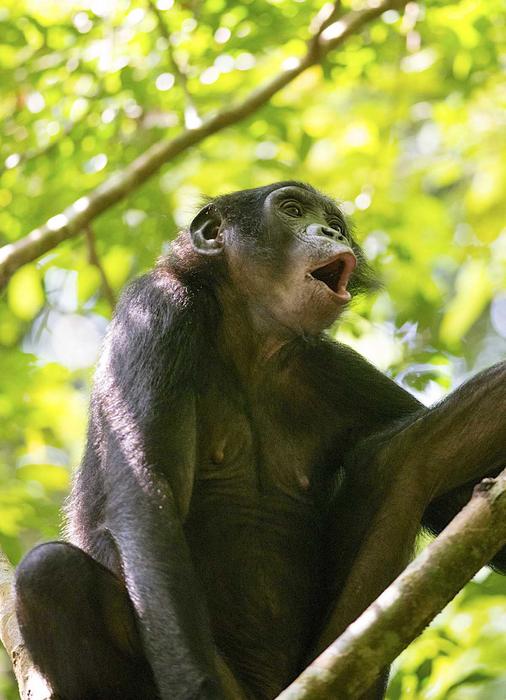
In the face of threats from other groups, humans, chimpanzees, and a selection of other species get closer with their own. Now an international team led by Kyoto University has shown that even our more peaceful cousins, bonobos — who have never been observed to kill outsiders — show a moderated version of this effect, hinting that this behavior may have emerged several million years ago, before our lineages went their separate ways.

Credit: KyotoU/Shinya Yamamoto
In the face of threats from other groups, humans, chimpanzees, and a selection of other species get closer with their own. Now an international team led by Kyoto University has shown that even our more peaceful cousins, bonobos — who have never been observed to kill outsiders — show a moderated version of this effect, hinting that this behavior may have emerged several million years ago, before our lineages went their separate ways.
A link between outgroup threats and ingroup cohesion has been considered since the time of Darwin to be an adaptation for group-based competition. During the years since, studies of all sorts — from chimpanzees to cichlid fish to mongooses — have found evidence supporting this view, but a crucial question has remained unanswered: what about species without strong inter-group competition?
To find an answer, the KyotoU team set up an experiment matched as closely as possible to an earlier study with chimpanzees: playback of vocalizations from other groups. In total, eight groups of bonobos at five sites in four countries were studied.
“We had no idea how this would turn out,” says lead author James Brooks.
“Without lethal competition between groups, a link between ingroup cohesion and outgroup competition wouldn’t be so adaptive, but if the effect dated back to before the human-chimpanzee-bonobo evolutionary split, then there might still be relics of the effect in modern bonobos.”
The team’s findings, published in the journal PLOS ONE, indicate that the observed bonobos were alert and attentive to the calls of other groups, but showed just a minor increase in affiliation with their own group when compared to chimpanzees. The bonobos were observed sitting upright more and resting less, with a subtle increase in rates of social grooming, a key behavior for reinforcing social bonds.
The authors hypothesize that our common ancestor — living 5–6 million years ago — may have had some group-based conflict, but that as the intensity decreased in bonobos’ evolutionary history, so too did the strength of the effect.
“Although our study exposes deep roots to group conflict among our species, the real takeaway is that this can be overcome,” adds Brooks, “not merely in individual instances, but on a species level.”
All other ape species, including gorillas, orangutans, chimpanzees, gibbons, and humans, have been observed killing one another in the wild. Bonobos may have found a way to end this pattern, not only because they do not commit lethal aggression today, but more importantly because at some point within the past few million years they somehow stopped.
“Humans are capable of both: we can commit horrific acts to those we see as outside our group, but we’re also capable of collaborating and working together across borders,” says senior author Shinya Yamamoto.
“Bonobos teach us that the ways our ancestors treated other groups does not seal our fate. Our own species has elements of both chimpanzee and bonobo group relations, so it is crucial that we understand how both can, and have, evolved.”
###
The paper “Increased alertness and moderate ingroup cohesion in bonobos’ response to outgroup cues” appeared on 21 August 2024 in PLOS ONE, with doi: 10.1371/journal.pone.0307975
About Kyoto University
Kyoto University is one of Japan and Asia’s premier research institutions, founded in 1897 and responsible for producing numerous Nobel laureates and winners of other prestigious international prizes. A broad curriculum across the arts and sciences at undergraduate and graduate levels complements several research centers, facilities, and offices around Japan and the world. For more information, please see:
Journal
PLoS ONE
Method of Research
Observational study
Subject of Research
Animals
Article Title
Increased alertness and moderate ingroup cohesion in bonobos’ response to outgroup cues
Article Publication Date
21-Aug-2024
COI Statement
None
Cite Scienmag News
Courtney Benton. (August 23, 2024). New evidence suggests ancient origin of the “common enemy effect”. Scienmag. https://scienmag.com/new-evidence-suggests-ancient-origin-of-the-common-enemy-effect/
Courtney Benton. "New evidence suggests ancient origin of the “common enemy effect”." Scienmag, 23 August 2024, https://scienmag.com/new-evidence-suggests-ancient-origin-of-the-common-enemy-effect/. Accessed 4 September 2026.
Courtney Benton. "New evidence suggests ancient origin of the “common enemy effect”." Scienmag. August 23, 2024. https://scienmag.com/new-evidence-suggests-ancient-origin-of-the-common-enemy-effect/

