

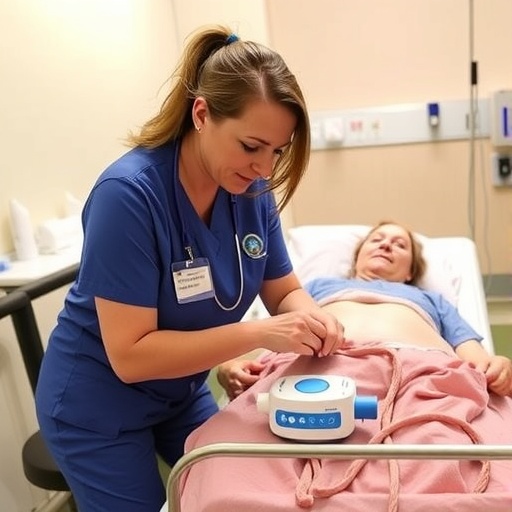
In a groundbreaking step towards enhancing patient care and streamlining ostomy nursing practices, researchers Zhou, Liang, and Wu, along with their team, have unveiled a pioneering enterostomy chassis measuring tool. This innovative instrument is designed to address critical challenges faced by nurses when dealing with patients who have undergone ostomy procedures. Ostomy surgery, which may be performed due to conditions such as cancer or inflammatory bowel disease, has an undeniable impact on patients’ quality of life. By improving the efficiency of ostomy care, this new tool promises to facilitate better outcomes for these individuals in both clinical and home settings.
Understanding the significance of ostomy care is fundamental to grasping the potential impact of this research. Ostomy patients often wrestle with a myriad of issues ranging from skin irritation to the emotional challenges of adjusting to life with an ostomy bag. The quality of nursing care directly influences both the healing process and the emotional well-being of these patients. Nursing professionals require precision, understanding, and advanced tools to execute care effectively. In this landscape, the newly developed chassis measuring tool emerges as a significant aid, bridging the gap in ostomy management.
The enterostomy chassis measuring tool is specifically crafted for accuracy and user-friendliness. It integrates ergonomic design principles, enabling nurses to measure the patient’s stoma and surrounding skin area easily, thus facilitating optimal fitting and placement of ostomy pouches. The accuracy of measurements is pivotal, as improper sizing can lead to complications such as leaks, skin breakdown, and infections. Hence, better measurement translates to better patient care, showcasing how technological advancements can directly enhance healthcare outcomes.
Moreover, the researchers emphasize the tool’s role in education. Many nurses enter ostomy care with varying degrees of training and experience. By using the chassis measuring tool, healthcare providers can develop their skills and deepen their understanding of ostomy management. This educational component is instrumental not only for novice nurses but also for experienced practitioners seeking to refine their techniques. By incorporating this tool into training programs, healthcare systems can enhance the quality of ostomy care delivered to patients.
The study that led to the tool’s development involved extensive collaboration among multi-disciplinary teams, ensuring that a range of perspectives was included in the design process. This collaborative approach is indispensable in contemporary research and development, leading to robust solutions that meet real-world clinical demands. Contributions from nurses, medical professionals, and design engineers allowed for a full spectrum of insights that informed each stage of the tool’s creation.
Field tests of the chassis measuring tool have shown promising results that indicate improved nursing workflows and reduced complication rates. In clinical trials, nurses reported a significant decrease in time spent on ostomy management, as the tool allows for faster and more accurate measurements. Additionally, patient feedback has highlighted higher satisfaction levels, noting that the comfort and fit of the ostomy pouches have measurably improved post-implementation of the tool. These findings substantiate the need for ongoing innovation and adaptation within nursing practices to enhance patient care experiences.
Furthermore, as healthcare systems worldwide continue to navigate patient care challenges—heightened in recent years by global events—there is an increasing necessity for tools that provide efficiency without compromising quality. Employing technological innovations like the enterostomy chassis measuring tool aligns with broader goals of advancing healthcare practices in a post-pandemic landscape where efficiency and patient-centered care are paramount.
The clinical implications of this research extend beyond immediate patient outcomes. Enhanced ostomy care practices can decrease hospital readmission rates and associated healthcare costs. When patients experience fewer complications, there is a subsequent reduction in the need for additional medical interventions, leading to greater cost-effectiveness for healthcare facilities. Consequently, investing in such innovations speaks volumes about the commitment to improving healthcare delivery while ensuring financial sustainability within the system.
In addition to practical applications in clinical settings, the tool also opens avenues for future research and development. As the healthcare landscape continues to evolve, ongoing feedback and data collection related to the use of the chassis measuring tool can lead to iterative improvements. Researchers can also explore how enhanced measurement techniques can integrate with digital health technologies, such as telehealth services, creating comprehensive remote monitoring solutions for ostomy patients.
Looking forward, the potential for scalability of the chassis measuring tool cannot be understated. As practitioners recognize the benefits of improved ostomy care, there may be heightened interest from healthcare institutions worldwide. The aim would be to implement the tool across diverse settings, thereby democratizing high-quality ostomy management, particularly in under-resourced areas where trained nursing care may be limited.
Community outreach and engagement will be essential in promoting the use of the chassis measuring tool. Public health initiative programs can leverage partnerships with healthcare providers to educate patients about their care options and empower them to advocate for themselves. By embedding the use of such innovative tools within community health strategies, researchers can realize the larger vision of improving healthcare outcomes on a global scale.
As the research by Zhou and colleagues gains traction within the medical community, it nudges the needle towards a future where ostomy care is not merely about providing medical interventions; rather, it is about creating an environment where patients feel supported and empowered in their healthcare journey. The enterostomy chassis measuring tool exemplifies this shift toward patient-centered innovation in nursing, ultimately fostering a culture of compassionate care.
In summary, the recent implementation of the enterostomy chassis measuring tool marks a significant milestone in nursing practice and patient care. It enhances measurement accuracy, encourages educational growth, and streamlines workflows, all while addressing the emotional and physical challenges faced by ostomy patients. As further research underscores its effectiveness, the ripple effects of such innovations are poised to lead to broader transformations in ostomy management and healthcare delivery systems.
Subject of Research: Enterostomy Chassis Measuring Tool
Article Title: Implementation of a novel enterostomy chassis measuring tool to improve ostomy nursing outcomes.
Article References:
Zhou, Z., Liang, T., Wu, X. et al. Implementation of a novel enterostomy chassis measuring tool to improve ostomy nursing outcomes.
BMC Nurs (2025). https://doi.org/10.1186/s12912-025-04030-8
Image Credits: AI Generated
DOI: 10.1186/s12912-025-04030-8
Keywords: Ostomy care, nursing innovation, measurement tool, patient outcomes, healthcare efficiency.


