

Monday, June 15, 2026
Science
No Result
View All Result
  • Login
  • HOME
  • SCIENCE NEWS
  • CONTACT US
  • HOME
  • SCIENCE NEWS
  • CONTACT US
No Result
View All Result
Scienmag
No Result
View All Result
Home Science News Cancer

New discovery of a mechanism that controls cell division

May 3, 2024
in Cancer
Reading Time: 2 mins read
0
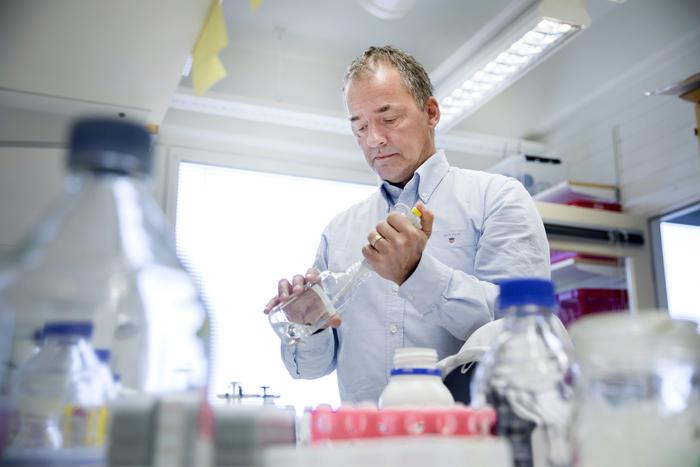
Stefan Björklund in lab
67
SHARES
611
VIEWS
Share on FacebookShare on Twitter
ADVERTISEMENT

Researchers at Umeå University, Sweden, have discovered that how a special protein complex called the Mediator moves along genes in DNA may have an impact on how cells divide. The discovery may be important for future research into the treatment of certain diseases.

Stefan Björklund in lab

Credit: Johan Gunséus

Researchers at Umeå University, Sweden, have discovered that how a special protein complex called the Mediator moves along genes in DNA may have an impact on how cells divide. The discovery may be important for future research into the treatment of certain diseases.

“We have gained in-depth knowledge of how cell division is controlled, which is important for understanding the causes of various diseases that are due to errors in cell division, such as various tumour diseases,” says Stefan Björklund, professor at the Department of Medical Biochemistry and Biophysics at Umeå University and lead author of the study.

In each cell there is a machinery called the ribosome. It uses DNA as a template to produce proteins, which are necessary for virtually all processes in the cell. First, however, the cells must make a copy of the instructions in the form of mRNA through a process called transcription.

The research team at Umeå University has discovered how the Mediator, a protein complex in the cell nucleus, can bind to DNA and interact with another protein complex, Lsm1-7, to regulate the production of proteins that make up the ribosomes. The study shows that when cells grow too densely, cell division slows down. When this happens, the mediator moves to the end of the genes where it interacts with Lsm1-7. This has the dual effect of both slowing down the reading of the genes and interfering with the maturation of mRNA. This, in turn, leads to a reduced production of ribosomal proteins and thus a slower cell division.

A possible direction of future research may be to study whether it is possible to control the position of the mediator, in order to inhibit rapid cell division, for example in tumours.

“We are still early in the research in the field, so more studies are needed before we can say that this is a viable path, but it is an exciting opportunity,” says Stefan Björklund.

The study has been conducted in yeast cells that serve as a good model when it comes to understanding basic mechanisms that work in a similar way in more complex systems such as animal and plant cells.


Journal

Nucleic Acids Research

DOI

10.1093/nar/gkae266

Method of Research

Experimental study

Subject of Research

Cells

Article Title

Growth-regulated co-occupancy of Mediator and Lsm3 at intronic ribosomal protein genes

Article Publication Date

13-Apr-2024

Share27Tweet17
Previous Post

A cost-efficient path to a renewable energy grid for Australia

Next Post

Towards transparent and antimicrobial surfaces for touch displays

Related Posts

3D Multi-Omics Tumor Atlases: Tech to Clinic — Cancer
Cancer

3D Multi-Omics Tumor Atlases: Tech to Clinic

June 15, 2026
Secondhand Smoke Deposits Cancer-Causing Cadmium in the Body, Study Finds — Cancer
Cancer

Secondhand Smoke Deposits Cancer-Causing Cadmium in the Body, Study Finds

June 15, 2026
European Study Reveals Significant Cost Savings from Preventative Care in Patients with Inherited Cancer Risks — Cancer
Cancer

European Study Reveals Significant Cost Savings from Preventative Care in Patients with Inherited Cancer Risks

June 15, 2026
HPV Therapeutic Vaccine Demonstrates Safety, While Its Efficacy in Preventing Head and Neck Cancer Recurrence Remains Unclear — Cancer
Cancer

HPV Therapeutic Vaccine Demonstrates Safety, While Its Efficacy in Preventing Head and Neck Cancer Recurrence Remains Unclear

June 15, 2026
Innovative Advances Propel Personalized Lung Cancer Treatments Forward — Cancer
Cancer

Innovative Advances Propel Personalized Lung Cancer Treatments Forward

June 15, 2026
Weill Cornell Medicine Scientist Honored for Breakthrough Research Identifying New Ovarian Cancer Targets — Cancer
Cancer

Weill Cornell Medicine Scientist Honored for Breakthrough Research Identifying New Ovarian Cancer Targets

June 15, 2026
Next Post
Scanning Electron Microscope (SEM) image of the copper dewetted nanoparticles with antimicrobial properties over the glass substrate.

Towards transparent and antimicrobial surfaces for touch displays

  • Mothers who receive childcare support from maternal grandparents show more parental warmth, finds NTU Singapore study

    Mothers who receive childcare support from maternal grandparents show more parental warmth, finds NTU Singapore study

    27654 shares
    Share 11058 Tweet 6911
  • University of Seville Breaks 120-Year-Old Mystery, Revises a Key Einstein Concept

    1059 shares
    Share 424 Tweet 265
  • Bee body mass, pathogens and local climate influence heat tolerance

    682 shares
    Share 273 Tweet 171
  • Researchers record first-ever images and data of a shark experiencing a boat strike

    545 shares
    Share 218 Tweet 136
  • Groundbreaking Clinical Trial Reveals Lubiprostone Enhances Kidney Function

    531 shares
    Share 212 Tweet 133
Science

Embark on a thrilling journey of discovery with Scienmag.com—your ultimate source for cutting-edge breakthroughs. Immerse yourself in a world where curiosity knows no limits and tomorrow’s possibilities become today’s reality!

RECENT NEWS

  • 3D Multi-Omics Tumor Atlases: Tech to Clinic
  • Extensive Population Studies Essential to Minimize Risks in Newborn Genome Screening
  • UCF Coastal Expert: Extreme Coastal Water Level Events Are Now 12 Times More Frequent
  • Secondhand Smoke Deposits Cancer-Causing Cadmium in the Body, Study Finds

Categories

  • Agriculture
  • Anthropology
  • Archaeology
  • Athmospheric
  • Biology
  • Biotechnology
  • Blog
  • Bussines
  • Cancer
  • Chemistry
  • Climate
  • Earth Science
  • Editorial Policy
  • Marine
  • Mathematics
  • Medicine
  • Pediatry
  • Policy
  • Psychology & Psychiatry
  • Science Education
  • Social Science
  • Space
  • Technology and Engineering

Subscribe to Blog via Email

Enter your email address to subscribe to this blog and receive notifications of new posts by email.

Join 5,146 other subscribers

© 2025 Scienmag - Science Magazine

Welcome Back!

Login to your account below

Forgotten Password?

Retrieve your password

Please enter your username or email address to reset your password.

Log In
No Result
View All Result
  • HOME
  • SCIENCE NEWS
  • CONTACT US

© 2025 Scienmag - Science Magazine

Discover more from Science

Subscribe now to keep reading and get access to the full archive.

Continue reading
